
15/05/08
We worked our way through the 1999 past paper.
HW Complete the 2002 past paper for next week.
We spent a period in the computer room looking at this very website! You created a Word based revision document to help you before the exams.
We then started the 1998 2nd form exam.
HW Finish the 1998 exam to hand in next week.
We tested several components in a circuit containing a variable resistor. We tried to push charge through the various components both forwards and backwards.
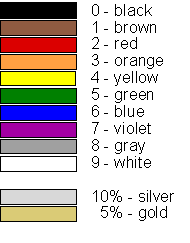
Some components have a greater opposition to the flow of charge than others and hence registered lower currents. They are said to have a higher resistance. We tested several types of resistors and learned how to "read" the size of the resistance based on the coloured bands printed onto them.
You will always be given the table below, so there is no need to learn the colours.
2 components, the diode and the light emitting diode would only allow charge to flow through them in one direction.
HW Revision, obviously and my brief question on resistors.
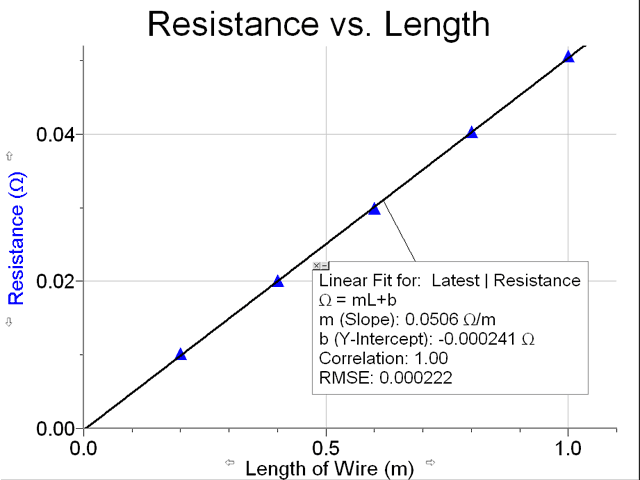
We looked at how the length and thickness of a wire altered how much it resisted the flow of charge in a circuit.
It was found that including a long wire reduced the current more than including a short one. It was also found that including a thin wire reduced the current more than a thick one.
This was due to a property called electrical resistance - a measure of how much something slows down the flow of charge through itself. Long wires have a larger resistance than short wires, and thin wires have a larger resistance than thick wires.
Wires can be thought of rather like pipes carrying water. It is obviously easier to get more water down a thicker pipe, and the longer the pipe, the more friction there is slowing the flow of water down. This exactly matches the situation for electrical wires and is called an analogy.
This animation demostrates the idea.
HW Finish transferring your decription of your experiment, stick you graph in and answer Qs 15-18 on resistance from Physics Now.
We continued and extended the experiment from last week by looking at other combinations of bulbs in series and parallel. The rules discovered last week still fitted. Have a look here if still confused.
In series, the current is the same all the way round the circuit. The more bulbs added in series, the less current in the circuit.
In parallel, the bulbs always remain as bright as one bulb on its own howver many bulbs you add in parallel. Each bulb takes the same current as one on its own, so the total current is just this "normal" current multiplied by the number of bulbs in the circuit.
We'll do the thick and thin wires experiment next week. Books were taken infrom all except Jos.
We then just started to look at electricity, building a few simple circuits with light bulbs.
We learned that electric current is a flow of charge around a continuous circuit of electrical conductor.
Electric current is a word describing moving electrical charges. It is the rate of flow of electrical charge. The unit which is used to measure charge is called the Coulomb. (The numbers of individual electrons moving would be very large indeed.)
Current is therefore measured in Coulombs per second. Another word for 1 Coulomb per second is an Ampere
. Electrical conductors are materials that allow the passage of electric current. In order to do this they must have charge carriers (usually electrons) which are free to move.
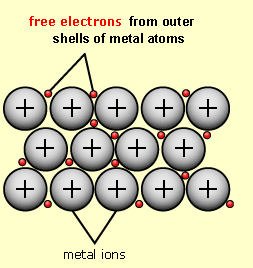
Metals have free electrons as part of their structure which can conduct electricity.
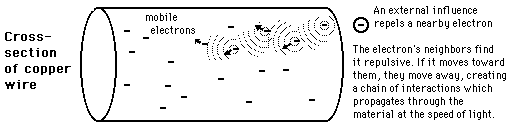
Although electrons move slowly through metal wires, each electron repels its neighbour causing a knock on effect which means that electrical energy is transferred at the speed of light.
Then onto an electricity experiment looking at how different numbers and arrangements of bulbs changed the current in a circuit.
We tested some simple circuits with light bulbs in and came up with the following rules:
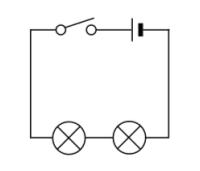
1. The current in a series circuit is the same at all points.
2. The bulbs lit up at less than normal brightness in series; less current was flowing through them than in a single bulb.
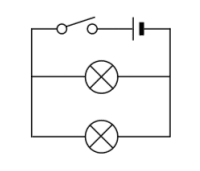
1. The total current in a series circuit is equal to the sum of the currents in each parallel path.
2. The bulbs in parallel lit up at normal brightness; they had the same current flowing through each of them as flows through a single bulb.
HW Qs 1-6 P121-124