2R 26/05/06
We revised by going through the 1998 past paper.
HW Do the 1999 past paper and hand in on Monday.
2L 25/05/06
We revised by going through the 1998 past paper.
HW Do the 1999 past paper and hand in on Monday.
2R 19/05/06
We did an experiment looking at how the current in an electrical circuit varied when we included wires of different types.
It was found that including a long wire reduced the current more than including a short one. It was also found that including a thin wire reduced the current more than a thick one.
This was due to a property called electrical resistance - a measure of how much something slows down the flow of charge through itself. Long wires have a larger resistance than short wires, and thin wires have a larger resistance than thick wires.
Wires can be thought of rather like pipes carrying water. It is obviously easier to get more water down a thicker pipe, and the longer the pipe, the more friction there is slowing the flow of water down. This exactly matches the situation for electrical wires and is called an analogy.
We also went through the test.
HW Finish set of photocopied questions in full sentences in your book.
2L 18/05/06
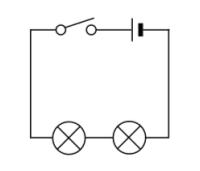
We built some more circuits, to see how arranging bulbs in series and parallel affected the current in the circuit.
In series, each bulb resists the flow of electrons, and so the total current is less and the bulbs glow less brightly.
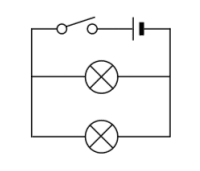
In parallel, the electrons can pass through either bulb. This gives them more "space" to flow and so double current passes around the whole circuit, half going through each bulb. The bulbs light up normally as each has the same amount of current flowing as if it were in the circuit on its own.
HW Finish the long set of photocopied questions in your book (in full sentences where appropriate.)
2R 12/05/06
We sat the light test.
Then onto an electricity experiment looking at how different numbers and arrangements of bulbs changed the current in a circuit.
We tested some simple circuits with light bulbs in and came up with the following rules:
1. The current in a series circuit is the same at all points.
2. The bulbs lit up at less than normal brightness in series; less current was flowing through them than in a single bulb.
1. The total current in a series circuit is equal to the sum of the currents in each parallel path.
2. The bulbs in parallel lit up at normal brightness; they had the same current flowing through each of them as flows through a single bulb.
HW P121-125 Qs 1-8
2L 11/05/06
We did an experiment looking at how the current in an electrical circuit varied when we included wires of different types.
It was found that including a long wire reduced the current more than including a short one. It was also found that including a thin wire reduced the current more than a thick one.
This was due to a property called electrical resistance - a measure of how much something slows down the flow of charge through itself. Long wires have a larger resistance than short wires, and thin wires have a larger resistance than thick wires.
Wires can be thought of rather like pipes carrying water. It is obviously easier to get more water down a thicker pipe, and the longer the pipe, the more friction there is slowing the flow of water down. This exactly matches the situation for electrical wires and is called an analogy.
We also went through the test.
2R 05/05/06
We did not sit the light test. Oh no.
We started the new topic of electricity instead. We learned that electric current is a flow of electrons around a continuous circuit of electrical conductor.
Electric current is a word describing moving electrical charges. It is the rate of flow of electrical charge. The unit which is used to measure charge is called the Coulomb. (The numbers of individual electrons moving would be very large indeed.)
Current is therefore measured in Coulombs per second. Another word for 1 Coulomb per second is an Ampere
. Electrical conductors are materials that allow the passage of electric current. In order to do this they must have charge carriers (usually electrons) which are free to move.
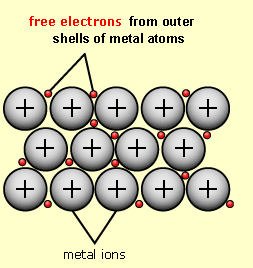
Metals have free electrons as part of their structure which can conduct electricity.
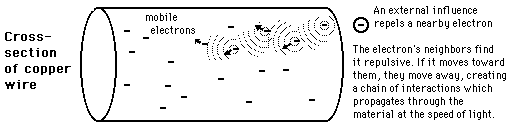
Although electrons move slowly through metal wires, each electron repels its neighbour causing a knock on effect which means that electrical energy is transferred at the speed of light.
HW Revise for the test on light.
2L 04/05/06
We sat the light test.
Then started the new topic - electricity very briefly.
Electric current is a word describing moving electrical charges. It is the rate of flow of electrical charge. The unit which is used to measure charge is called the Coulomb. (The numbers of individual electrons moving would be very large indeed.)
Current is therefore measured in Coulombs per second. Another word for 1 Coulomb per second is an Ampere
. Electrical conductors are materials that allow the passage of electric current. In order to do this they must have charge carriers (usually electrons) which are free to move.
Metals have free electrons as part of their structure which can conduct electricity.
Although electrons move slowly through metal wires, each electron repels its neighbour causing a knock on effect which means that electrical energy is transferred at the speed of light.
HW Find a dictionary or thesauras definition of electrical current and copy it into your exercise book.
2R 28/04/06
As 2L below in most details.
HW Do set of colour questions on the sheet. Books have been taken in.
2L 27/04/06
We looked at colours in light.
The primary colours are red, green and blue. Mix all three together and we see white. This is due to us having seperate red, green and blue colour sensitive cones in our retinas. When they all fire off simultaneously, we see white.
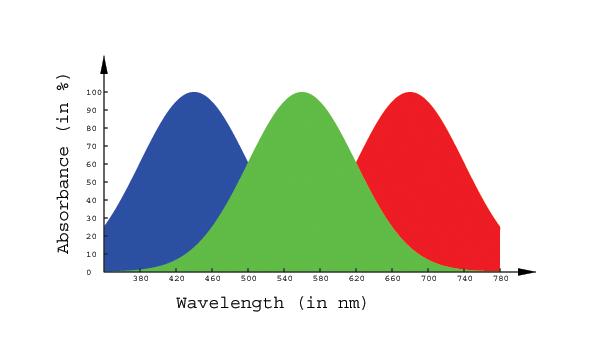

However, white light from the Sun comes with all of the the colours of the rainbow present (RedOrangeYellowGreenBlueIndigoViolet). Light can be split into its constituent parts by using a prism, this also occurs naturally in a rainbow.
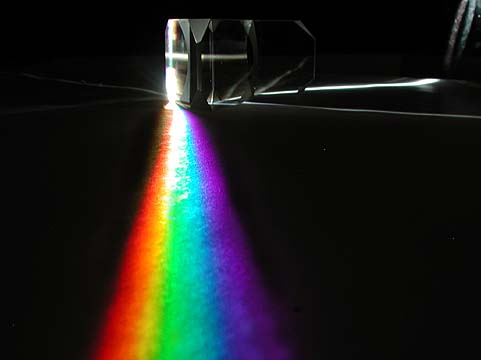
Red objects appear red because they absorb all light except red, which they reflect. Shine green light on a red object and it will look black. A red filter only allows red light ot pass through it. A blue filter only allows blue light to pass through it. Put a red filter in front of a blue one and no light at all can get through.
HW Revise for a short test on light only.