09/06/08
Post exam week, we went through the exam.....
More with the computers. The time taken for a pendulum to swing rises as the length of the pendulum increases. However, the relationship is not proportional, so if you double the length then the time doesn't double.
Mr Richardson taught you how to input data into Excel, get an average value for repeat readings and plot a graph (although it was not printed by many).
Mr Richardson took you for a lesson in which you carried out your experiments using pendulums that you planned last time.
You took 3 repeat readings of the time taken for 10 complete swings. This allowed you to get an accurate average time for one swing (by dividing your average time by 10).
You discovered that the only variable which caused a significant change in the length of time the pendulum took to complete a swing (period) was the length of the pendulum.
The mass and angle of swing do not alter the period of a pendulum.
So therefore everybody needs some results with the length of the pendulum as a variable (just so we can practise graph plotting skills).
| Length of Pendulum (cm) | Average time for one swing (s) |
| 0 | 0.00 |
| 5 | 0.45 |
| 10 | 0.63 |
| 15 | 0.78 |
| 20 | 0.90 |
| 25 | 1.00 |
| 30 | 1.10 |
| 35 | 1.19 |
| 40 | 1.27 |
| 45 | 1.35 |
| 50 | 1.42 |
If you have enough of you own data on the length of the pendulum you can use yours - if not use mine.
HW Plot a graph of Time period of pendulum (y axis) against Length of pendulum (x axis). Then draw an appropriate line of best fit. Stick the graph into your book and write a conclusion about how changing the length of a pendulum affects the time it takes to swing.
Mr Richardson took you for a lesson in which you sat a test on solutions, distillation and filtration and the like.
You then started to plan for an experiment which you will do on Monday, investigating the time taken for a pendulum to swing.
You finished writing up your experiment on cooking spaghetti. It turns out that over half the mass of the substance you are eating when the pasta is cooked is just water!
HW Revise for a test on all that we have covered in the water topic. Filtration, water treatment, the water cycle, solutions, evaporation and distillation should all be revised.
We did a little cooking!
You designed an experiment to test how much of the mass of cooked spaghetti we eat is actually just absorbed water.
HW A neat write up of the method, safety, diagram and results into your book. Leave the conclusions for tomorrow.
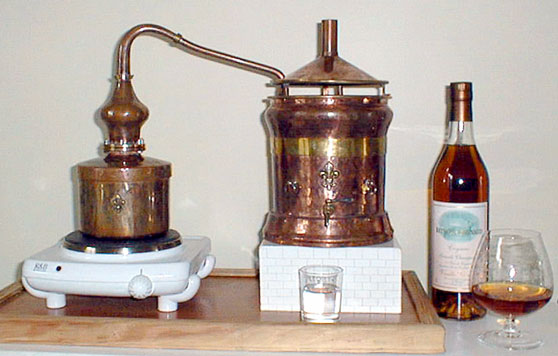
We had the laptops in and you designed a poster to show the industrial uses of distillation. Either in the alcholic drink industry:
The equipment required to make a spirit (40% alcohol) from a weaker fermented drink (e.g. wine - about 10% alcohol) is very similar to the distillation equipment we used in the lab!
Or in the seperating crude oil out into its constituent fuels.
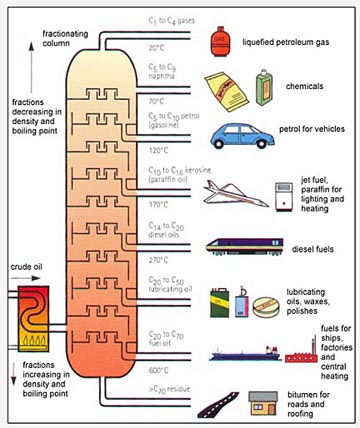
Crude oil is a mixture of loads of different substances with different boiling points. The oil undergoes fractional distillation to seperate out all of the different parts, which have a very wide range of uses.
You did some work with Mr Richardson on labelling and describing the Leibig condenser and distillation in general. Books came in.
We performed an experiment to see if ink is a pure liquid or a mixture. We distilled the ink, collecting the evaporating liquid by condensing it in a boiling tube.
When heated up, the particles in the ink moved faster, and some escaped the liquid to become a gas. When they hit the cold delivery tube walls, some of the gaseous particles slowed down enough to turn back into a liquid again. This is condensing.
A clear liquid was collected which was water. A solid was left behind showing that ink is a mixture.
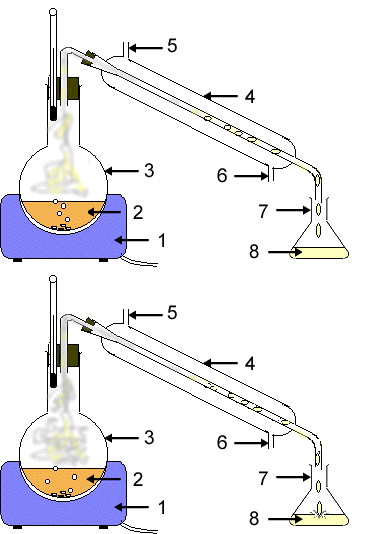
The above animation shows a better method of distaillation using a water jacket called a Liebig condenser to make sure that all of the evoprated liquid recondenses.
HW Finish write up as detailed in handout.
More on dissolving and the difference between mixtures and solutions.
We looked briefly into another class of substances which are very well mixed suspensions of one substance in another. Milk is an example of this, fatty droplets spread throughout a watery liquid. Milk is an example of a colloid.
Read here for more complex explanations.
Books came in again.
We defined some important words used in dissolving and solutions. We also learned how to describe the dissolving of a solid in terms of the particles involved.
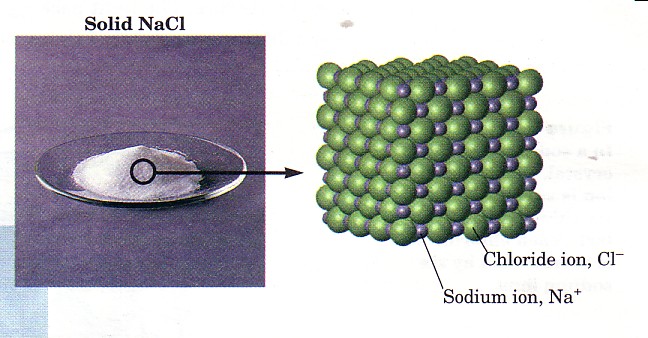
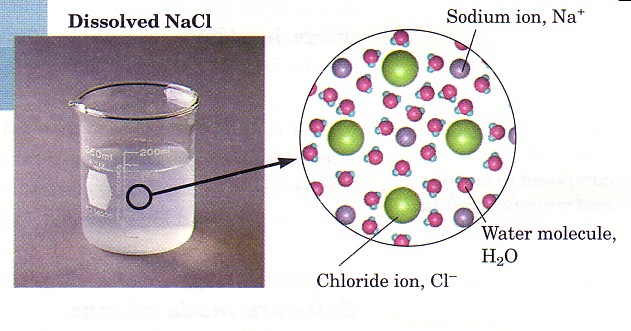
Individual sodium and choride ions are too small to be visible when dissolved in water.
This link does the same thing in an animated fashion. And this one. And this one.
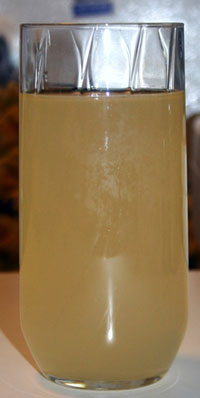
This is not like muddy water, where the mud is just spread through the water in a mixture. The little lumps of mud in the water are still billions of times bigger than the salt particles.
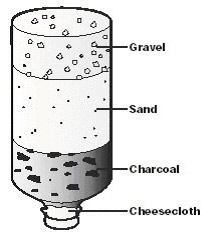
The mud can be flitered out of muddy water using a gravel filter as we have seen.
The partially evaporated salt solution from the experiment on Monday had been left on the windowsill. Now, all the water had evaporated and left behind solid salt crystals. The crystals which had formed more slowly as the water gradually evaporated were much larger than those which appeared during the heating of the salt solution.
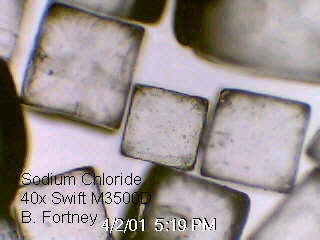
Salt crystals are cubic. You can try to grow really large ones at home with a very slow evaporation process......
Tips for home crystal growing.
Mr Richardson took you for a look at solutions.
We then evaporated the water off a salt solution. Salt is a solid at the temperature of boiling water and so does not turn into a gas but is left behind as a white solid.
The water can evaporate quickly as it is boiled off or it can slowly evaporate away over time. We'll leave the remaining salt solution on the windowsill for a week and see what happens.
HW Finish your experimental write up and then answer Qs 1-3 on P 131-133
Mr Richardson took you for more on water. We saw a very interesting video on the London ring main.

You listed some ways in which water use can be kept to a minimum.
Mr Richardson took you for a continuation of the new topic - water. You also recapped the lab safety rules. A demonstration sand filter was shown which could easily get all the mud out of really muddy water.
Mr Richardson gave you a test on reproduction.
Next up you started to look at the next topic to be covered - water.
Water is a vital chemical for all life and humans require large supplies of fresh water in order to survive. We watched some Thames water videos about how waste water is treated and then how water is treated for drinking.
Mr Richardson took you for a look into the growing process. The human head makes up a decreasing proportion of its total height as it gets older.
NB: Not entirely Biologically accurate!
HW Revise for a test on all the topics listed by Mr Richardson on the board. All of reproduction, basically.
Mr Richardson took you for more biology. Childbirth was studied.
HW Revise for a test on everything that you have studied on reproduction.