 |
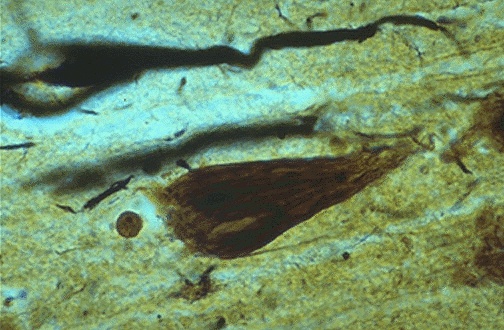
| Research interests in more detail tau Alzheimer's Disease, PSP, CBD, FTDP-17, Down's Syndrome, ARJP amd many other neurodegenerative diseases share a common pathological hall mark; the accumulation of a naturally occuring protein called tau. These diseases are sometimes collectively called tauopathies. Normally, tau stabilizes microtubules, bones of the nerve cell skeleton. In tauopathies, and for reasons not fully understood, tau becomes detatched from the microtubules and accumulates into dense tangles, which can be seen in the brains of the sufferers. |
| a-synuclein Parkinson's Disease is a member of another class of neurodegenerative diseases call synucleinopathies. In these disorders accumulation of a-synuclein is often found in the brain, in dense structures called Lewy bodies. Again we have created cell expression systems using fluorescent proteins, but we have also been making interesting discoveries looking at the protein-protein interactions between a-synuclein and a number of other targets. |
| BRI British familial dementia (BRI) is a disease which is inherited through a mutation in the gene for a transmenbrane protein, which gives rise to an amyloidic protein that accumulates in the brain. We are investigating biochemical interactions with this protein too. |
|
| Neurofibrillary Tangles in AD |
| One way that we study tau is to express it with a green or red fluorescent tag in cultured neuronal cells. In this way we can see what happens to tau when we subject the cells to a variety of chemicals thought to be involved in the neurodegenerative process. In this way we are currently looking at cell stress, and how tau affects the cell's ability to cope. The experiments test the hypothesis that oxidative damage or irregular phosphorylation leads to tau disfunction, and that an aberrant form of the protein ubiquitin causes accumulation of tau into tangles. The advantage of studying these processes in cells is that animals are not harmed, and the experiments are quick |
| and cheap to perform. It is also possible to quickly perform biochemical tests on the cells, to study in more detail what is happening at the protein level. Tau genetics has also led to a number of important discoveries. We have found that mutations in the tau gene lead to inherited forms of tauopathy called FTDP-17. We have screened genetic material from hundreds of cases in the United Kingdom and have found that there are polymorphisms in the tau gene that are over-represented in cases of PSP (the disease which Dudley Moore suffers from). Study of these genetic differences gives insight into the disease, and how it might be treated. |