Interview

with Jimmie Begay, Teacher Aide at Pine Hill Elementary School.

Date: April 2005


Interviewed Jimmie Roy Begay who is the teacher aide for second grade at Pine Hill School.

Do you think teaching Navajo language in the school helps students speak and understand Navajo? Yes, especially if it is spoken at home

Do the students retain Navajo language? No

Are the students learning their Navajo language? Yes, only in Elementary level. Mid and High school I do not know.

What kind of strategies do you use to teach Navajo language? Picture of Navajo Alphabets
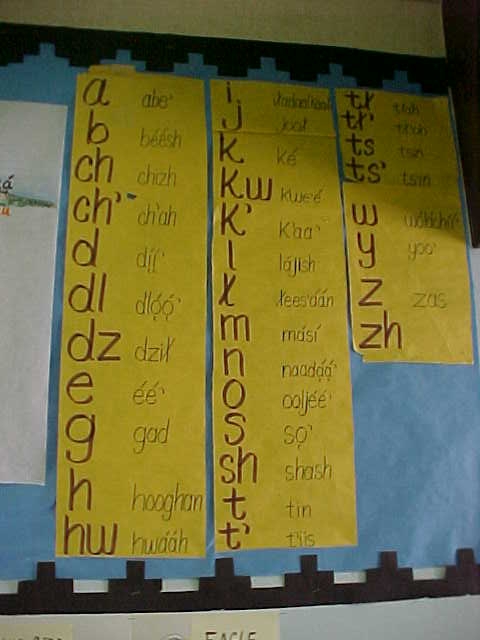
Navajos is spoken at all times a type of immersion of the language.

How fast do the students pick up Navajo language? If it is verbal at home right away, the students do much better. If it is not spoken at home, it is something new to them, which makes it hard to re explain in English

How much time do you have to teach Navajo language? 30 minutes a day.

How many times a week do you teach Navajo language? Five times a week

Does the school you teach at have a balanced Navajo curriculum? No, they are still trying to get it together and keep changing.

Are the parents supportive of your teaching Navajo language? If it is just Navajo language or culture yes but because of religious beliefs, some parents object to certain aspects of culture.

Do you have support from the teacher and principal? Yes

Are the students interested in Navajo language? Yes

Do you enjoy teaching Navajo language? Yes

Overall, how do you rate Navajo language at Pine Hill School? Average at the Elementary school because there is no curriculum is in place.

Building a foundation for community support of Native language teaching and awareness of critical issues relative to language vitality must be a crucial element of "preserving" languages. Schools, because of their inherent agendas for teaching other things, cannot be expected to fully carry the responsibility for language teaching. Effective methods for language teaching, when implemented correctly, can help support such efforts, but these must of necessity include Native speakers who know the languages most fluently. Schools also must be made to understand that in cases where language retention or revitalization is at a critical stage, issues of certification and the like become moot points. What becomes critical are the quality of linkages established between school and community, and between generations in a given language community. I applaud SEDL's efforts to support information networking, but the work of Native language "preservation" is in the trenches, so to speak. That is, working in communities or at least providing appropriate technical resources to Native communities. --Christine Sims, Board Chairperson, Linguiistic Institute for Native Americans (LINA)

Go back to Menu


This page is copyright©2005, Renaye Apachito

Last version: April 27, 2005

Hosted by www.Geocities.ws

1