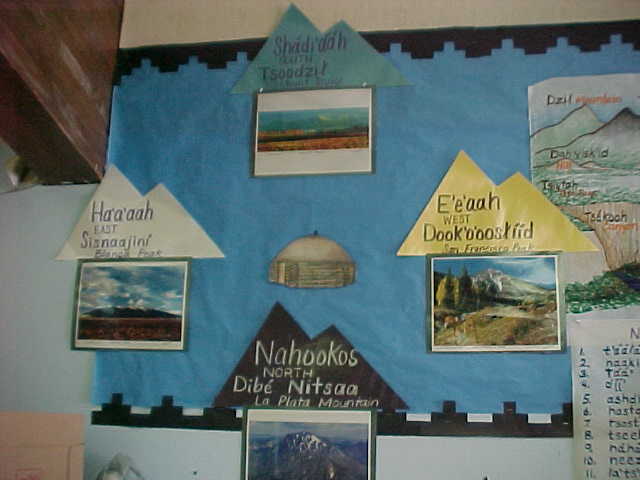
 Since the schools inception the goal has remained constant, to educate the community children not only instilling goals of academic achievement but cultivation the Ramah Navajo culture and language to carry on for future generations. Jeannette A. Yazzie is one of the many mothers whose child attends Pine Hill Elementary; in our interview she explains her experience with the schools core curriculum in which the Navajo culture plays an integral part. Jeannette�s daughter Ziara is in third grade at Pine Hill Elementary. Jeannette spoke of Ziara�s knowledge of how to recite the pledge of allegiance in Navajo.
Question 1: How did your daughter learn to say her pledge of allegiance in Navajo?
Here previous Navajo Culture teacher taught her. She put the effort to make a copy of the pledge of allegiance to study from. Ziara studied the paper everyday. She read it over and over in Navajo .
Question 2: Do you speak to your child in Navajo?
Yes, Ziara learned her Navajo language by living with her grandparents. The majority of the spoken language used is Navajo at her grandparent�s house.
Question 3: Do you get support from the Navajo teacher aide at Pine Hill School?
Not in the grade my daughter is presently in. Previously yes I had support. I mostly practice with her myself. I give my parents a lot of credit.
Question 3: Is your daughter interested in learning her Navajo language?
Yes, very much so. Ziara has learned a lot by living with her grandparents ever since Ziara was a toddler. Ziara is very fluent in Navajo and can easily pick up Navajo language.
Go back to Menu