| WORLD WAR II: THE JAPANESE OCCUPATION |
| Ten hours after the bombing of Pearl Harbor on December 7, 1941, the Japanese began attacking the Philippines next. On December 8 they bombed US bases in Clark Field, Sangley Point and Nichols Field. To save Manila from further bomb attacks and destruction, Gen. Douglas MacArthur declared it to be a free city. On January 2, 1942 Manila finally fell in the hands of the Japanese Imperial Army. The Americanswere not able to hold the enemies back as they were easily crushed by the overwhelming forces of the Japanese. President Manuel Luis Quezon and his family escaped to Corregidor as advised by Gen. MacArthur. And on February 20, the president and his family, Vice President Osmena, Prime Minister Jose Abad Santos and others fled to the United States. Gen. MacArthur was ordered to flee from Corregidor to Australia on March 11. And on March 17, he made his promise to the people as he uttered his famous words, "I shall return." |
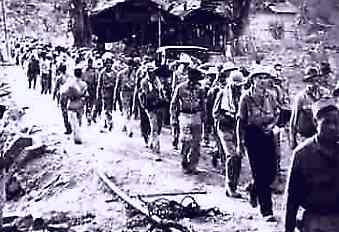
| THE FALL OF BATAAN: The Death March The Japanese were the worse forces that colonized the Philippines. They mercilessly raped and killed women, and murdered men and children. The Bataan Death March was one of their most brutal acts. Gen. King finally surrendered the Bataan peninsula on April 9, 1942. In the morning of April 10, 78,000 Filipino and American soldiers were taken captive. They were forced to walk the distance of 90 miles from Bataan to Pampanga. Those who fell and were not able to walk either beaten to death or stabbed by bayonets . Many died of hunger, thirst and exhaustion. But despite being heavily guarded, some were still able to escape. Only over 50,000 reached the concentration camps in Capas, Tarlac but some died of malnutrition and disease. |
 |
| Despite defeat, the people still displayed an astonishing resistance against their conquerors. Those who were able to escape from the march of death formed guerilla groups. In Central Luzon. the group was formed by Walter Cushing, Col. Volkman, Enriquez, Ilocos Norter Governor Roque Alban, Lt. Col. Arthur Noble, Col. Martin Moses and a young officer by the name of Ferdinand Marcos, who would later become the 6th president of the Philippine Republic. In Northern Luzon, the groups identified as Lapham, Ramsey and Anderson Guerillas were led by the Phil-American forces with Col. Thorpe as their commanding officer. In Manila, the ROTC "Hunters" were led by Col. Eleuterio Adaveso with the Marking Guerillas led by Col. Marcos Agustin and Yay Panlilio. In Tarlac, Pampanga and Nueva Ecija, the HUKBALAHAP or Hukbo ng Bayan Laban sa Hapon (Forces of the People Against the Japanese) led by Luis Taruc and brothers Jose and Jesus Lava were greatly feared by the Japanese. Col. Alejo Santos led his band of guerillas in Bulacan. In Southern Luzon the guerilla supporters of Pres. Quezon headed by Umali gained thousands of civilian supporters from the provinces of Quezon, Batangas, Laguna and Cavite. |
| THE RETURN OF GEN. DOUGLAS MACARTHUR |
| On October 20, 1944, the US freedom forces led by Gen. MacArthur finally waded ashore at Red Beach, Palo, Leyte. The Japanese fought hard to hold their ground as Gen. Tomoyuki Yamashita sent more troops to Leyte, but to no avail. Christmas of 1944, the islands of Leyte and Mindoro were completely taken by the Americans. On January 9, 1945 Gen. MacArthur and his troops advanced to Luzon and on February 3, Manila was finally set free. July 4, 1945, Gen. MacArthur declared the liberation of the Philippines. |
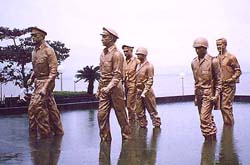 |
| MacArthur Park, Leyte Landing Monument |
 |
 |
| The Bataan Death March |
 |