|
Here are some pictures from a trip I
took to Israel in January 1996. While the entire eastern United States
was getting buried in a blizzard, I was enjoying the warm, sunny weather
of the Holy Land.

|
|
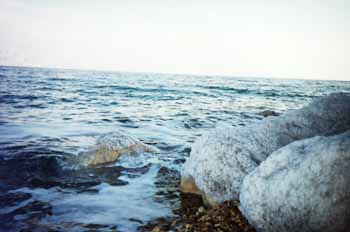
This first picture is of the Dead Sea.
Whatever you may have heard about it's saltiness, believe it. Besides having a salt density seven times that of ocean water, it also has many other minerals that have flowed in from both the Jordan River, as well as the runoff from the surrounding hills.
|
|
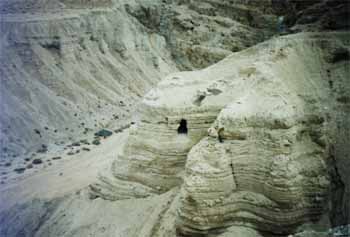
This is one of the caves where the famous Dead Sea scrolls were found. If you don't already know the story, back in 1947 a young Bedouin shepherd boy was throwing rocks up into the surrounding caves, when suddenly one of the rocks he threw caused a shattering sound inside one of the caves. Upon investigation, some broken jars were discovered that were holding some ancient scrolls. These scrolls turned out to be one of the single greatest discoveries in the field of Bible manuscript research. The scrolls are the oldest known copies of the Old Testament Scriptures that exist, and contain
full or partial copies of nearly every Old Testament book. Because of their age, they have aided Biblical scholarship by giving copies of the Old Testament writings that date much closer in time to the originals.
|
|
|
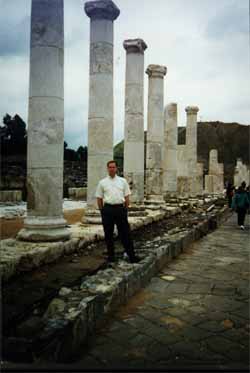
Here I am standing among the somewhat restored ruins of
Beit-Shean, sometimes referred to as Scytopolis. Scytopolis was the only city of the ten Roman cities of the Decapolis that was built on the Western side of the Jordan river. The name Beit-Shean is borrowed from the name Beth Shan, which is the ancient city of the Philistines where the body of King Saul was
taken and nailed to the city wall. The ancient Philistine city is still being uncovered, and sits a few hundred yards behind where I'm standing in this picture. The Roman city that you see was actually built right beside the original Philistine city, as opposed to being built on top of the former city, which was the typical way a city was "rebuilt" in ancient Israel.
|
|
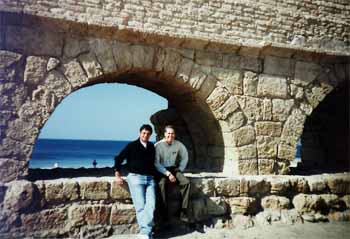
On my last day in Israel, I had this picture taken of myself
with my guide, Doron Heiliger, on one of the ancient aquaducts built by Herod the great in the city of Caesarea. Doron was a wonderful guide during my trip in Israel. He provided a wealth of not just historical information, but also
great insight into the modern culture of Israel. I learned from him that the modern Jew is a very proud person, a person who is very much in touch with his heritage. On our last day together, he said that the modern Israeli has few friends, but that American Christians were counted among those friends. Trying not to show too much emotion, Doron asked that when we return home to the U.S., that we would "pray for the peace of Jerusalem". (Psalm 122:6)
|
|
|
|
|