|
 Introduction
The International
Baccalaureate (IB) Diploma Programme:
Often colloquially referred to simply as "IB", is an educational programme
taught in one of three languages (English, French or Spanish) and is intended
for students in their final two years of secondary schools often before entering
university. It is taught in 2,091 schools, to a great extent in international
schools, in 125 countries (till July, 2007). The programme, administered by
the International Baccalaureate Organization (IBO), is one of the most widely recognised pre-university educational programmes in the world
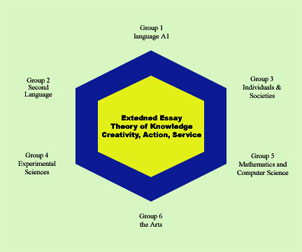
The Diploma Programme (DP) curriculum consists of
completing six courses from six different subject areas, writing an Extended
Essay (EE) of up to 4,000 words, taking part in the Theory of Knowledge (TOK)
class, and fulfilling a requirement of 50 hours in each of the Creative, Active
and Service (CAS) pursuits. Grades are awarded from 1 to 7 in each subject, and
up to three 'bonus' points may be awarded depending on the grade results of the
EE and TOK. Thus, a total of 45 points may be obtained by the candidate for
their final diploma. In order to receive an International Baccalaureate Diploma
you must receive a minimum of 24 points. If candidates study in a language other
than their native language (i.e. their language A1), they may receive a
Bilingual Diploma. If students choose not to fulfill all parts of the programme
they can receive 'subject certificates' for the IB classes they take.
Subject Areas
Students pursuing the Diploma take six courses,
usually from six different subject areas (detailed below), with three (or four)
of them taken at Higher Level (HL) and the rest at Standard Level (SL). Higher
Level subjects require approximately 240 hours of teaching time, and standard
level subjects about 150.
Group 1: Language
A1 - It consists of students’
strongest languages, with over 80 different languages available.They may choose
to self-study a language of their choice at Standard Level if their fluent
language is not taught by the school.
Group 2:
Second Language –This group offers additional language, taken either at
A2, B (SL or HL) or ab initio (SL only). This group may also be replaced
by a second A1 language.
Group 3:
Individuals and Societies
It is comprised of Humanities and Social Sciences, such as Philosophy,
Economics,
Business &
management, Psychology,
Social Anthropology, information Technology in
a Global Society (ITGS),
Geography and
History (or History of the Islamic World). At Higher Level, there are
several different regionalised History classes including: History of the
Americas, History of Europe, History of Africa, History of West Asia, and
History of East and South-east Asia. The variant/s taught is usually largely
dependent on the location of the school. In some schools it is possible to
choose three subjects from this group and none from Group 4 with special
permission from the IBO.
Group 4: Experimental Sciences
– This group consists of subjects such as Physics, Chemistry, Biology,
Environmental Systems and Design Technology. In some countries, such as the
Netherlands, Sweden, Finland, New Zealand and Turkey students are allowed to
choose three subjects from this group and none from Group 3, as it is required
for admission into some universities.
Group 5: Mathematics - The subjects are, in order of increasing
difficulty, Mathematical Studies (SL), Mathematics SL, and Mathematics HL.
Furthermore, Further Mathematics can be studied at SL in addition to a
Mathematics HL course. This group also includes computer science but only as an
elective (not a substitute for the other mathematics courses).
Group 6: Arts
- Subjects such as Visual Arts, Film, Music, Dance, and Theatre Arts.
Students can also choose to take another subject from any of the other five
groups to substitute for this group. One of the main criticisms of the Diploma
Programme is that it discriminates against artists by allowing those
specialising in other subject areas to take a second subject within that Group,
but offering no such option for those favouring the creative arts. The defence
often used to counter this point is that candidates can use their 50
'creativity' hours of their CAS programme to enrich this part of themselves. At
some schools it is possible to take Ecosystems and Societies as both a Group 3
and Group 4 subject, giving the possibility of two subjects from Group 6.
Related
Topics: EE, CAS, and TOK, Assessment Procedure, Internal Assessment and
Extended Essay in Business & Management
|
