Ray Kreienkamp
6/10/05
Journal 1
untitled
Weekly Journal
Week One: The Human Condition
1) One paragraph summary of the The Human Condition.
The human condition is "the situation, or condition, in which every human being finds himself or herself by virtue of being human."(RB, p. 10) Stated differently, despite the differences that separate humans, all humans share in the same basic condition. Although this situation has been written about in many different ways, the same underlying idea has been expressed since ancient times. As a result of the similarity of the content of the writings, philosophers have concluded that there really is a human condition. Some of the most notable writings on this condition include those by Blaise Pascal and Buddha. Blaise Pascal said man's condition is "inconstancy, boredom, and anxiety." Similarly, Buddha said in his First Noble Truth that man's condition is misery. He said individuals try to themselves from boredom by engaging in ephemeral pursuits. Likewise, others have said the human condition is "the desire for happiness, ignorance, boredom, concupiscence, and death, among others."(RB, p. 13) Despite the different ways to express this idea, these writings can help one to understand the effect of the human condition on humans through the common bond of human nature.
2) List and explain three of the most important ideas you want to remember from this week.
- First, I want to remember the five foundational lessons. The five foundational lessons are a set of ideas that help us understand our life, and how the decisions we make affect our life, others, and the world. By looking at these lessons, you can better understand your life and make better decisions.
| Lesson #1: I am necessarily and unavoidably making decisions all the time. These can and do affect me, others, and my world. By these decisions, I am determining who I am and the person I will become. |
| Lesson #2: I see the world through "colored lenses." I am necessarily and unavoidable (to a greater or lesser degree) biased. |
| Lesson #3: The value judgments I make determine my action. My mental health and happiness (and often those of many others) rests on the validity of these value judgments. |
| Lesson #4: Any change in the particular beliefs that control my life cannot help but change and modify my life. It will affect the quality and texture of all that I experience. |
| Lesson #5: The most significant decisions I make in my life need to be faith decisions. Faith is an opinion based on evidence to which I am committed. |
From p.V from Summer Faith Course Intro Packet
- Second, I want remember Plato's allegory of the cave. Plato's allegory of the cave says that we as humans are in the cave and are trying to find reality from the illusions we see. Since we are trapped in the cave, we can not total grasp reality. Plato's allegory then shows the reaction of the ignorant towards the enlightened one. It shows how enlightened individuals that come back to the cave (likened to the world) are rejected by humans and are usually killed. This idea is important because it helps to explain why people like Socrates, Jesus, and Gandhi were killed.
- Third, I want to remember the difference between thinking and reasoning. I want to remember that when you reason, you usually make better decisions than when you just think. Consequently, I want to remember this so that when I realize I am thinking instead of reasoning, I can make a more reasonable decision. This is important because it can help me to make more quality decisions and improve my quality of life.
3) One image of that minds you of the topic. Attribute, link, your source.
Picture of Plato's Allegory of the Cave
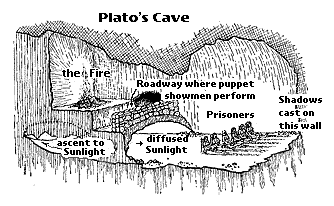
S. Marc Cohen
4) One good question you should keep with you to ponder.
- Am I living an examined life? Does my ship have a rudder? How can I improve to make my map even better?
5) What should you try to do to make you a better person from this study?
After studying the human condition and related articles, I feel there are a few things I could do to make myself a better person. First, I discovered from M. Scott Peck's article that I should be more open with my map to the scrutiny of others. I think that I could make my map or worldview even better if I was more open of the criticism of others. Furthermore, I think I could improve my map by being more critical of myself and using the "examine" to improve my map. Also, I think that by looking at the five fundamental principles and by recognizing the affects of my actions on the whole world, I could make better decisions. I think that if I used Jefferson's method of deciding how to act in my daily life (that is asking yourself what you would do if the whole world was watching), I think I would be a much better person and make better decisions. As a result, I think these things that I have just studied could help me become a better person.
Back to My Summer Faith Course Page