His Story:
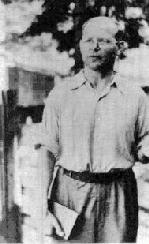
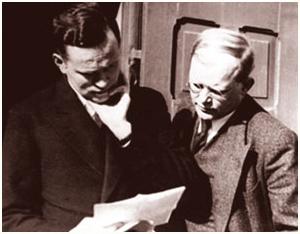
Dietrich Bonhoeffer was born into an aristocratic family on February 4, 1906 in Breslau, Germany (modern day Poland) shortly before the birth of his twin sister Sabine. His father, Karl Bonhoeffer, was a respected psychiatry and neurology professor, while his mother, Paula Bonhoeffer, was a teacher who had graduated from college. His mother was the daughter of a professor of theology. During his childhood, Dietrich showed an interest in music and philosophy. Although his family did not regularly attend Church, his mother and other adults taught him about religion. When Germany became heavily involved in World War I in 1917, three of Dietrich's brothers enlisted in the German Infantry. Unfortunately, the Bonhoeffer's lost on of their sons in the war. This devastating misfortune for the family caused them to question God after the war. Consequently, most of Dietrich's siblings went into professional and scientific fields. Dietrich, however, against the will of his parents, decided to study theology and to become a minister. In 1927, Dietrich graduated from the University of Berlin and his dissertation, Sanctorum Communio, was published. Then, he went off to Barcelona, Spain to serve as an assistant pastor. In 1930, he was awarded the Sloane scholarship to study at Union Theological Seminary in New York City. He studied in New York for a few years, and then, he was invited to visit Abyssinian Baptist Church in New York City. Dietrich was extremely impressed with the African American's worship there. In 1931, Bonhoeffer went back to Germany to lecture at the University of Berlin. After becoming frustrated with his fellow ministers in Germany, he went to England to serve as a pastor there. While there, Bonhoeffer spoke out vibrantly against the Third Reich and the Nazi party. While planning to go study Gandhi in India, he quickly decided to go back to Germany because he knew his country needed help. In 1936, Bonhoeffer took leadership of the Confessing Church's seminary at Zingst, Germany. This seminary eventually had to go underground to keep the Nazis from destroying it. Here, he wrote his famous book, The Cost of Discipleship. The Gestapo eventually uncovered Bonhoeffer's seminary, and it was shut down. Bonhoeffer now became a candidate for Hitler's military. Fortunately for Bonhoeffer, Dohnanyi, Bonhoeffer's brother-in-law, who was working for the Abwehr, pulled Bonhoeffer into the conspiracy to kill Hitler. Bonhoeffer, this one time pacifist, was now involved in trying to assassinate the German leader. Also, Bonhoeffer now participated in "Operation 7" which worked to deceive Hitler and save Jews by exporting them out of the country. On April 5, 1943, the Gestapo arrested Dohnanyi and Bonhoeffer for evidence of some of the things they had done.
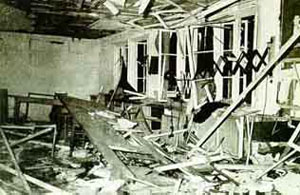
On July 20, 1944, von Stauffenberg planted bombs in Hitler's meeting room that were expected to go off while a meeting was going on. These bombs had been part of the plan devised to assassinate Hitler arranged by Bonhoeffer and his colleagues. Unfortunately, the meeting lasted shorter than expected, and the bombs detonated while no one was in the room. When Hitler heard of this, he was outraged, and he called for the punishment of conspirators. On October 5, 1944, Walter Huppenkothen, a Gestapo lawyer, found Dohnanyi's documents (Zossen Documents) detailing his and his colleagues crimes. When Bonhoeffer heard of the Zossen documents having been found, he decided to arrange for escape plans. When he considered what the Nazis might do to his family members if he escaped, however, he decided he had to stay with them. Bonhoeffer and his family members were shipped from camp to camp until April 1945. Their time in prison and concentration camps was not as bad as some of the Jews because Bonhoeffer was able to befriend many of his guards. This was fortunate for him because he was able to give them letters which they would sneak out of prison for him and give them to his family and friends. These letters would latter be published in Letters and Papers from Prison. Then, when Hitler realized that the Germans were going to lose the war, he ordered Bonhoeffer and his colleagues to be killed because he wanted to be certain that these men would not survive the war. On April 9, 1945, Bonhoeffer was hanged at Flossenberg. He was buried then in a mass grave. Until August 1996, he was regarded in German law as a traitor. It was not until then that the German government recognized the validity of his actions in trying to stop the immoral acts of Hitler.