When we say that there is a force on an object we mean that there is a push or a pull on the object. Some outside agent is placing this push or pull on the object.
In the metric system forces are measured in units of Newtons. This unit is named after Isaac Newton. In the English system forces are measured in units of pounds. A Newton of force is much smaller than a pound of force. It takes about 4.5 Newtons to equal a force of one pound. So, if you usually state your weight in pounds, then you could figure your weight in the Newtons by multiplying those pounds by 4.5.
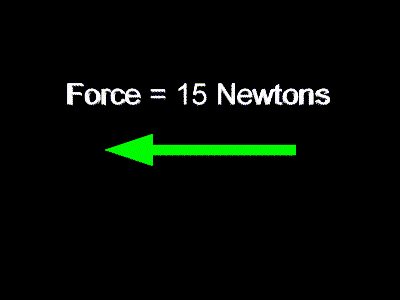
Forces are vectors. That is, they are quantities that have both size and direction. Forces can be symbolized with arrows, as can all vectors. The arrow in the picture below is meant to show a force with the size of 15 Newtons directed toward the left.
One must understand vectors to understand forces.
"Net force" is a central idea of dynamics. Here's why:
Newton's Laws are the big deal in dynamics. Newton's First Law can be stated:
If the net force on an object is zero, its acceleration will be zero.
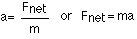
You will soon find out that Newton's Second Law says:
where Fnet means "net force".
In order to use Newton's Laws, the first thing you need to know is "What is the net force".
In Physics 1, you will need to be able to calculate the net force on an object in the five situations shown below.
|
|
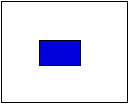
If no forces act on an object, the net force on the object is zero. Although this happens in physics problems, it is very unlikely in practice that an object will have no forces at all acting on it. |
|
|
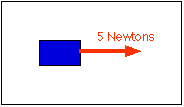
If there is just one force on an object, then that force is the net force. In the diagram at left, the net force is 5 Newtons to the right. For example in free fall, the net force on an object equals its weight - the one force pulling on it. |
|
|
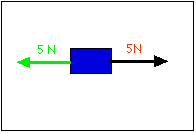
If 2 forces push or pull on an object in opposite directions, and the two forces cancel each other exactly, the net force is zero. |
|
|
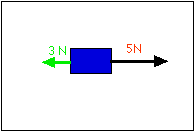
If two forces act on an object in opposite directions and they don't exactly cancel, what is left over is the net force (the difference in the forces). In the diagram at left, the net force is 2 Newtons to the right. |
|
|
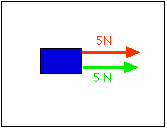
If two(or more) forces act on an object in the same direction, the net force is the sum of the forces. In the diagram at left, the net force is 10 Newtons to the right. |
1.Mechanics & Forces; Working with Net Forces Click here to view
2. Vectors in 4 parts; Introduction, Finding Components, Visualizing Components, & Component Method for Adding Vectors Click here to view
Inertia is defined as that property of matter that resists changes to its state of motion or when it is at rest. Inertia is a resistance to a change in motion, whereas friction is a resistance to that motion. Remember a body at rest will stay at rest, a body in motion will stay in motion, unless acted upon by some external force. This is not extremely obvious on Earth because all motion is subject to some from of friction which is an external force an will act in opposition to any appllied force or motion. The above statment is essentially Newton's First Law of Motion.
A force is either a push or a pull.
When a force acts on an object, this object will accelerate in the direction of the applied
force. As long as the force is applied the object will accelerate. A bullet fired from a rifle will
accelerate down the barrel of the rifle. Once it leaves the barrel, the applied force of the
chemical explosion is not longer present and the bullet will now gradually slow down due to
air resistance. Actually the bullet will either strike some object or fall to the ground long
before air resistance will stop its motion. Gravity will act on the bullets vertical motion but
will not effect its horizontal motion.
The mass of an object is also part of the equation. Throw a baseball then try to throw a
bowling ball. Which can you throw farther? The applied force which cames from you arm
muscles is
the same in both cases. The baseball will achieve a greater acceleration and travel further.
The only difference if the mass of each ball.
Newton's Second Law is stated on page 108 of the text, and so is the equation theat relates
the three variables; mass, acceleration, and force. F = ma. Remember that F is actually the
net force acting on the object.
Another example of this concept is the difference between mass and weight.
The Law itself is simple and straight forward to use. Additions to a problem include
Forces always occur in pairs. The action force and the reaction force. Whenever one object exerts a force on another or second object, the second object exerts a force on the first object will an equal magnitude but in the opposite direction. So who wins this apparent pushing contest? Lets look at a couple of examples.
First we must look at what is called a Free Body Diagram representing all the forces acting on an object. Please note that all forces are vectors. This will be dealt with accordingly.
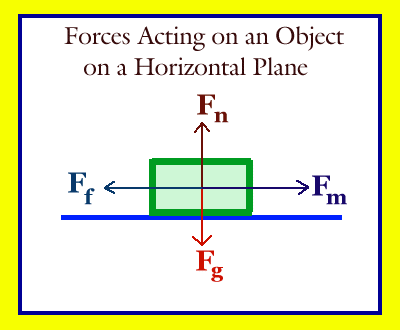
An object, either in motion or at rest on a horizonatal plane has four forces acting on it.
Situations relating these four forces:
*****************
 Due date is September 7 2008 or Feburary 6 2009
********************************