|
| |
Kayak

 | Kayaks comes in many shapes and sizes. |
| The main variables in kayak performances are:
 | forward speed |
| manoeuvrability |
| stability |
| rough water capability |
|
| The hull requirements for speed and manoeuvrability contracts each other.
| A pencil floating on the water - its long narrow shaped and pointed end will let it
travel easily and quickly in a straight line forward. It will not be easy to turn. |
| A watermelon skin floating on water. It can spin easily. but the curved shape will make
it difficult to push along in a straight line. |
|
| The width also affects the speed: the narrower, the higher the speed. But the more
narrow the kayak is, the less stable the kayak. |
| Rough water capability requires a strong deck and hull because rough water bends and
compresses the kayak with considerable force. |
Main parts
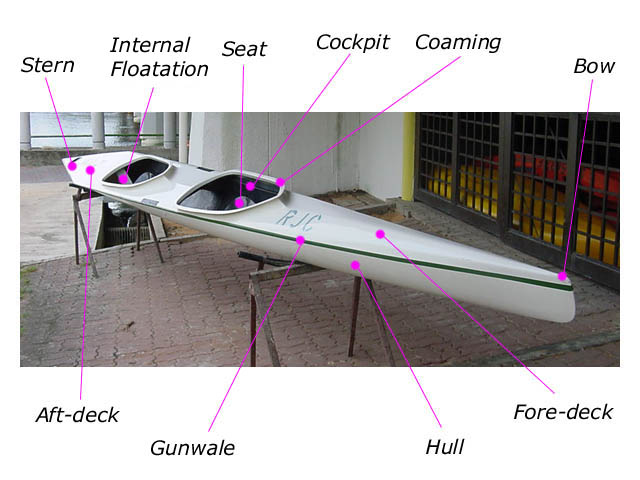
Parts / Terminology not shown
| Port - Left side of the kayak |
| Starboard - Right side of the kayak |
| Toggle line - Lines attached to the decks of the kayak to aid in towing and rescue,
usually not found on racing kayaks |
| Grab handles - Fitted to ends of kayaks, usually at deck level, used for short distance
carrying of kayak and for rescue, usually not found on racing kayaks |
| Keel - Line along the very bottom of the kayak |
| Footrest - Located inside the kayak, used for more efficient paddling |
|