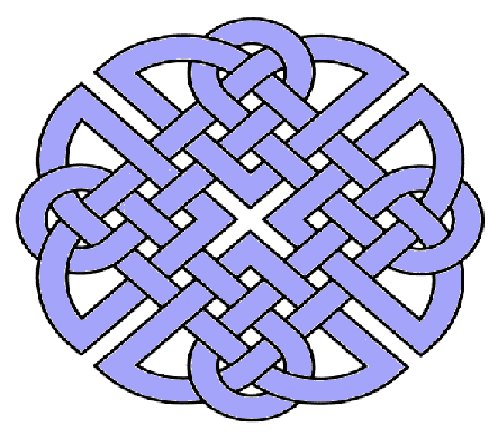
Celt also spelled KELT, Latin CELTA, plural CELTAE, a amember of an early Indo-Europen people who from 2nd millennium BC to the 1st century BC spread over much of Europe. Their tribes and groups eventually ranged from the British Isles and northetn Spain to as far east as Transylvania, the Black Sea coasts, and Galatia in Anatolia and were in part absorbed into the Roman Empire as Britons, Gauls, Boii, Galatians and Celtiberians. Linguistically they survive in the modern Celtic speakers of Ireland, Highland Scotland, the Isle of Man, Wales and Brittany.
The oldest archaeological evidence of the Celts comes from Hallstatt, Austria, near Salzburg. Excavated graves of chieftains there, dating from about 700Bc, exibit an Iron Age culture (one of the first in Europe) which received in Greek trade such luxury items as bronze and pottery vessels. It would appear that these wealthy Celts, based from Bavaria to Bohemia, controlled trade routes along the river systems of the Rhone, Seine, Rhine and Danube and were the predominant and unifying element among the Celts. In their westward movement the Hallstatt warriors overran celtic peoples of their own kind, incidentally introducing the use of iron, one of the reasons for their own overlordship.
For the centuries after the establishment of trade with the Greeks, the archaeology of the Celts can be followed with greater precision. By the mid-5th century BC the La Tene culture, with its distinctive art style of abstract geometric designs and stylized bird andanimal forms, had begun to emerge among the Celts centred on the middle Rhine, where trade with the Etruscans of central Italy, rather than with the Greeks, was now becoming predomonant. Between the 5th ans 1st centuries BC the La Tene culture accompained the migration of Celtic tribes into eastern Europe and westward into the British Isles.
Although Celtic bands probably had penetrated into northern Italy from earlier times, the year 400BC is generally accepted as the approximate date for the beginning of the great invasion of migrating Celtic tribes whose names Insubres, Boii, Senones and Lingones were recorded by later Latin historians. Rome was sacked by Celts about 390BC, and rading bands wandered about the whole peninsula and reached Sicily. The Celtic territory south of the Alps where they settled came to be known as Cisalpine Gaul (Gallia Cisalpina), and its warlike inhabitants remained an ever-constant menace to Rome until their defeat at Telamon in 225BC.
Dates associated with the Celts in their movement into the Balkans are 335BC, when Alexander the Great received delegations of Celts living near the Adriatic, and 279BC, when Celts sacked Delphi in Greece, but suffered defeat at the hands of the Aetolians. In the following year three Celtic tribes crossed the Bosphorus into Anatolia and created widespread havoc. By 276BC they had settled in parts of Phrygia, but continued raiding and pillage until finally quelled by Attalus I of Pergamum about 230BC. In Italy, meanwhile, Rome had established supremacy over the whole of Cisalpine Gaul by 192BC and in 124BC had conquered territory beyond the western Alps - in Provincia (Provence).
The final episodes of Celtic independence were enacted in Transalpine Gaul (Gallia Transalpina), which comprised the whole territory from the Rhine River and the Alps wesward to the Atlantic. The threat was twofold: Germanic tribes presing westward toward and across the Rhine and the Roman arms in the south poised for further annexations. The germanic onslaught was first felt in Bohemia, the land of the Boii, and in Noricun, a Celtic kingdom in the eastern Alps. Teh German assailants were known as the Cimbri, a people generally thought to have originated in Jutland (Denmark). A Roman army, sent to the relief of Noricum in 113BC, was defeated, and thereafter he Cimbri, now joined by the Teutoni, ravaged widely in Transalpine Gaul, overcoming all Gaulish and Roman resistance. On attempting to enter Italy, these Germans marauders were finally routed by Roman armies in 102 and 101 BC. There is no doubt that during this period many Celtic tribes, formely living east of the Rhine, were forced to seek refuge west of the Rhine; and these migrations, as well as further german threats, gave Julius Caesar the opportunity (58BC) to begin the campaigns that led to the Roman annexation of the whole Gaul.
The Celtic settlement of Britain and Ireland is deduced mainly from archaeological and linguistic considerations. The only direct historical source for the identification of an insular people with the Celts is Caesar's report of the mogration of belgic tribes to Britain, but the inhabitants of both islans were regarded by the Romans as closely related to the Gauls.
Information on Celtic institutions is available from various classical authors and from the body of ancient Irish literature. The social system of the tribe or "people", was threeforld: king, warrior aristocracy and freemen farmers. The druids, who were occupied with magico-religious duties, were recruited from families of the warrior calss, but ranked higher. Thus Caesar's distinction between druids (man of religion and learning), eques (warrior) and plebs (commoner) is fairly apt. As in other Indo-European systems, the family was patriarchal. The basic economy of the Celts was mixed farming and, except in times of unrest, single farmsteads were usual. Owing to the wile variations in terrain and climate, cattle raising was more important than cereal cultivation in some regions.Hill forts provided places of refuge, but warfare was generally open and consisted of single challenges and combat as much as of general fighting. La Tene art gives witness to the aesthetic qualities of the Celts, and they greatly prized music and many forms of oral literary composition. |