| The Naval Quarantine of Cuba, 1962 |
| MSO's Which Received the Armed Forces Expeditionary Medal for Participating in the The Naval Quarantine of Cuba, 1962 |
| Agile (MSO 421), 28 Oct - 11 Nov 62. |
| Aggressive (MSO 422), 28 Oct - 11 Nov 62. On station 5 miles off Cape Maisi (eastern point of Cuba) when JFK made his "We're going to blockade Cuba " speech, (October 22) which we heard over the radio. We were more than a little nervous with our single barrel 40MM on the foc'sle, but were relieved the next day by a DD. We went back to Gitmo and were assigned to harbor patrol.(Bob Adelwerth) |
| CNO's responsibility not only included the execution of the blockade and defense of Guantanamo, but protection of U.S. shipping as well. CINCARIB Sea Frontier was responsible for the Windward Passage and the evacuation of Guantanamo dependents with 1 DD, 1 AVP, 2 MSO, 2 DE, 1 VA squadron (AD's), 1 VU squadron (F8U's) and 1 VP detachment. |
| Ability (MSO 519), 6 - 24 Nov 62. |
| Rival (MSO 468), 24 Nov - 31 Dec 62. |
| Salute (MSO 470), 29 Nov - 31 Dec 62. |
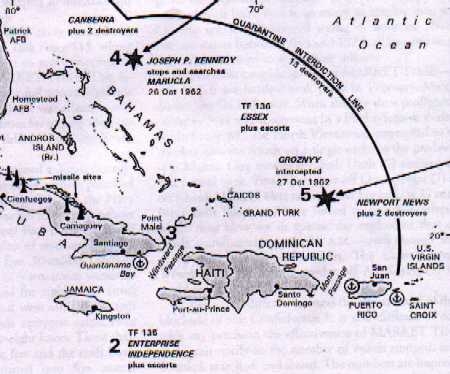
| The importance of maintaining an adequate, ready, and flexible Defense establishment was clearly illustrated in the fall of 1962 when the Soviet Union moved ballistic missiles into Cuba. Starting in late July 1962, evidence of increased Soviet military assistance to Cuba accumulated. The presence of air defense missiles was confirmed from pictures taken on August 29. A determination that certain shipping crates noted on September 28 aboard Cuba-bound ships contained IL-28 medium-range bombers was made on October 9. Conclusive proof of the presence of medium-range ballistic missiles did not become available until the analysis of photographs taken on October 14 was completed on the next day. Further photographic evidence on the size and type of the Soviet buildup was obtained during the following days as the high altitude air surveillance, assigned to the Strategic Air Command on October 12, was greatly increased by Presidential order. This sudden clandestine introduction of clearly offensive weapons of mass destruction constituted a direct threat to the peace and security of the Western Hemisphere. It had to be countered quickly and effectively. During the week of October 15, the President and his civilian and military assistants canvassed the alternative courses open to the United States. The conclusions reached, as announced to the Nation by the President on October 22, called for a strict quarantine on all offensive military equipment under shipment to Cuba, increased close surveillance of Cuba, reinforcement of our base at Guantanamo, and various diplomatic measures, including the endorsement of the quarantine by the Organization of American States. When this endorsement was given on October 23, the President issued Proclamation 3504 establishing the quarantine effective on October 24 and directed the Secretary of Defense to take appropriate measures. Military steps to meet the current emergency had been initiated during the previous week. Better than normal security was maintained, aided by the previous scheduling of routine amphibious and other naval exercises in the Caribbean and Atlantic areas and by the gradual buildup of air defenses in the southeastern United States started early in the year. Nevertheless, rumors of increased military activities began to circulate, but it was vital to the success of our policy that maximum secrecy be maintained until our course of action was firmly determined, our information on Soviet activities as complete as possible, and our armed forces ready to carry out their assignments. Since it was not known what course the Soviet Union would choose to follow, the armed forces had been ordered "to prepare for any eventualities," and almost the entire Defense establishment was placed on alert status. In case the Soviet Union determined to unchain a nuclear attack, our retaliatory forces were ready to counter. Starting on October 20, the Strategic Air Command (SAC) began dispersing its bombers and placed all aircraft on an upgraded alert--ready to take off, fully equipped, within 15 minutes. On October 22, the B-52 heavy bombers started a massive airborne alert, involving 24- hour flights and immediate replacement for every aircraft that landed. ICBM (Intercontinental Ballistics Missile) crews assumed a comparable alert status. POLARIS submarines went to sea to preassigned stations. The tremendous nuclear firepower of the United States was deployed to discourage any reckless challenge. Our air defense forces, under the operational control of the North American Defense Command (NORAD), were equally ready for any emergency. Fighter interceptors and HAWK and NIKE- HERCULES missile battalions were moved to the southeast to supplement local air defense forces. After October 22, interceptor units were either on patrol missions or on a 5-to-15-minute alert. The general purpose forces of the Army, Navy, and Air Force started to organize for the emergency on October 16. The command organization, as finally developed, called for the Commander in Chief, Atlantic (CINCLANT), to provide the unified command. He also retained control of all naval components involved in tactical operations, as the Commander of the U.S. Fleet, Atlantic. The responsibility for Army and Air Force components was assigned to the Continental Army Command (CONARC) and the Tactical Air Command (TAC) under the designation of Army Forces, Atlantic (ARLANT), and Air Forces, Atlantic (AFLANT). The commander of the Army XVIII Airborne Corps was designated Joint Task Force Commander to plan for any joint operations that might become necessary. Over-all direction was exercised by the President and the Secretary of Defense through the Joint Chiefs of Staff, who named the Chief of Naval Operations as their representative for the quarantine. The operational control of the quarantine force was assigned to the Commander of the Second Fleet, who organized Task Force 136 for this purpose. Effective deployment constituted a mammoth task to be accomplished in minimum time. To prevent future difficulties, plans had to be developed, ship captains briefed, supply ships dispatched, and thousands of details checked. Other Navy and Marine forces faced similar tough schedules. Marines, if not already engaged in landing exercises, were loaded on amphibious ships and ordered to sea. At Guantanamo, dependents were evacuated to the United States on October 22, and Marine units were shipped by air and sea to reinforce the base. Task Force 135, including the carrier Enterprise, was sent to the south of Cuba, ready to join in the defense of Guantanamo if needed. The carrier Independence and the supporting ships of Carrier Division Six stood by to provide additional support. Antisubmarine forces were redeployed to cover the quarantine operations. An intensive air surveillance of the Atlantic was initiated, keeping track of the 2,000 commercial ships usually in the area; regular and reserve Navy aircraft were joined in this search by SAC bombers. Major elements of the Strategic Army Corps (STRAC) were designated for use by ARLANT and placed in advanced alert status. Logistic support for the more than 100,000 men involved was directed by a newly established Peninsula Base Command. Preparatory steps were taken to make possible the immediate callup of high priority Army National Guard and Army Reserve units. Air support for the ground forces was provided by the TAC, which moved hundreds of tactical fighter, reconnaissance, and troop carrier aircraft to the southeast. To make room for all these units, the bombers, tankers, and other aircraft not required for the current operations were ordered to other bases in the United States. This massive movement of ships, aircraft, and troops, together with their weapons and equipment, was carried out with unprecedented speed. The forces alerted were ready for their assignment when the President addressed the Nation on the evening of Monday, October 22. Low altitude reconnaissance flights started over Cuba on October 23. When the Quarantine Proclamation became effective at 10:00 a.m. (EDT) on October 24, air and surface units of the Atlantic Fleet were at their designated stations. Whether or not other units would be called upon to carry out their operational missions remained an unanswered question throughout this week of maximum danger. Photographic intelligence continued to show a rapid buildup of offensive weapons in Cuba. The construction of permanent sites for intermediate-range ballistic missiles was noted, in addition to the deployment of the mobile medium-range type. On the other hand, the potentially dangerous confrontations inherent in the quarantine failed to develop. On October 25, the first Soviet ship, the tanker Bucharest, was intercepted without incident and permitted to proceed after it was determined without boarding that it carried oil and no prohibited material. On the same day it was confirmed that other Cuba-bound Soviet ships, likely to require closer inspection, had changed course, possibly to return to their home ports. On October 26, the freighter Marucla, flying the Lebanese flag but chartered by the Soviet Government, was boarded and cleared after a brief inspection. Tension increased on October 27, when a U-2 aircraft, piloted by Maj. Rudolf Anderson, Jr., USAF, was destroyed. Later in the day, the Secretary of Defense asked the Air Force to call 24 troop carrier squadrons and their supporting units to active duty, involving about 14,000 Air Force Reservists. The break in the crisis came on Sunday, October 28, when the Soviet Government finally agreed to dismantle its offensive weapons in Cuba and return them to the Soviet Union subject to United Nations verification. If this pledge were carried out, additional military actions would become unnecessary. Quarantine measures and aerial surveillance, however, remained in effect. They were suspended temporarily only for 2 days, October 30 and 31, while the Secretary General of the United Nations was trying unsuccessfully to reach an agreement with the Cuban Prime Minister on verifying the removal of offensive weapons. While decreased activity at the missile sites was noted on October 29, it was not until November 2 that it could be announced that the dismantling of the weapon systems had definitely been started. During the following days, aerial reconnaissance provided detailed information not only on the progress made in this work but also on the transfer of the missile systems to the Cuban ports and the loading of 42 missiles and their support equipment on eight Soviet ships. These ships sailed between November 5 and 9, and a final visual check was made as each of them passed the quarantine. Still unresolved, however, was the future of 42 IL-28 medium-range bombers. Their removal entailed further diplomatic negotiations that were not concluded successfully until November 20. The return of these bombers to the Soviet Union was checked as carefully as that of the missiles. All of them left Cuba on December 5 and 6, loaded on three Soviet ships. Concurrently with the Soviet commitment on the IL-28's, the United States Government announced the end of the quarantine effective at 6:45 p.m. (EDT), November 20, 1963. Fifty- five Cuba-bound merchant ships had been checked during the 4-week quarantine; none was found to carry any prohibited material. With the end of the quarantine, the ships of Task Force 136 as well as those of the more recently formed Inter-American Quarantine Force, composed of Argentinian, Dominican, Venezuelan, and United States units, returned to normal duties. The special alert activities of our armed forces at home and abroad gradually were reduced, and the units no longer required were returned to their permanent stations. The Air Force Reserve units called to active duty were released by the end of November, and the extension of tours of duty for Navy personnel, ordered on October 24, was canceled. Only aerial reconnaissance sorties were continued, since the on-site verification of the removal of all offensive weapons, originally agreed upon by the Soviet and the United States Governments, continued to be opposed by Cuba. The Cuban crisis demonstrated the readiness of our armed forces to meet a sudden emergency. It also highlighted the importance of maintaining a properly balanced Defense establishment, including not only retaliatory forces of overwhelming strength but also adequately trained and equipped units in sufficient numbers for lesser types of action. This military flexibility was a major force in bringing about the removal of a dangerous threat to the security of the United States. While our armed forces carried out their assignments well, numerous lessons were learned, insuring that any future emergency will be met with even greater efficiency. The officers and men, both regular and reserve, who participated in the Cuban operation and, above all, the Navy, Marine, and Air Force pilots who collected the hard intelligence required for a successful national policy rendered an outstanding service to their country. Source: Department of Defense. Annual Report for Fiscal Year 1963. |
 |
 |
 |
|
 |
|
|