 |
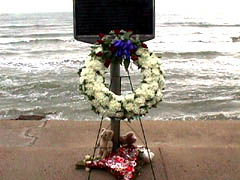 The Sisters of Charity placed a wreath in memory of St. Mary's Orphanage, where 10 nuns and 90 children died during the Great Storm. St. Mary's Orphanage, home to 93 children and the 10 nuns who cared for them, sat on a beautiful beach in 1900, overlooking the Gulf of Mexico |
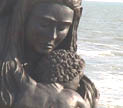
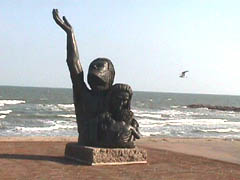 Galveston artist David Moore created this public sculpture, "Place of Remembrance" to commemorate the 100-year anniversary Remembering Clara Barton and the Red Cross |
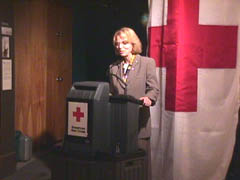 Red Cross President Dr. Bernadine Healy spoke at the Galveston County Historical Museum on Friday. |
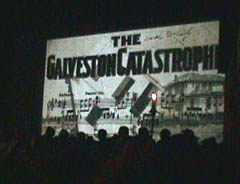 The candlelight Storm Centennial Tribute featured a slide show of storm images from local archives. |
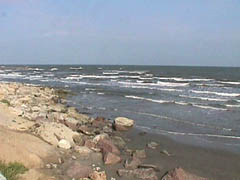 One hundred years later, Galveston is a popular beach resort town. |
100
Years Later: Remembering the Great Hurricane of Galveston, Part II
Written by Christina Ward, Staff Writer, DisasterRelief.org
GALVESTON, TEX. ---Sister Ursula O'Keeffe stood early Friday morning in
front of a quiet crowd, her back to the breaking waves. This group, gathered
a few miles outside of downtown Galveston, had come together on a patch
of empty grass where the Sisters of Charity once built a wooden refuge
for the young and homeless. "One hundred years ago today, at this time,
at this place, there was an orphanage," O'Keeffe said. "It is so far away...and
yet so near, it seems that you should hear the giggles of children at
play."
On Sept. 8, 1900, the wealthy, thriving island of Galveston was ripped
apart. A powerful hurricane churned up from the Gulf of Mexico and pummeled
an unexpecting, unprepared population. In the span of a few hours, winds
damaged thousands of buildings, turned trees to splinters and sent debris
flying through the air with deadly force. But the worst damage came from
the floodwaters, which eventually submerged the entire island. The port
city known as the "Wall Street of the West" was left with nothing but
carnage and rubble. This weekend, Galveston commemorated the storm that
killed more than 6,000--possibly as many as 8,000 to 10,000---of its citizens.
A pair of large, two-story buildings served as residences, wrapped in
spacious porches and surrounded by wide lawns where the children ran and
played. When the Great Hurricane hit on Sept. 8, the boys' dormitory Ñ
older and weaker Ñ was the first to go, collapsing in the late afternoon
and floating away in pieces on the rising floodwaters. All of the children
and nuns were crowded on the second floor of the girls' dormitory when
they heard the boys' building crash to pieces. Wind speeds were more than
120 mph, and the storm surge was 15 feet high. As the floodwaters poured
in through shattered windows, each of the 10 Sisters used clothesline
to tie herself to between six and eight of the smaller children, in the
hope no one would be lost. Their efforts were in vain: The girls' dormitory
soon collapsed, and nearly all of the nuns and orphans were killed. Only
three boys survived, clinging in the water to a treetop until the hurricane
died down.
At a small, emotional ceremony Friday morning, a group of nuns,today's
Sisters of Charity of the Incarnate Word, placed a wreath at the waterfront
site of the old orphanage. They led the audience in singing "Queen of
the Waves," a hymn the nuns sang on the evening of Sept. 8, 1900, to calm
the children as the 1900 Storm roared around them.
Remembering Clara Barton and the Red Cross
Clara Barton, founder and president of the American Red Cross in 1900,
gathered a team and traveled by rail from Washington, D.C., to Galveston
as soon as she heard the news of the disaster. Dr. Bernadine Healy, president
of the Red Cross in 2000, made the same trip Friday Ñ though by plane
this time, and under far less tragic circumstances. Healy spoke Friday
afternoon to a group gathered at the Galveston County Historical Museum.
In the audience were a group of 7th and 8th graders from Galveston Catholic
School, who are learning disaster preparation skills this fall through
a Red Cross program in their classroom.
The Red Cross recently introduced "Masters of Disaster," a disaster-preparedness
program that teachers can incorporate into traditional classroom curricula.
"We're learning how to be prepared so we'll know what to do if a big hurricane
hits," said Carolina Thomas. Her teacher, Doris Falk, explained: "It's
so important to be knowledgeable about disasters. We want them to be able
to help themselves Ñ and to be good weather predictors." Ê ÊHealy said
it took about 36 hours for word of the Great Hurricane to get to Washington.
"It those days, we didn't have CNN," she said with a smile. By the time
Clara Barton arrived in Galveston, the town Ñ overwhelmed by the thousands
of bodies Ñ had already begun to burn funeral pyres in the streets. "Barton
described it as utter chaos, like a scene from Dante's Inferno," Healy
said. "But she had seen this before. She knew what to do."
During the Civil War, Barton had served as a volunteer on the battlefields,
tending to the sick and dying soldiers. When Barton finally left Galveston
after nearly three months of nonstop relief work, the city presented her
with a special "thank-you" resolution. The original resolution hangs in
the Red Cross president's office in Washington, D.C. This weekend, in
commemoration of the Great Storm, Healy presented Galveston with a replica.
The Galvestonian Spirit
Much of Texas has struggled in recent weeks with a terrible drought; even
some of the usually wet coastal cities announced water-rationing policies
last week. But on Friday in Galveston Ñ as if in memory of the deadly
floods of a century earlier Ñ it rained. Off and on all day, Galvestonians
and visitors attending the Great Storm events all over town had to open
umbrellas and head for cover. The island's popular beaches were nearly
deserted. ÊAnd so the town decided to move the main commemorative event
Ñ the 1900 Storm Centennial Tribute, an evening candlelight ceremony Ñ
from the outdoor football stadium to the much smaller high school auditorium.
As the ceremony began, the huge room was packed to the point of overflow.
Photographers, video cameras and families crowded the aisles; dozens of
people were turned away. "It is hot. We are crowded. Many of us are uncomfortable,"
said one local official, quieting the crowd from the stage. "But imagine
our inconvenience compared to that of 100 years ago tonight."
With that, a nearly three-hour ceremony, two years in the making, began.
The 1900 Storm Community Chorus sang. The Galveston Symphony Orchestra
played. The Oppe Elementary School Honor Choir belted out a song called
"Light the Candles All Around the World." A group of high school bagpipers
accompanied the crowd in Amazing Grace. Local officials and religious
leaders read aloud from first-person accounts of storm survivors. The
theme was clear: Celebrating the strength of Galvestonians Ñ those who
survived and rebuilt the city, and those living on the island today. "We
have inherited the spirit of a strong and determined people," said Mike
Doherty, chairman of the Great Storm Committee. Red Cross President Dr.
Bernadine Healy spoke of the importance of helping one another during
"unfair and inexplicable" disasters. "The human spirit prevailed" after
the Great Storm, she said. "We honor those who lost their lives. We also
honor the survivors.
Many speakers also evoked the fearful power of hurricanes. Texas native
Dan Rather, CBS news anchor and keynote speaker, reminded the audience
of the great strides made in hurricane prediction technology since September
1900. Hurricanes could not kill so many today, he said, because meteorologists
offer "full, clear warnings ahead of time." In addition to "heroic feats
of engineering" that resulted in a 15-foot seawall and raised the ground
level of the entire island, scientists also began work to advance hurricane
forecasting immediately after the Galveston tragedy. "Their lives were
given in part to get us where we stand today," Rather said. Still, even
with Doppler radar and satellite imagery, it is important to remember
the destructive strength of these storms, he added. "Hurricanes haunt,"
he said. "Galveston will never forget what happened here."
Read
Part 1.
The
Front Page
Home
©2000 American National Red Cross. All rights reserved.