|
|
|
|
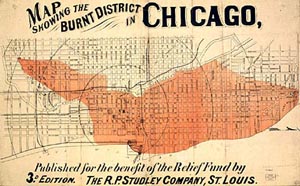 More than 2,000 acres were burned in 29 hours. Image courtesy of the Chicago Historical Society. |
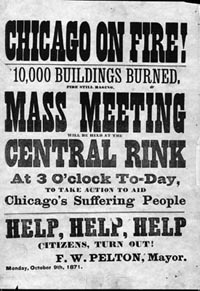 Relief groups immediately formed to help those who had lost family members or homes. Image courtesy of the Chicago Historical Society. |
This
Week in Disaster History: The Great Chicago Fire
Written by Christina Ward, Staff Writer, DisasterRelief.org
The summer of 1871 was hot and dry in Illinois. Only an inch and a half
of rain fell on Chicago from July 4th to early October Ñ the city was
parched. Firefighters had battled countless small fires for months, and
by autumn, the blazes had become commonplace. When yet another fire broke
out around 9 p.m. on October 8, 1871, near the cowshed of the O'Leary
family in Chicago's West Side, no one could have predicted its disastrous
consequences.
According to popular legend, Mrs. Catherine O'Leary, who ran a neighborhood
milk business, was milking her cow that Sunday evening when the animal
kicked over a lantern in the cowshed. Historians cannot confirm the cow's
role, and Mrs. O'Leary repeatedly denied the story, which seems to have
first appeared in the Oct. 9, 1871 issue of the Chicago Evening Journal.
Most agree, however, that the O'Leary's cowshed at 137 De Koven Street
was the location of the first spark. Barn fires were not unusual at that
time, and most were extinguished quickly. But on this evening, due to
some confusion among the city's fire watchmen, the fire department mistakenly
sent a team to the wrong street, a mile away from the blaze. By the time
firefighters arrived at the O'Leary's, the flames were out of control.
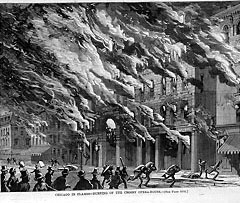
After racing through the West Side for several hours, the fire ignited
Chicago's business district by 1:30 a.m. on Oct. 9. It went on to burn
for a total of 29 hours, blazing through more than 2,000 acres. Rain began
to fall on Monday night around midnight, finally extinguishing the flames.
Between 250 and 300 people were killed and 100,000 people were left homeless.
More than 17,400 buildings were destroyed. Property loss was estimated
at $200 million. A City Ripe for Fire Whether or not Mrs. O'Leary and
her cow started the fire, the blame cannot be placed on a single person
or incident. Several characteristics of pre-fire Chicago contributed to
the disaster.
According to The Great Chicago
Fire Web site, a joint project of the Chicago Historical Society and
Northwestern University, one major problem was the construction material
of choice for 19th century America: wood. The city was full of it. Countless
buildings were made out of or trimmed with wood; 57 miles of streets and
561 miles of sidewalk were paved with wood; lumber yards along the river
contained stacks and stacks of wood; and mills and factories churned out
wood products all day long.
Although the Great Chicago Fire received more worldwide attention, it
was not the only devastating fire to blaze through an American town on
the evening of Oct. 8, 1871 Ñ nor was it the worst. A massive wildfire
ripped through northeastern Wisconsin that same night, killing about 1,200
people, burning 1.25 million acres and causing millions of dollars in
damage to property and timberland. The Peshtigo, Wis., fire remains the
deadliest forest fire in U.S. history. For more on the Great Peshtigo
Fire, read this DisasterRelief.org story, published last year: Fire Danger
Rating System Heats Up New Fire Policy In addition, the Chicago Fire Department
was exhausted before the fire even began. Twenty fires had occurred in
the previous week, the largest of which started on Saturday night, Oct.
7 Ñ one day earlier. Most of the department's firemen had struggled with
that fire all night Saturday and through the day on Sunday. They had only
hours to rest or eat before the fire broke out at the O'Leary's. Furthermore,
much of their equipment, including the fire hose, was worn out and needed
repair. All in all, the Chicago firefighters were wholly unprepared for
the Oct. 8 catastrophe.
Nature didn't help. Fueled by the effects of a nearly rainless summer,
the fire was driven by a strong wind that blew from the southwest, sending
the flames directly toward the center of the city. Chicago residents watched
the blaze with interest at first, many peering out of buildings they thought
were "fireproof," but as houses began to crumble around them, it became
clear that few were safe. Families fled to the streets, racing to escape
the fire. Crowds and chaos ensued. Some people died when they were trapped
or crushed in their homes. Others were killed while trying to escape,
running across crumbling bridges and through collapsing underground tunnels.
Those who did make it out of the inferno gathered together on patches
of safe ground west and northwest of the city.
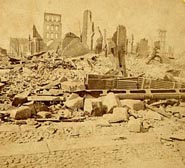
Even after the fire ended, Chicago remained so hot that it was two days
before any real damage assessment could begin. City officials dubbed the
damaged section of the city "The Burnt District," and it covered an area
about four miles long and three-quarters of a mile wide. Although the
fire started in the West Side, that area of the city was not the most
severely burned. (The O'Leary's house, incidentally, was completely spared.
The fire burned through the cowshed and avoided the main home.) The North
Division was hit the worst. An estimated 13,300 of the area's 13,800 buildings
went up in flames, leaving about 75,000 people homeless. In the days following
the fire, a group of city officials and prominent citizens came together
to organize a recovery plan.
They established a relief committee, which immediately began to distribute
any donated food, supplies or money to victims. Over the coming months,
about $5 million in donations would be sent to Chicago from all over the
world. Authorities also attempted to impose order amid the post-fire hysteria,
but at first, nothing could stop the thieves and other criminals from
taking advantage of the crippled city. According to the Chicago Evening
Journal on Oct. 11, 1871, "The city is infested with a horde of thieves,
burglars and cut-throats, bent on plunder, and who will not hesitate to
burn, pillage, and even murder, as opportunity may seem to offer to them
to do so with safety."
Chicago Mayor Roswell B. Mason placed Lieutenant-General Philip Sheridan,
a Civil War hero who had settled in Chicago, in charge of peacekeeping
for the city. Sheridan pulled together policemen, soldiers and volunteers
to create an impromptu military rule that patrolled the streets, arrested
looters and enforced curfews. The Chicago Relief and Aid Society took
over the long-term relief effort. For more than two years, this group
provided food, clothing and supplies to fire victims. The society distributed
several thousand kits for basic "shelter houses," enabling families to
erect their own temporary homes. Four homeless shelters also were opened.
About 64,000 smallpox vaccinations were administered.
Home
Front Page
© 2000 American National Red Cross. All rights reserved.