
Short Answers Review Final
Short Answer
1. How would conditions on Earth be different if Earth were not tilted on its axis? Explain your answer.
2. List the phases of the Moon, beginning with a full moon.
3. What is a black hole?
4. Identify the type of spectrum shown below and describe what causes the lines.
5. Describe the formation of clouds.
Use the graph to answer the following questions.
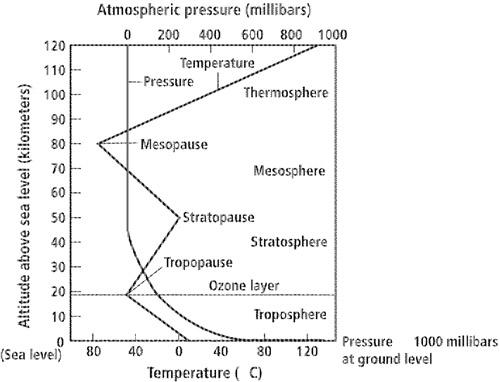
6. Do air pressure and temperature change in the same way with altitude? Explain your answer.
7. Describe the temperature changes that take place in each layer of the atmosphere.
8. Why does temperature increase with height in the stratosphere?
9. Describe the three conditions that must exist in order for a thunderstorm to form.
10. Why does the intensity of a hurricane diminsih rapidly when it moves over land?
11. Describe the formation of a tornado.
12. What is the thermocline?
13. What is the difference between a continental slope and a continental rise?
14. List several natural cycles that could cause climatic change on Earth.
Compare and contrast each pair of related terms or phrases.
15. apparent magnitude, absolute magnitude
16. aphelion, perihelion
17. terrestrial planets, gas giant planets
18. condensation, evaporation
19. conduction, convection
20. Fujita tornado intensity scale, Saffir-Simpson hurricane scale
21. fusion, fission
22. air mass, front
23. eye, eyewall
24. greenhouse effect, global warming
Problem
25. Fill in the chart below with the correct type of front. Use the following terms: cold front, occluded front, stationary front, warm front.
|
Movement of air masses |
Type of front |
|
An advancing warm air mass displaces a cold air mass and glides over the top of it. |
a. |
|
Two air masses with similar temperatures and pressures meet, and neither advances into the other's territory. |
b. |
|
A cold, dense air mass displaces a warm air mass and forces the warm air to rise steeply. |
c. |
|
A warm air mass is squeezed upward between two cold air masses. |
d. |