
| Chocobo | |
| Large Magical Beast | |
| Hit Dice: | 2d10+6 (17 hp) |
| Initiative: | +1 |
| Speed: | 60 ft. |
| Armor Class: | 16 (-1 size, +1 Dex, +6 natural) |
| Attack: | Bite +5 melee (1d8+4); or Kick +5 melee (1d8+4) |
| Full Attack: | Bite +5 melee (1d8+4) and Kick +5 melee (1d8+4) |
| Space/Reach: | 5 ft. by 10 ft./5 ft. |
| Special Qualities: | Resistant to magic, Sprint |
| Saves: | Fort +6, Ref +4, Will +4 |
| Abilities: | Str 18, Dex 16, Con 17, Int 5, Wis 12, Cha 9 |
| Skills: | Jump +2, Listen +1, Search +1 |
| Feats: | Improved Bull Rush, Weapon Focus (kick), Weapon Focus (bite), Run |
| Environment: | Any temperate land |
| Organization: | Solitary or flock (3-10) |
| Challenge Rating: | 1 |
| Treasure: | None |
| Alignment: | Always Neutral |
| Advancement: | 3-6 HD(Large) |
| Level Adjustment: | -- |
The chocobo is a large friendly bird that resembles an ostrich but instead has a large array of feathers, normally a bright canary yellow, though other colours are not unknown. Chocobos do good in just about every climate and condition and have been found in most terrain. They are usually found as mounts or beasts of burden. Standing about 8 feet tall, chocobos are exceptionally fleet of foot and are able to out run most everything.
Combat
With a resounding 'Wark', chocobos can attack opponents to the front with a vicious bite, or behind with an even nastier kick. They do not fear battle, and they make excellent war mounts.
Resistant to magic (Ex): Chocobos gain a +2 bonus on all saving throws against magical effects.
Sprint (Ex): Once an hour, a chocobo can take a charge action to move ten times its normal speed (600 feet).
Training a Chocobo
Chocobo eggs are worth 2,000 gp each on the open market, while young are worth 3,000 gp per head. Chocobos mature at about the age of two years. Professional trainers charge 2,000 gp to rear or train a chocobo, which serves its master with absolute faithfulness for life. Training a chocobo as an mount requires a successful Handle Animal check (DC 22 for a young creature, DC 29 for an adult) and that the creature be willing. Trainers can reduce the DC by 5 and the training time by half by using a magic bridle enchanted for the purpose. A chocobo can fight while carrying a rider, but the rider cannot also attack unless he or she succeeds at a Ride check (see Ride, Page 72 in the Player's Handbook). Carrying Capacity: A light load for a chocobo is up to 300 pounds; a medium load, 301-600 pounds; and a heavy load, 601-900 pounds. A chocobo can drag 4,500 pounds.

| Moogle | |
| Small Fey | |
| Hit Dice: | 3d6 (10 hp) |
| Initiative: | +7 |
| Speed: | 30 ft., fly 20 ft. (clumsy) |
| Armor Class: | 14 (+1 size, +3 Dex) |
| Attack: | Claw +5 melee (1d2-4) |
| Full Attack: | 2 claws +5 melee (1d2-4) and bite +0 melee (1d3-4) |
| Space/Reach: | 5 ft. by 5 ft./5 ft. |
| Special Attacks: | Moogle's Dance |
| Special Qualities: | Low-light vision, Feather fall |
| Saves: | Fort +1, Ref +6, Will +4 |
| Abilities: | Str 3, Dex 17, Con 10, Int 10, Wis 12, Cha 15 |
| Skills: | Animal Empathy +8, Diplomacy +8, Listen +7, Move Silently +13, Prefoem(dance) +10, Survival +7 |
| Feats: | Improved Initiative, Weapon Focus (bite), Weapon Focus (claw) |
| Environment: | Any temperate forest or mountain |
| Organization: | Solitary or family (2-5), or colony (10-30) |
| Challenge Rating: | 3 |
| Treasure: | Standard |
| Alignment: | Usually Neutral Good |
| Advancement: | By character class |
| Level Adjustment: | +2 |
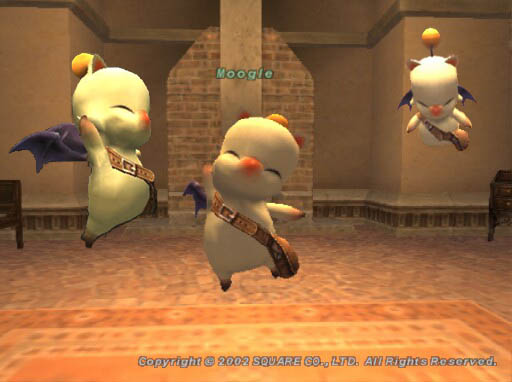
Moogles are small, tubby, teddybear like creatures that are often found in forests, but have been seen in caves and near settlements. Moogles have soft, white fur and tiny purple wings that barely hold them aloft, but the oddest feature on a moogle is the small pom-pom that is attached to the moogles head by a short antenna. Very intelligent, they are often able to speak common along with their native language which has been dubbed Kupo,(named so because the language is derived from that word, 'Ku kup ku kupo'). Most moogles are skilled dancers.
Combat
Moogles are quite cowardly and avoid battle if able, though if threatened can be fierce opponents. Some moogles use armor and weapons but usually they rely on their natural weapons and abilities.
Moogle's Dance (Ex): Moogles are able to do dances that seem almost magical. Depending on the dance a moogle is able to recreate a powerful spell, also the surrounding land resembles the area the dance is named after as per the hallucinatory terrain spell. All spells are cast as if the creature was a 3rd level spellcaster. A moogle can perform a dance only once every 1d4 rounds.
Desert Aria: This dance creates a small sandstorm that deals 1d4 damage and obscures the vision of all opponent in a 15 by 15 foot square designated by the moogle. During the dance the area surrounding becomes a sandy desert.
Forest Suite: This dance causes several vines to erupt from the ground, as the spell vine mine. During the dance the area surrounding becomes a ancient forest.
Love Sonata: This slow paced dance causes an enemy to see the moogle as a friend and do about anything it says, similar to the charm monster spell. During the dance the area surrounding becomes a blossoming garden.
Snowman Jazz: This dance creates sheets of ice and lumps of snow that cover the victims body for four rounds. If the victim resists the spell, the ice and snow instantly slough from its body, causing a mere 1d4 points of cold damage and ending the effect. If the victim fails to resist, the ice and snow cling tenaciously to its body and cause 1d8 points of cold damage per round. Each round, the victim can make a new Fortitude saving throw to avoid suffering damage that round. The second time a victim suffers damage, it becomes fatigued. The fourth time it suffers damage from the same dance, it becomes exhausted. During the dance the area surrounding becomes a snowy mountain top.
Wind Song: This quick dance causes the air around the moogle to course with energy, surging towards an enemy causing 2d6 damage. A reflex save halves this damage. During the dance the area surrounding becomes a grass covered plain.
Dusk Requiem: This dance mystically covers the area with a shimmering dust that lightly illuminates everything, as the glitterdust spell. This dance also causes a razor sharp stalagmite to burst forth from the ground to impale the targeted creature. Although the target gains a Reflex save to halve the damage done, the stalagmite itself is nonmagic and is not subject to spell resistance. Airborne creatures within 10 feet of the ground gain a +4 bonus on this save, and creatures higher than this cannot be harmed by this spell. The stalagmite is about 1 foot wide at its base and up to 10 feet tall. If it encounters a ceiling before it reaches full size, it stops growing. The sudden growth of the stalagmite does 1d6 points of piercing damage per caster level (maximum 15d6). In addition, a target that fails to make a saving throw against this spell and takes damage from it is impaled on the stalagmite and cannot move from its current location until it makes an Escape Artist check (DC 15). The stalagmite can be removed in other ways, as well, such as with a stone shape spell. The victim can even break free with a successful Strength check (DC 25), although this deals an additional 3d6 points of slashing damage on the victim. The damage caused by this spell is nonmagical, but it penetrates damage reduction as if it were a +1 weapon. During the dance the area surrounding becomes the inside of a stalagmite covered cavern.
Earth Blues: This jagged looking dance causes a violent movement of the earth as the earthquake spell. During the dance the area surrounding becomes a deserted rock quarry.
Water Rondo: This graceful dance creates a healing rain to fall upon all allies, as the spells create water and healing circle. During the dance the area surrounding becomes a bubbling brook.
| Moomba | |
| Small Monstrous Humanoid | |
| Hit Dice: | 3d8+6 (19 hp) |
| Initiative: | +1 (+1 Dex) |
| Speed: | 30 ft. |
| Armor Class: | 16 (+1 size, +1 Dex, +4 Natural) |
| Attack: | Claw 1d4+1, bite 1d8 |
| Full Attack: | 2 claws +4 melee1d4+1 and bite -1 melee (1d8) |
| Space/Reach: | 5 ft. by 5 ft./5 ft. |
| Special Attacks: | Pounce, Rake |
| Special Qualities: | Low-light vision, Scent, Sense Intentions |
| Saves: | Fort +3, Ref +4, Will +4 |
| Abilities: | Str 13, Dex 12, Con 15, Int 5, Wis 11, Cha 11 |
| Skills: | Listen +5, Spot +5, Survival +7 |
| Feats: | Multiattack |
| Environment: | Any temperate forest |
| Organization: | Solitary, pack (3-6), or pride (7-15) |
| Challenge Rating: | 2 |
| Treasure: | None |
| Alignment: | Always Neutral Good |
| Advancement: | -- |
| Level Adjustment: | -- |
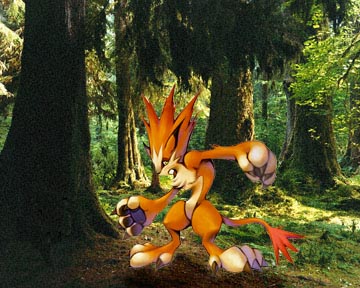
These gentle, lion-like humanoids stand upright but often use all four paws when running. Huge paws are characteristic of this species as is the fiery orange fur with patches of white on the snout, neck, and belly. Naturally friendly towards most everything, a moomba can uncannily tell the intentions of anyone around them and will distance themselves from an enemy. Moomba�s don�t speak a language but communicate through squeaks, purrs, growls, and body movement, although they seem to understand common.
Combat
Moombas are naturally friendly but are cunning in combat, using ambushes, feigned retreats, and attacks converging from various directions, bringing their razor-sharp claws against a foe.
Pounce (Ex): A moomba leaps upon a foe during the first round of combat, it can make a full attack even if it has already taken a move action.
Rake (Ex): A moomba that gets a hold can make two rake attacks (+4 melee) with its hind legs for 1d4+1 points of damage each. If the moomba pounces on an opponent, it can also rake.
Sense Intentions (Su): A moomba can sense the alignment of creatures around them as the spell detect alignment.

| Dolls | |
| Tiny Construct | |
| Hit Dice: | 2d10 (11 hp) |
| Initiative: | +2 (Dex) |
| Speed: | 20 ft. |
| Armor Class: | 14 (+2 size, +2 Dex) |
| Attack: | Bite/Scratch 1d4-1 and poison |
| Full Attack: | Bite/Scratch +2 melee (1d4-1) and poison |
| Space/Reach: | 2 1/2 ft. by 2 1/2 ft./ 0 ft. |
| Special Attacks: | Poison |
| Special Qualities: | Construct traits |
| Saves: | Fort +0, Ref +2, Will +1 |
| Abilities: | Str 8, Dex 15, Con --, Int 5, Wis 12, Cha 11 |
| Environment: | Any land and underground |
| Organization: | Solitary |
| Challenge Rating: | 1 |
| Treasure: | None |
| Alignment: | Always Neutral |
| Advancement: | 3-6 HD (Tiny) |
| Level Adjustment: | -- |
A doll is a diminutive servant created by a wizard. These creatures are weak combatants but make effective spies and scouts and make exellent familiers. Dolls are little more than tools designed to carry out assigned tasks. A doll cannot speak, but the process of creating one links it telepathically with its creator. It knows what its master knows and can convey to him or her everything it sees and hears, up to a range of 500 yards. A doll never travels beyond this range willingly, though it can be removed forcibly. If this occurs, the creature does everything in its power to regain contact with its master. An attack that destroys a doll deals its master 2d10 points of damage. If the creature�s master is slain, the doll also dies, and becomes a non-magical toy. A doll is a child�s stuffed toy brought to life. It has one of four forms: a moogle (bite attack), a moomba (bite or scratch attack), a tonberry (scratch attack), or a cactuar (scratch attack), which form is chosen at creation. In general one stands about 16-18 inches tall.
Combat
Dolls lunge upon their victims with their venomous bite or poisonous scratch.
Poison (Ex): Bite/scratch (chosen by which form is chosen at creation), Fortitude save (DC 11). During creation the spellcaster chooses which type of poison can be inflicted; sleep, strength damage, dexterity damage or just straight damage. Sleep; initial damage sleep for 1 minute, secondary damage for 5d6 minutes. Strength and Dexterity; initial damage 1 temporary Str or Dex loss, secondary damage 1d2 temporary Str or Dex loss. Damage; initial damage 1d2 hp, secondary damage 1d4 hp.
Construct traits: Immune to mind-influencing effects, poison, disease, and similar effects. Not subject to critical hits, subdual damage, ability damage, energy drain, or death from massive damage.
Construction
A doll costs 100 gp to create, including 20 gp for the body. This cost includes all the materials and spell components that are consumed by or become a permanent part of the creation. The first task is creating the body with cloth, cotton, silver thread and a pint of the creator�s own blood. Also depending on the form the creator also needs a special item. Moogle: a small nut. Moomba: cat whiskers. Cactuar: twelve cactus needles. Tonberry: A miniature mithral knife. The creature�s master may assemble the body or hire someone else to do the job. Creating the body requires a Craft (sewing) check (DC 12). After the body is assembled, it is animated through an extended magical ritual that requires a 5th-level character with the Craft Wondrous Item feat. This ritual requires a week to complete: The creator must labor for at least 8 hours each day in a specially prepared laboratory or workroom, similar to an alchemist�s laboratory and costing 500 gp to establish. If the creator is personally constructing the creature�s body, the building and ritual can be preformed together. A character not actively working on the ritual must rest and can perform no other activities except eating, sleeping, or talking. If he or she misses a day, the process fails, and the ritual must be started anew; any gp spent on the failed ritual is lost (but not XP). The previously crafted body can be reused, as can the laboratory. Completing the ritual requires casting animate object, arcane eye, and mending on the final day of the ritual and drains 25 XP from the creator. He or she must cast the spells personally, but they can come from outside sources, such as scrolls.
