Indian Art
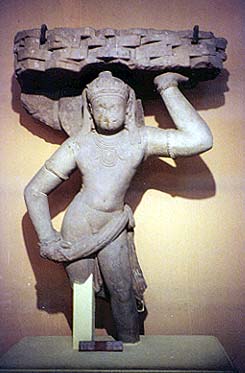
The major themes of Indian art seem to begin emerging as early as the Harappan period, about 2500 BC. Although we're still not sure, some Harappan images look like later images of Vishnu and Shiva, and the tradition may start this early.
With the arrival of the Indo-Europeans (or Aryans) around 1500 BC, came new artistic ideas.
Around 500 BC, the conversion to Buddhism of a large part of the population of India
brought with it some new artistic themes. But at first nobody made images of the Buddha
- only stupas (STOO-pahs), symbolic repreesentations that didn't look like a person.
Then the conquests of Alexander the Great, in the 320's BC, also had an important impact
on Indian art. Alexander left colonies of Greek veteran soldiers in Afghanistan and
Pakistan, and these soldiers attracted Greek sculptors (maybe some of the soldiers were
sculptors). Their Greek-style carvings attracted attention in India - the first life-size stone
statues in India date to the 200's BC, just after Alexander.
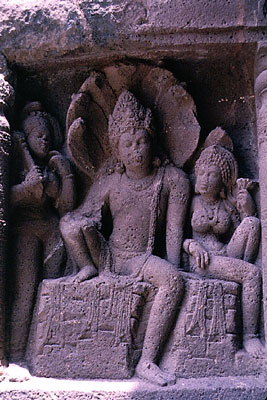
During the Guptan period, about 500 AD, the great cave temples of Ajanta and
Ellora were carved. Scenes from the life of the Buddha became popular, and statues of
the Buddha.
Finally, the arrival of the Islamic faith and Islamic conquerors about 1000 AD brought
iconoclasm to India, and a love of varied and complex patterning derived from
Arabic and Persian models. This affected even Hindu artists who had not converted to
Islam. Small Persian-style miniature paintings also became popular.
Eyewitness India, by Manini Chatterjee (2002). Written for kids. It's not specifically
about Indian art, but you'll find information about Indian art in this book.
Ancient India, by Virginia Schomp (2005). Written for middle schoolers. Again, not
specifically about Indian art, but very good for reports, and there is information about
Indian art.
Indian Art (Oxford History of Art), by Partha Mitter (2001). Not especially for kids, but a
good survey of Indian art for ordinary people, going from ancient India to modern India.
Indian Art, by Vidya Dehejia (1997). Also written for adults, but the author's the curator
of Indian art at the Smithsonian Institution. She emphasizes the close relationship
between Indian art and religion.
 Eyewitness India, by Manini Chatterjee (2002). Written for kids. It's not specifically