
THE GIRAFFE
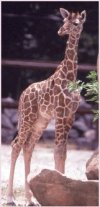 The giraffe (Giraffa camelopardalis) is often referred to as "the animal built by a committee," an assemblage of left-over parts, put together after the creator had run slap out of ideas. This animal however is superbly adapted for feeding on the high foliage that other hoofed mammals can't get to.
They are found in Africa south of the Sahara in open woodland and wood grasslands. When you hear the name Giraffe, an image immediately pops into your mind. That is, you see a short lengthed body in relation to the pronounced length of the neck. This is then exaggerated by the height of the legs, with the forelegs being longer than the hind and creating an image of a continual slope from it's horn tips to it's tail. The hoofs (which are about the size of a soup plate) are used as offensive weapons, for one powerful kick from the front feet can kill a lion. The hide on a Giraffe is thick for their defense. Males can reach a height (to horn tips) of 4.7-5.3 meters (15-17 feet) and a weight of 800-1,930 kilograms (1,765-4,255 pounds). The female is slightly shorter reaching a height of 3.9-4.5 kilograms (13-15 feet) and reaches a weight of 550-1,180 kilograms (1,213-2,601 pounds). The usual colour of a Giraffe is orange-brown, russet or almost black separated by a pattern of cream-buff lines.
The main food source of the giraffe is acacia leaves, these leaves supply the giraffe with most of it's liquid nutrients. They will also eat, other shoots and stems, flowers, vines, herbs, and sometimes even weaver-birds nests (with the young). They will eat on average for 16-20 hours a day gaining up to 140 pounds of fresh foods. A giraffe can go for more than a month without drinking, and the few times it does drink, the animal must spread the long forelegs widely to reach the water. This awkward posture is why a giraffe rarely grazes grass. When a giraffe vocalizes, it emits moans or low notes. A giraffe usually sleeps in standing position. The giraffe has keen sight, smell, and hearing.
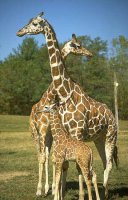 When a giraffe walk, it will move the 2 feet of one side simultaneously, and when the giraffe gallops, it moves with the hind feet reaching in front of the fore feet and the neck swinging widely, giving the appearance of slow motion, although it can reach 56 km/h (35 mph). The giraffe's great weight makes it unable to traverse boggy swamps or riverbeds. On dry, hard land, however, it ranges widely and sometimes is found hundreds of kilometers from water.
Giraffes congregate in loosely organized herds of two to ten members, with individuals often joining and leaving again. Each herd is led by an adult bull and consists of cows, calves, and sexually immature males. During mating season males vie for females by butting each other with their heavy necks and heads. After about 15 months a cow bears a single calf, 1.7 to 2 m (5.6 to 6 ft) high, which can stand 20 minutes after birth. Calves come to sexual maturity in about four years.
GIRAFFE TIDBIT
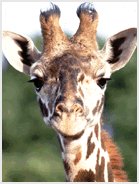
The giraffe's heart is an enormous two feet long and twenty-five pounds, with muscular walls several inches thick, driving the highest known blood pressure in any mammal: up to 280/180 mm Hg (millimeters of mercury) at heart level when prone, or more than twice that of ours. The heart beats up to 170 times a minute - also double our own. Amazing isn't it!