
Gorilla gorilla berengei
(Endangered)
Phylum: Chordata
Subphylum: Vertebrata (backbones)
Class: Mammalia (warm-blooded with fur and mammary glands)
Order: Primates
Family: Pongidae
Genus: Gorilla
Species: gorilla
Subspecies: beringei
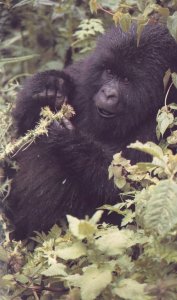 Found only in the Virunga mountains of southwest Uganda, morthwest Rwanda, and eastern Zaire. They are the rarest and largest of the three subspecies of gorilla's. They have the largest jaws and teeth and the longest black hair. Adult males can weigh up to 400 pounds or more and reach a height of 6 feet. The male's can weigh up to twice the size of the females.
Due to disease, civil war, poaching and continual habitat loss there remains only around 600 mountain gorilla's in the wild. They live in groups ranging from 3 to 30 creatures consisting of a dominant male (the silverback) who leads, a few submissive males, females and the young. They have a quiet, shy attitude. They have very long arms (longer than the legs) and a short bulky body with a wide chest and have no tail. Their head is very large with a bulging forehead with a crest of top - This crest is larger on the males. The also have tiny ears, and small dark-brown eyes. The long silky black hair covers everything but it's face, fingers, palms, underarms, and soles of the feet. They have 5 fingers and 5 toes (one of those being an opposable "thumb") They also have a unique nose print..a lot like our unqiue fingerprints. The senses are a lot like ours also including hearing, sight - which seems to be slightly nearsighted and with colour vision, smell, taste and touch. Males are called 'silverbacks' because of the saddle-shaped patch of silver hair on their backs. They obtain this patch around the age of 12 years.
The foods in it's vegetarian diet is the tender shoots of bamboo, roots stems, leaves, vines, fruits and flowers. They seldom drink water as their diet provides the liquid they need. Sometimes they will supplement their diet with termites and ants. Males can eat up to 50 pounds of food a day.
They are almost an entirely ground-dwelling species. The gorilla's prefer open-canopy forests that allow the light to reach the floor. They are diurnal animals (active throughout the day). The major occupation among a band of gorilla's in Grooming on another (cleaning the hair of another gorilla). Female's will often groom their offspring, each other and the silverback. The silverback does not groom others though. Each evening, the gorilla's will construct "nests" for the night to sleep in. These nests are made of leaves and other plant material. A Nest is shared only by a mother and her offspring. A gorilla walks using both the legs and the long arms (putting pressure on their knuckles, with the fingers rolled into the hand) They will rarely walk on only their legs. They can climb trees, however they do not do this very often and they cannot swim.
The action of a male gorilla beating it's chest - also known as Drumming - is a type of a warning to other gorilla's and intruders. It also serves sometimes as a form of communication to other groups. Contrary to the beliefs and movies, gorilla's are not aggressive animals. When disturbed they will make a lot of noise but will rarely confront another animal.
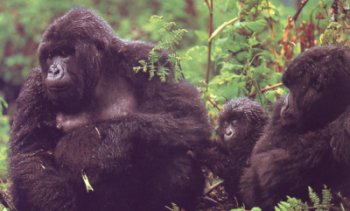 Gorilla's are sexually dimorphic. Around the age of eleven, the male's reach sexual maturity and begin to dominate most females during aggressive interactions. Male protection is essential to female reproductive success. The female actively chooses her breeding partner, usually the older more experienced silverback males. Female gorilla's remain pregnant for around 8 to 9.5 months (a lot like us) and have about 3 babies in their lifetime. The newborn gorilla's weigh only about 1.4 to 1.8 kilograms (3-4 pounds) at birth (which is about half the weight of a newborn human). The baby gorilla's learn to crawl around the age of 2 months and can walk before 9 months. They can grasp their mother's fur for travel around 4 months. They are fed their mother's milk for the first 2 1/2 years of life. When weaned, the young gorilla will start building it's own nest to sleep in. The young will stay with the mother for 3-4 years.