
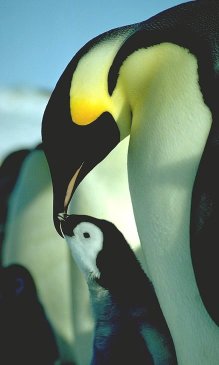
The Emporers arrive in April. Their eggs are layed in May - which will then hatch in July. And the babies will leave around December/January. Reproduction occurs on the ice shelf between Carrel Island and the nunatak in a single colony. The males, after the female lays the egg, will take care of the sitting by incubating the egg on his feet - tucked under a flap of skin (kind of like an upside down pouch). As they do this for up to 4 months they will lose half their body weight (20kg). During storms - and to minimize heat loss - the males will gather together in 'turtles' that can have up to 10 individuals per metre squared. After the chick is born (around August) both the male and the female look after it, recognized by it's voice, they take turns out at sea every 2 weeks.
Emporer Penguins can swim up to 60 km/h. The deepest dives recorded are 16 mins at 534 m for a male and 15 mins at 477m for a female. The average dive is 5-6 mins at 100m.
Large Penguins
~ Emporer Penguin ~ King Penguin
Brush-Tailed Penguins
~ Adelie Penguin ~ Chinstrap Penguin ~ Gentoo Penguin
Crested Penguins
~ Macaron Penguin ~ Royal Penguin ~ Erect-Crested Penguin ~ Snares Penguin ~ Fordland Penguin ~ Rockhopper Penguin
Banded Penguins
~ African Penguin ~ Humboldt Penguin ~ Magellanic Penguin ~ Galapagos Penguin
Yellow-Eyed Penguins
~ Yellow-eyed Penguin
Little Penguins
~ Little (Fairy) Penguins
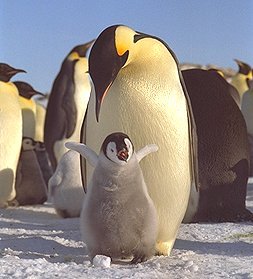
All penguin pictures are copyright of Gillaume Dargaud
POLAR BEARS
Polar Bears (Ursis Maritimus)spend most of their time on ice floes in the Northern Arctic. They are the largest land carnivore (meat-eater) in the world and are the largest of the bear family. They have an off-white body fur with black nose, eyes and mouth.The average height and weight of the polar bear can reach is, for a male - 2.6m (8.5ft) weighing in at around 900lbs and for a female - 2m (6.5ft) weighing in at around 500lbs.
Polar Bears are known for their unique adaptation to tolerate the cold. Their skin is actually black, which allows the heat to soak up into them. They are also known for their excellent ability to swim. You can find them swimming from ice floe to ice floe. They swim by using the "doggy-paddle" with their head and most of their backs out of the water. Swimming at an average of about 6 miles per hour, they have their blubber to help them float.
The Polar Bear has a diet consisting of mainly seals. They will, however, eat other mammals, eggs, vegetation, and beach-cast carrion. An interesting fact is that Polar Bears do not drink water. They get their liquids from their meals. Have you ever watched a Polar Bear catch is seal dinner?! It is rather interesting. They will search for a seal air hole and wait patiently and quietly for the seal to come up for air, and then just scoop him up and...Yuummmmmy *grin* Seal Dinner.
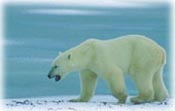
The Polar Bear is generally a solitary creature unless around mating time, which occurs April through June producing 1-3 cubs every 28 months. They reach their sexual maturity around the age of 4-8 years and may live anywhere between 25 to 30 years. The males will pair with more than one female around the breeding time.

 This Web Maniac's Arctic Circle
site is owned by
This Web Maniac's Arctic Circle
site is owned by Madi. Want to join Web Maniac's Arctic CircleWebRing? |
|---|
| [Skip Prev] [Prev] [Next] [Skip Next] [Random] [Next 5] [List Sites] |


 .
.