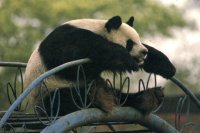
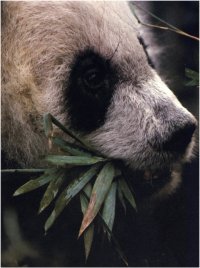
 The Giant Panda is also known as the Panda Bear, Bamboo Bear or Daxionmao (Chinese which means 'large bear cat'). The Giant Panda is among the rarest of mammals in the world, with below 1,000 left in the wild. They can only be found in China in the cold, damp coniferous forests around the elevation of 1,200 to 3,400 metres ( 4,000 to 11,000 feet) high. Although the adult panda has few natural enemies, the young are sometimes prey for a hungry leopard. The size of a Panda Bear is generally that of the American black bear or the Asiatic black bear. Generally an adult Panda will reach the height of 160 to 180 centimeters (5 1/4 to 6 feet). An adult male will weigh around 80 and 125 kilograms (176 and 276 pounds) with females weighing around 10-20% less. In the wild, the Panda can live around 25 years maybe more.
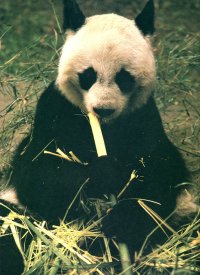 The Panda Bear has a massive head, heavy body, short tail, rounded ears and plantigrade feet (meaning when a panda moves, it moves in a similar way to a human where both heel and toe make contact with the ground). The Panda bear has very distinct colouring, with white fur containing black patches on the eyes, ears, legs, feet, chest, and shoulders. In it's natural habitat this colouring camouflage's it. The fur is very thick and very oily to the touch. This helps protect the panda from the cool and damp climate in which it lives. The claws of a Panda bear allow it to climb trees relatively easy. Evolution has changed the Panda considerably, such as the enlarged wrist bone that works in the manner of an opposable thumb. This 'opposable thumb' allows the bear to manipulate their food source with dexterity and precision.
The bulk (99%) of the Panda bear's diet consists of bamboo leaves, stems and shoots. Because of their inefficient intestinal system, the Panda must eat great quantities of food to survive. They will eat for 12-16 hours per day consuming around 10 to 18 kilograms (22 to 40 pounds) of bamboo leaves and stems. When consuming fresh foods, the intake raises to about 38 kg (84lbs) per day. Studies have shown that the Panda bear is generally a solitary creature. The Panda is one of the four bears that do NOT hibernate. There are 2 plausible reasons for this. One, their food source prevents them from storing sufficient fat resources to last a lengthy period of hibernation. Secondly, the climate allows for their food to be available the whole year round.