

KOALA'S
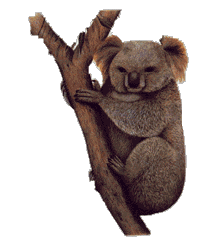
Koala's are marsupials which live mainly in specific trees by the name of Eucalyptus Trees. These trees are normally poisonous to other animals including humans. One thing for Koala's is that they will never have bad breath *grin*. Koala's carry their babies in pouches, much like Kangaroos. Sometimes a mother will ignore her baby leaving another mother to carry both it's child and that of the lazy parent. People get the idea that Koala's are bears, they are NOT bears. Koala's have a woolly coat, large fluffy ears, a bulbous nose and almost no tail. Koala's are very very territorial, mainly sticking to the one area or tree they are in. They have a slow metabolic rate because of their high fibre, low nutrient diet, and because these marsupials store little to no fat, they must adopt strategies to conserve their energy. One of these strategies is sleeping. Koala's are found only in certain parts of Australia and around 80% of these have been destroyed due to their local habitats being annihilated for our land development. If touched on the face, a koala will retaliate in an attacking manor because that is the way males fight..Attacking the face.
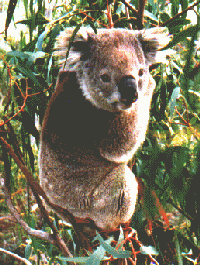 A photo by P.Wright
TASMANIAN DEVIL'S
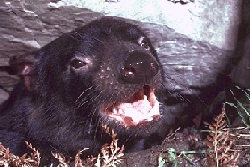
Tasmanian Devil's are carnivorous marsupial's and are found only in Tasmania's forests and scrub area's, although they used to be found also on Australia's mainland. Devil's are nocturnal and are named by European settlers due to their eerie growl which starts sounding like a whistle and ends in a bark. Tasmanian Devil's have a reputation for their ferocity and the strongest jaws. The Devil can grow up to 4 feet long with a large head and is very strong for it's size, sometimes preying on animals larger than itself. Their diet consists of small mammals, reptiles and also they scavange on dead animals and devour their entire prey. The Tasmanian Devil's destruction is due to it's attack on poultry, livestock and other mammals.
KANGAROO'S
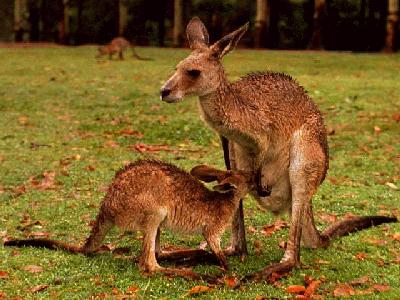
European Explorer's saw these creatures and asked the Aborigine's "What are these animals?" and the aborgine's replied "Kangaroo" (meaning "I don't understand you") So the European's named these bouncing creature's Kangaroo's. Kangaroo's are generally called "Roo's" with about 60 different kinds and 12 relatives called 'Rat Kangaroo's'. The males are always larger, called a boomer than the females, called aflyer with the smallest species being a Warabi Rock Wallaby wieghing in at 2 pounds and the largest being a male Red/Grey weighing 200 pounds. Kangaroo's can sprint 40mph over a 1-2 mile distance and 20mph over 10 miles or more. Roo's need their tails for balance so if you lift a kangaroo's tail it will not be able to hop. The Roo is a shy, mainly nocturnal creature but some species will be active at dawn and dusk, they spend the day lazing about in the shade. They can live up to 20 years in captivity but last only about 6 years in the wild. In the last 12 months a virus has spread like an epidemic in Western Greys, Eastern Greys and in some of the Red's where they are going blind, permanently. Some have adjusted, but many die due to starvation and such.
ADDITIONAL ROO LINKS
Kangaroo's Haven
Chris' Joey Haven
Kangaroo Facts
CASSOWARY
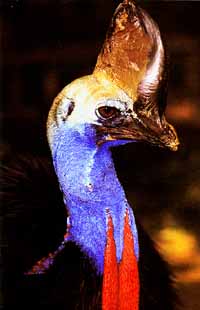
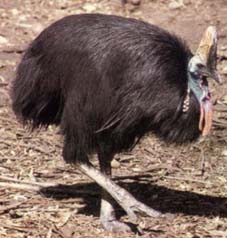
The Cassowary is a large, flightless bird found in the swamplands and rainforest's of Australia and New Guinea. This bird can grow up to 2 meters in height, standing around 1.2 to 1.8m (roughly 4 to 6 ft). The weight can get as heavy as 60kgs (130lbs).
SUGAR GLIDER'S
TAXONOMIC CLASSIFICATION
CLASS: Mammalia
SUBCLASS: Marsupialia
ORDER: Diprotodontia
SUBORDER: Phalangerida
SUPERFAMILY: Petauroidea
FAMILY: Petauridae
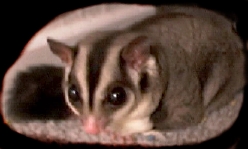
The Sugar Glider (Petaurus breviceps) is a marsupial native to Australia and Indonesia. A marsupial is an animal which carries their babies in a pouch.
PLATYPUS
Platys ="Broad", pous ="foot" -
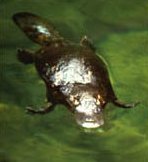
The Platypus (Ornithorhynchus anatinus) is an egg-laying mammal native to Southern and Eastern Australia as well as Tasmania. This mammal plus the echidna make up the order Monotremata (a name applied to egg-laying mammals). This rather unusual looking monotreme has a ducklike bill and webbed feet. It's body is eggshaped and reaches a length of 36cm (14in). The tail of the Platypus adds an extra 13cm (5in) to it's overall length. With no apparent neck, the head is it's most unusual feature. The head is small and is accentuated by a ducklike bill. This bill is used for stirring up mud at the bottom of rivers in order to uncover it's meal. The platypus' meal consists mainly of insects, worms and shellfish.
The adult male has a hollow, horny spur on the inner side of the hind leg. This spur will excrete a toxic fluid in it's defense. These particular monotreme's are very very shy and nocturnal animals. You are indeed luck to have spotted one of these creatures in it's habitat. The Platypus is a wonderful diver and swimmer, but do not have much in the way of it's defense therefore they build long, winding burrows (usually dug by the females) deep into the banks of rivers and streams.