
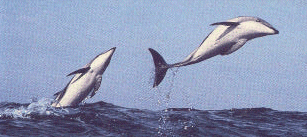
The Tursiops truncatus or more commonly known as the Bottlenose Dolphin is
the most recognized of all the dolphins. This is "Flipper". It's short,
stubby beak is how it got it's name - "Bottlenose". The Bottlenose dolphin generally has a colouring ranging from a light gray
to slate gray on the upper part of the body, then shading to lighter sides and last but not lease is the
pale, pinkish gray on the belly. The belly and lower sides are sometimes even spotted.
The bottlenose dolphin has more flexibility in its neck than many of the other
oceanic dolphins. The reason being 5 of the 7 neck vertebrae that are not fused together as in the other dolphins. In each side of its jaw,
there are 18-26 pairs of sharp, conical teeth. They have a maximum life span of about 25 years.
A bottlenose can reach a length ranging from 6-12 feet (1.9-3.8 m). They can weigh as much as 1430 pounds (650 kg) off the coast of Great Britain,
though most are much smaller in other parts of the world. Males are somewhat larger than females.
Their feeding behavior is diverse. They can range from coordinated efforts to catch food, to chasing fish into mudbanks, and even feeding in association with human fishing.
An adult bottlenose dolphin may consume 15-30 pounds (8-15 kg) of food each day. They eat a wide selection of food, including fishes, squid, and crustaceans. They fish mostly at the surface
of the water. They live in small pods of up to 12 bodies and are known to be very social animals. Often, many pods group together to form congregations of hundreds of dolphins.
Dolphins can dive down to more than 1,000 feet (300 m) and can jump up
to 20 feet (6 m) out of the water.
Dolphins breathe air at the surface of the water through a single
blowhole located near the top of the head. They need to breathe
about every 2 minutes, but can hold their breath for several minutes. Their blow is a single,
explosive cloud.
Males reach sexual maturity at about 11 years, while the females reach sexual maturity at about 5-7 years. The gestation period is 12 months.
Calving can take place year-round with peaks in some areas during spring and fall. Calves nurse for over a year (12-18 months), and stay with their
mothers for up to three years learning how to catch fish and other important tasks.
Endangered
Kingdom: Animalia
Phylum: Chordata
Class: Mammalia
Order: Cetacea
Family: Balaenopteridae
Genus Balaenoptera
Species: Balaenoptera musculus
The Blue whale is the largest living animal, and is found in all oceans of the world, from the tropics to the edges of the edges of the drift ice in polar waters. They live in the open oceans. An average Blue whale is between 75 and 80 feet (23 to 24.5 m) long, and weighs about 110 tons (99,800 kg). The females are larger than males of the same age, the largest perhaps weighing as much as 150 tons (136,000 kg). Though they may be found singly or in small groups, it is more common to see blue whales in pairs. They are sometimes seen in larger groups and loosely defined concentrations of 50-60 have been observed. They are fast, strong swimmers, capable of reaching 30 mph (48.3 km/hr) when alarmed, but they usually cruise along at about 12 mph (19.3 km/hr). Normal dives last from 10-20 minutes and are separated by 8-15 blows. The blue whale makes deep and rumbling sounds which can be felt as much as heard. These low-frequency sounds travel long distances through water, allowing blue whales to communicate with each other over hundreds of miles of ocean.
They are mottled bluish-gray on their backs and sides. Their bellies are a yellowish colour due to the growth of tiny plants called diatoms, this has caused to also be named �sulphur bottom� whales. Its body is long, somewhat tapered, and streamlined, with the head making up less than one-fourth of its total body length. The head is wide and flat, and the dorsal fin is very small (one foot high) and may not be visible except when they begin to dive. Its rostrum (upper part of the head) is very broad and flat and almost U-shaped, with a single ridge that extends just forward of the blowholes to the tip of the snout.There are 50-90 throat grooves that extend from the chin to just beyond the navel.
The Blue whale, like the Baleen Whale, has a series of 260-400 fringed overlapping plates hanging from each side of the upper jaw, where teeth might otherwise be located. These plates consist of a fingernail-like material called keratin that frays out into fine hairs on the ends inside the mouth near the tongue. The plates are black and measure about 20 inches (51 cm) in length toward the front of the mouth and about 40 inches (102 cm) at the rear. During feeding, large volumes of water and food can be taken into the mouth because the pleated grooves in the throat expand. As the mouth closes water is expelled through the baleen plates, which trap the food on the inside near the tongue to be swallowed. Feeding is usually at depths less than 100 m. Blue whales feed on krill (also known as euphausiids)and may consume several tons each day. During the summer feeding season the blue whale gorges itself, consuming an astounding 4 tons (3.6 metric tons) or more each day. This means it may eat up to 40 million krill a day.
Sexual maturity occurs as young as 8 or 9 years and young are produced every 2 or 3 years. The gestation period is eleven or twelve months long, unusually short for an animal its size. Young are born in warm, low latitude waters in the winter months after the adults return from their high latitude feeding grounds. At birth the young are 7-8 m long. While nursing, blue whales can gain up to 90 kg in body weight a day. Young are weaned after seven or eight months, usually after attaining a length of 16 m. Twins are rare but do occur occassionally. Longevity has been estimated to be as high as 110 years.
Kingdom - Animalia
Phylum - Chordata
Subphylum - Vertebrata
Class - Chondrichthyes
Subclass - Elasmobranchii
Order - Lamniformes
Family - Lamnidae
Genus - Carcharodon
Species - carcharias
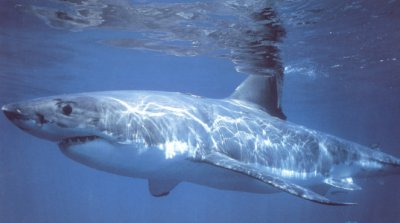 When you hear the word shark, you generally imagine a Great White *grin*. The Great White is also knowns as the White Pointer and the White Death. The Great White is the star of "Jaws". Impressive by any standard, the great white shark is the world's largest predatory fish, reaching a length ranging anywhere from 15-36 feet in length. The Great white can be found worldwide in temperate and subtropical seas. They can be found in waters as shallow as 3 feet deep but have also been found at depths as deep as 1280 meters, and can reach a swimming speed of around 25 mph.
The Great White has a dull grey back and a white underside. It's body is spindle shaped with a long conical snout and long gill slits. The very sharp teeth are triangularly shaped with serrations on the edges. There is a large caudal fin with both the upper lobe and lower lobe being approximately the same in size. The caudal keel is very strong.
While the movies may have given us the impression that Great Whites hunt humans, their diet really consists of seals, sea lions, dolphins, and fishes including other sharks. Attacks on humans are extremely rare, and are most probably cases of mistaken identity -- a human floating on a surfboard looks surprisingly like a sea lion or seal from below. They tend to cruise at the sea bottom while keeping an eye out for shapes on the surface. If a Great White sees a shape resembling that of a seal, it will make a full speed charge at that shape. Then the shark will ram it and give it a first bite all in one movement, stunning and injuring the prey. The Great White will then dissappear and allow it's prey to bleed to death. When the shark is certain that the prey is dead, it will then begin to feed. The Great White is a voracious and efficient predator, its prey includes a wide variety of bony fishes, including salmon, hake, halibut, mackerel and tunas, other sharks, sea turtles, seabirds, and marine mammals. The young eat mainly just fish, but as they age they start eating all the other foods listed.
Great White sharks are ovoviviparous (that is, egg bearing) and give birth to 2 - 14 fully-formed pups that can be 5 feet long. Like all sharks, fertilization of the eggs occurs within the female. The eggs hatch within the female. No placenta nourishes the babies. They must fend for themselves, even before birth and swim away from the mother immediately after birth.
LINKS
CETACEA
SEA WORLD DOLPHINS


 .
.