|
[Dragon
Stone Index]
These
are a few types of dragon from mythology, legend, and folklore...
Chiao
Chiao, Chiao-Lung, or Kiao, are the scaled dragons. Some Chiao are said
to start life as fish, and turn into Chiao apon reaching a great age.
According to some sources they symbolise the statesman.
Cockatrice
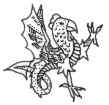
The cockatrice
is a hybrid of a cock and a wyvern. It hatches from a nine-year old
cocks egg, incubated by a toad, on a dunghill. The cockatrice is also
known as the basilisk. Sometimes a basilisk will have a dragons head at
the end of its tail.
Other Pages:
Heraldry - Draconic
Creatures
Dragon Kings
These dragons originate from China. Though there are four high Dragon
King's there are many local ones. The local Dragon Kings were much more
respected. Every well and watercourse has its own Dragon King. In
northern China beside every well is the Dragon King's tiny temple with a
statue of it. Dragon Kings are resorted to when there is too much or too
little rain. The Dragon King is approached with the request, and if it
is not granted within a certain time action is taken. For example, the
statue of the Dragon King may be left by the side of the road, to cause
it discomfort so that it grants the request. If a request is granted
then there is a celebration to honour the Dragon King.
The idea of
Dragon Kings also spread to other countries, such as Japan.
Other Pages:
Dragon List - Dragon
Kings; Rinjin;
Chi Lung
Wang; Vietnamese
Dragon King
Eastern Dragons / Oriental Dragons
These are dragons originating from countries such as Japan, China, and
Vietnam. Many of the types are not mutually exclusive. For example a
Chiao may be horned (Li) or without horns (Kiu). The types of Eastern
dragon listed on this page are:
Chiao
[China]; Dragon
Kings [Various]; Kiu
[China]; Li
[China]; Lung
[China]; Mang
[China]; Pa
Snake [China]; Tatsu
[Japan]; Ying-Lung
[China]
Other Pages:
Dragon List - Dragon
Kings; O
Goncho; Rinjin;
Chi Lung
Wang; Vietnamese
Dragon King
Firedrakes
Firedrakes are usually from Germanic or Celtic mythology. They often
live in caves and guard great treasure. They breath fire to defend
themselves. One example is the firedrake killed by Beowulf and Wiglaf,
which was guarding a hoard of gold.
Husormen
Norwegian house serpents.
Kiu
Kiu, or Kiu-Lung, are horned Chinese dragons. According to the Yuen Kien
Lei Han, dragons gain horns after 500 years.
Li
Li, or Li-Lung, of Chih-Lung, are hornless Chinese dragons. They may
symbolise the scholar. According to the Yuen Kien Lei Han, dragons gain
horns after 500 years.
Lindworm
Lindworms look like Wyverns,
but without legs. They eat cattle and bodies, and invade churchyards.
Lindworms symbolise war and pestilence. Also called a Lindorm snake.
Other Pages:
Heraldry - Draconic
Creatures
Lung
The Chinese Imperial dragon, whose head points South, and whose tail
points North. They have five claws on each foot. They symbolise the
rain, the East and the sun.
Mang
Mang have four claws on each foot. They symbolise temporal power. They
are a type of Chinese dragon.
Mlokoky Smij
These are milk dragons from Lithuania. They provide milk for the dairies
of good wives.
Moko/Mo'o
Moko, or Mo'o is a Polynesians term meaning lizard, or taniwha. It can
refer to both Polynesian dragons (taniwha) and any other lizard. Some
taniwha, and other great lizards, have moko or mo'o in their names. Moko
and Mo'o mean the same thing. Which is used depends on the region.
Related Types: Taniwha
| Other Pages: Dragon List - Moko;
Mo-o-inanea
Pa Snakes
These Chinese serpent-dragons are huge, and eat elephants. Three years
after swallowing the elephant, they spit out its bones. Serpent-dragons
that devour elephants appear in most places that have elephants.
Peist
The peist are the dragons of Ireland. These dragons are water-dwellers.
When St. Patrick drove the snakes out of Ireland, he imprisoned the
peist in their home, the water.
Other Pages:
Dragon List - Ollipeist
Penezny Smij
Penezny Smij are Lithuanian penny dragons, who bring wealth. They leave
out a 3 penny piece, and if you pick it up, leave a 6 penny piece in the
same place the next day. If this is picked up, they leave you a dollar.
If you take the dollar, all is well. If you don't, they set your house
on fire. The only way to get rid of the dollar is to sell it for less
than it is worth.
Puk
Puk are small four-footed dragons. These household spirits bring stolen
goods to their masters. The idea of puks spread outwards from Germany,
though they may have originated in Scandinavia or Britain. There are
many regional names for these creatures. Some of the more common
alternatives are pukys in Lithuania, puuk in Estonia, and pukis in
Latvia.
Taniwha
These are the dragons of the Polynesians. Some are water-dwelling, some
are not. Some burrow in the sand to hide themselves, some live in
caves... there is a great variety among taniwha. Their common trait is
they are all enormous lizards.
Other Pages:
Dragon List - Hotu-puku;
Peke-haua;
Kataore
Tatsu
These are Japanese dragons, with three claws on each foot. They live in
lakes and springs. They represent the Mikado, imperial power, and
spiritual power. Tatsu are based on an early type of Chinese dragon.
Western Dragons
These are dragons originating in places like Europe. The types of
Western dragon listed on this page are:
Cockatrice;
Firedrakes;
Husormen;
Lindworm;
Mlokoky
Smij; Peist;
Penezny
Smij; Puk;
Wyvern;
Zaltys;
Zitny
Smij
Wyvern
Wyverns look a bit like serpents. They have wings, and two legs. These
legs look like eagle's talons. They also have a barbed tail. These
dragons symbolise envy, war, pestilence, and viciousness. They are
common in heraldry. Wyverns without wings are called Lindworms.
Other Pages:
Heraldry - Draconic
Creatures
Ying-Lung
The Chinese winged dragon. According to the Yuen Kien Lei Han, dragons
gain wings after 1000 years. The Ying-Lung is said to lack scales.
Zaltys
These serpents are guardians of the home. In modern Baltic tradition,
they live by the stove, and are sacred to Saule (a sun goddess -
guardian of fire). The basic zaltys is known to be a species of grass
snake found in the region. However, some zaltys myths bear much more in
common with dragon myths (serpent transformation to human, talking and
giant serpent proportions).
Zitny Smij
The Lithuanian corn dragon. Corn dragons fill the threshing floors of
their friends.
|