
Dragon
Science
Draconology,
the science of dragons, is a dying specialty - literally. It's one practitioner,
Dr. Volodimir Kapusianyk, 98, currently resides in a nursing home in Moose Jaw,
Saskatchewan.
For
Several years, he has been trying to write the definitive draconology textbook,
but ill health has kept from completing more than the foreword. In the hope that
someone will take up the torch of draconology from his falling hand, Dr.
Kapusianyk has asked to InQuest magazine to print his foreword, reasoning that
their readers must include many whom already interested in dragons.
I take
personal initiative to put this on my page, knowing that on Internet there are
many dragon lovers that, maybe some, will continue his work.
Relegated
to myth by many cultures, dragons did, in fact, exist - but now, alas, are
extinct, the last having died in captivity in 1911 in a small traveling zoo in
Nebraska, where, as a teenager, I saw it. It was pitiful creature, scrawny,
barely 8 feet long, not a wisp of smoke coming from it, and, greatest indignity
of all, mistakenly labeled a "Rare Winged Garter Snake." But I knew
better, and on that fateful day chose to devote my life to the study of these
magnificent creatures.
Many
critics deride draconology, claiming a creature like a dragon, apparently
reptilian yet able to fly and breath fire, is scientifically impossible.
The
key, however, is that phrase "apparently reptilian." Yes, dragons
looked reptilian - but they were not. They were, in fact, a phylum unto
themselves, like no other creature that ever walked the Earth.
This
textbook contains all I have learned or theorized about dragons. Chapter 2, for
example, deals with flight. To fly, a creature must generate enough lift to
counteract the force of gravity exerts on its mass. To fly really well, you must
maximize lift and minimize mass. Dragons' huge wings generated plenty of lift,
and they minimized their mass in two ways.
First,
their bones, like birds', were almost hollow. Second, they were made, not of the
usual mixture of calcium and other minerals, but from long chain of hydrocarbon:
a natural form of very strong, very light plastic which also formed their
incredibly tough scales (Chapter 9).
In
fact, their whole bodies were awash in hydrocarbons. They had large internal
bladders filled with methane, a natural byproduct of digestion in human, and
more so in dragons. Methane is lighter than air, so this bladder, like a giant
internal balloon, reduced mass (and enhanced flight) even more.
Methane
is also flammable, and dragons evolved a way to spew flaming methane for
defensive purposes (Chapter 14). Study of dragon fossils (Chapter 5) reveals
that dragons had a specialized organ in the roof of their mouth in which a
jagged nugget of iron, coalesced from iron in the dragon's bloodstream, hung
suspended with pieces of flint, which the dragon ingested as needed. When the
dragon exhaled methane, the iron and flint tumbled around, generating sparks,
which ignited the gas.
Dragons'
peculiar body chemistry also made their blood highly corrosive (Chapter 10).
Essentially, they were walking chemical factories, their bloodstream filled with
toxic waste.
Finally,
in Chapter 21, we will examine in detail how dragons' growing dependence for
food on virgins provided by local villagers made them fat, lazy and easy prey
for glory-hungry knights, who drove them into a long, slow decline that ended at
last with the death of that poor, bedraggled specimen in Nebraska.
Draconology
is a difficult but rewarding field of study. I hope you enjoy your journey
through it

Everybody
knows what a dragon is: an enormous, fierce, bloodthirsty creature appearing in
fairy tales and legends as an accessory whose main function is to set off the
bravery of knight challenging him. The dragon is an obscure, mysterious
character, described in broad terms, and is little more than foil to enhance the
hero's valor.
Dragon
is a legendary beast in the folklore of many European and Asian cultures.
Legends describe dragons as large, lizardlike creatures that breathe fire and
have a long, scaly tail. In Europe, dragons are traditionally portrayed as
ferocious beasts that represent the evils fought by human beings. But in Asia,
especially in China and Japan, the animals are generally considered friendly
creatures that ensure good luck and wealth.
According
to some medieval legends, dragons lived in wild, remote regions of the world.
The dragons guarded treasures in their dens, and a person who killed one
supposedly gained its wealth. The English epic hero Beowulf died in a fight with
a treasure-guarding dragon.
In
China, the traditional New Year's Day parade includes a group of people who wind
through the street wearing a large dragon costume. The dragon's image, according
to an ancient Chinese belief, prevents evil spirits from spoiling the new year.
Another traditional Chinese belief is that certain dragons have the power to
control the rainfall needed for each year's harvest.
However
the dragon is something else. He is admirable, intelligent and educated
creature, who leads a most interesting life. He has some fascinating
characteristics in addition to those occasional glimpses we are given through
fairy tail and legends.
In
the world of fantastic animals, the dragon is unique. No other creature has
appeared in such a rich variety of forms. It is as though there was once a whole
family of different dragon species that really existed, before they mysteriously
became extinct. Indeed, as recently as the seventeenth century, scholars wrote
of dragons as though they were scientific facts, their anatomy and natural
history being recorded in painstaking detail.
The
naturalist Edward Topsell, for instance, writing in 1608, considered them to be
reptilian and closely related to serpents: "There are divers sorts of
dragons, distinguished partly by countries, partly by their quantity and
magnitude, and partly by the different form of their external parts."
Personifications of malevolence of beneficence, paganism or purity, death and
devastation, life and fertility, good or evil. All these varied, contradictory
concepts are embodied and embedded within that single magical word.
The
dragon has always been slandered and misjudged, persecuted and hounded by man,
simply because they are different. Like so many other living beings, he has
experienced death and persecution in the name of so-called superiority of
civilized man.
Perhaps,
in the future, man will learn with the death of a single animal or plant species
an irreplaceable asset - something more precious than all the wealth in the
world - is lost. Only then will the Earth continue to be a brilliant blue jewel
in the universe, for in its heart will be locked the priceless treasure of the
diversity of the species, and man will have recognized his duty to cherish every
single one.
I
take many informations from many books of many libraries, if some people think
that I put these descriptions here to prove that dragon have existed, sorry
you're off target, the question are not if they have existed or not... it is if
they are still alive... today in our modern world.
This
question will probably be the quest of my life but don't worry somewhere, a
person knows the answers... all what I need to do is to find who and where...
|
The
dragon is a homoiothermic reptile. In other words, he is a warm-blooded
creature and his body temperature is controlled internally. This
characteristic enables him to adapt to the different climates of his very
extensive habitat and to maintain his activities both day and night
throughout the year, as he is not dependent on the warmth from the sun
like the other reptiles. The dragon generally has wings, and his bones are
hollow, for lightness. There are dragons, usually ancient survivor from
the distant past, with stumpy legs and no wings. These rare survivors of a
remote era are intelligent and fairly aggressive, and belong to a single
species known as "worm of the deep", a species on the verge of
extinction. This creature lives for a very long time. There are records of
dragons who have lived for five hundred and even a thousand years, but
there are no knows cases of dragons who have died from old age. On the
other hand, they died from accidents, certain diseases, or as a result of
the actions of their most relentless enemy: MAN. |


The
dragon is the largest known flying creature. To maintain his enormous bulk in
the air, his physical structure has had to be different from that of other
reptiles whom many persons inaccurately associate dragon with these.
His
wing bones fit on to broad shoulders which support the powerful wing muscles;
these require an extraordinary articulator system unknown in other species. The
bones were tougher than reinforced concrete and much lighter.
It is
important to note that the bones of a dragon are hollow like bird reducing their
mass, scientifically: any creature with the physiology of a dragon can flight
well and at great speed.

Picture of a 3D dragon skeleton is Under Construction. Coming soon with maybe a
detailed 3D muscular system, we continue work on it.

The
dragons muscular system is one of the most fascinating... and one of the most
complicate. We can evaluate the power in the bite of a dragon to put to an
average of 2 ton per cm cube (in comparison it could easily gnaw steel).
As
a matter of fact, dragons are very powerful. Their leg and "arm" can
support great charge without much difficulty but this only applies on ground
movement because in the air, a dragon could not maintain more than half of is
weight for a long period of time.
If
you have vision keen you probably notice something at the looking of the
muscular picture and the skeleton picture... with the observation of the front
and the rear paws, I come to the conclusion that dragons COULD NOT run, their
muscles of the leg and arm were not developed for this matter. This doesn't
means they could not walk, this only means that they could not reach great speed
at ground. (Take in consideration that dragons come in so much variety that it
could be possible for a dragon to run but not those who have the similar
structure of the picture above).
The
dragon's body is completely covered with tough, shiny scales. Dragon usually
doesn't have this scaly armor on the neck or stomach, possibly due to his habit
of burrowing underground, not all draconologist are agreed about this. To
protect his "soft" abdomen (at least weaker than the rest of his body)
the dragon often wears jeweled breastplate. Using his saliva, which has powerful
adhesive properties, and which he secretes on an empty stomach, the dragon often
sticks precious stones on his neck and stomach, for protection as well as
adornment.
The
scales are pentagonal, and shaped like a teardrop, with two long sides and two
shorter ones, and a very short fifth side attached to the skin. The dragon can
make them stand on end whenever he likes to preen them. Remember, the dragon is
a very clean creature and takes great care always to keep his skin and scales
clean and immaculate.
In
their normal position, the scales overlap very neatly and, thanks to a tiny
cavity in the surface, they fit into each other to allow perfect freedom of
movement.
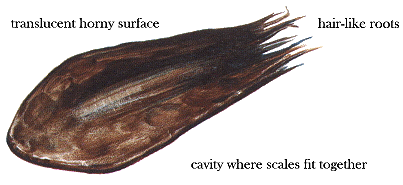
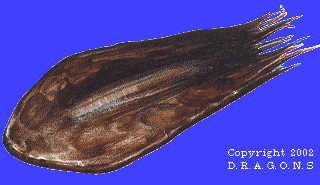
If
we study a scale closely, we observe the following characteristics: the
innermost part is composed of a compact hairy formation firmly rooted in the
epidermis. On the hair follicle there are some tiny glands which secrete a
substance that adheres firmly to the skin.
This
substance is rich in minerals, which determine the hardness and the color of the
dragon's scales. The external surface has a horny, translucent texture, which
gives the scales their habitual luster.
CROSS
SECTION

The dragon does not need to sloughs off his skin like most other reptiles, as
the scales grow, they are renewed automatically, like human nails and hair. They
are not shed from the body, except in case of illness.
FRONTAL
SECTION
|
This
is very important since if the wings would be connected in the top
of the back, the dragon would fly but it would have a vertical position
(head up, posterior & tail down) that would be a serious disadvantage
for the speed and also for the maneuvrability. When the wings are
connected at the bottom of the back, the dragon can have a
horizontal position and thus the head and the tail can be used as rudder
and allows a great maneuvrability (at least, definitely higher than the
vertical position). This also allows a greater surface for the wings (a
critical element in flight). |
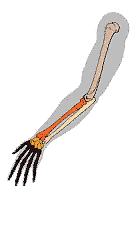 The
wings of a dragon are based on the principle arm of any animal, i.e. they
consist of an thumb and four very lengthened fingers, the whole connected
with a membrane as we can observe in the bat. It is significant to
understand that the similar struture between the shoulder, the arm and the
hand is homologous with the corresponding structures of the wing for the
dragon (see opposite figure). It is also important to understand that the
membrane of the wing do not attaches close to the shoulder as certain
biologically erroneous drawings can sometimes shown but near the bottom of
the back of the dragon close to the thighs.
The
wings of a dragon are based on the principle arm of any animal, i.e. they
consist of an thumb and four very lengthened fingers, the whole connected
with a membrane as we can observe in the bat. It is significant to
understand that the similar struture between the shoulder, the arm and the
hand is homologous with the corresponding structures of the wing for the
dragon (see opposite figure). It is also important to understand that the
membrane of the wing do not attaches close to the shoulder as certain
biologically erroneous drawings can sometimes shown but near the bottom of
the back of the dragon close to the thighs.

|
1.
The wings are connected near the shoulder. |
|
2.
The wings are connected below the chest. |
|
3.
The wings are connected near the thighs. |
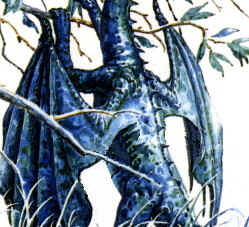
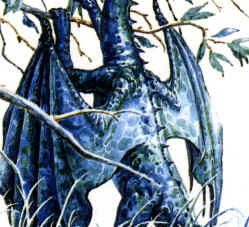
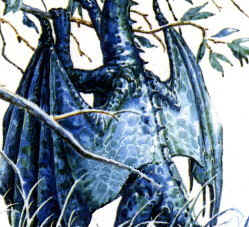


It is
impossible to list the enormous variety of hues that make up the dragon's
brilliant coloring, but they can be divided into three broad color groupings:
Blues, ranging from dark blue to silver and mother-of-pearl.
Red, ranging from copper-red to dark red and reddish-black.
Greens, which include every imaginable shade of green and yellow and even
dark brown, emerald green and burnished gold.
Although
these three principal color groups are not usually mixed, a dragon's coloring is
rarely uniform. In general, his scales are several hues from one of the main
color categories, with a metallic luster which is hard to define. When the
scales have a pale, opaque appearance, it is a sure sign of ill health.
Many
dragons are known by their scales, such as Ancalagon the Black, Smaug the Golden
and Spars the Green.
|
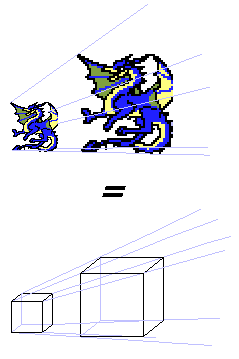
For
many of you, the word "dragon" means huge, enormous or imposing
creature but out of any reasonable doubts, the facts are different from
the fairy tale. Dragons are probably small creatures (from 1 foot to 10
feet long). For this we need to look at fundamental principle of physics
called "Physics of Proportion" or more commonly called
"Physics of Lilliput". First,
you look at a cube (1cm x 1cm x 1cm) and you decide to double the length
and you want to keep the proportion. You will have a bigger cube (2cm x 2
cm x 2cm). The length of the enlarged cube will be multiplied by 2, the
surface will be multiplied by 4 and the weight/volume will be multiplied
by 8. For example, let say that a bird needs to have a wing span equal to
his body length to fly, enlarge this bird ten time. There will be 100 time
more surface... However he will weight 1000 time more and since his wings
give him the power to fly and that these rely on the surface and not on
the volume, he will be unable to fly for his lack of lift power. We have
proof now that a large creature could have some difficulties to fly, but
we haven't proof they cannot exist. The second thing is the structure of
the dragon. Some persons send me theories that dragons could have
cartilage instead of bones but this could only be possible in very small
creature: The shark for example, live in water and in water your apparent
weight is much lighter than in air that explain why an animal like this
could live with only cartilage. Look at your nose and you ears, these are
made in cartilage but as you have surely notice, this isn't very strong
and it's could not support the weight of your entire body. Now if they
cannot be made with cartilage, they are obviously made with flesh and
bones but the fact with bone is that they rely on the surface (i.e.
diameter and not surperficies) to be strong and large bone increase the
mass and thus make the flight much more difficult. |
 Dragons
- David or Goliath?:
Dragons
- David or Goliath?:
I
think this point really needed to be cleared up since artistic representations
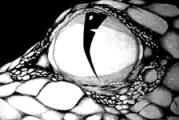
and sciences occasionally do not mix very well. Dragons eyes are usually shown
to be reptilian with a vertical slit for the pupil, while somewhere else you
will have a round pupil and if you search hard you may even find dragon with
insect-like eyes not to mention the "glow-in-the-darktm"
eyes with no pupil at all.
In all these view about dragons (pun intended), what is possible and what is
not, and more importantly: why?
The traditional (vertebrate) dragon eye:
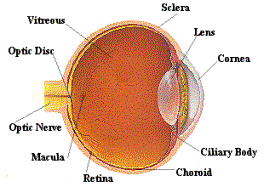
The eyes
come in two flavors: with a round pupil or with a vertical slit. This is just a
small detail because they both work the same way and they both have much in
common with a standard camera. The light first pass through the cornea, the main
source of refraction, then it pass through the lens which controls 1/3 of the
refraction of light that enters the eye (the cornea, the other 2/3). Located
just behind the pupil it allows for changing of focus from distance to near
objects by altering its shape. This changing focus is called accommodation. As a
person ages the lens hardens and accommodation becomes more difficult. Finally,
the lights reach the retina that contains photoreceptors (rods and cones) that
change light into sight by converting light into electrical impulses. These
electrical messages are sent from the retina to the brain and interpreted as
images. Simple heh?
The
iris is the colored part of the eye has very fine muscles to control the size of
the pupil and thus the intensity of the light (in conjunction with the eyelids).
Being able to reduce the pupils to slits rather than tiny circles gives the
creature a greater and more accurate control of how much light enters their
eyes; this ability is particularly important in bright sunlight. Vertical slits
also have an advantage over horizontal slits. When the creature's eyelids close
at right angles to the vertical pupil, he can reduce the amount of light even
further by bringing its eyelids closer and closer together. This combination of
the vertical slits of the pupils and the horizontal slits of the eyelids, allows
the creature to make the most delicate adjustments of the light reaching its eye
compared to any other animal.
Also,
many animals also have an additional structure called the tapetum - a reflective
layer that lies under the retina and acts as a mirror, bouncing light back
toward the retina a second time. Dogs, cats, horses, and cattle all possess
them. This allows them to function under dim lighting better than humans. Cats,
for instance, are five times better at detecting light than humans.
This
is probably the most plausible situation, while is contain nothing new, this
type of eyes has a long history of great functionally and an acceptable field of
perception. However, this type of eyes possess only a 0.02 degree of visual
range (i.e. there is only a small point in the picture where everything is
clear. As you read this line, the paragraph above is blurred and cannot be read
until you move the focus of your eyes on it).
Eyes made from a mosaic of lens (insect-like eyes):

As
opposite to the vertebrate eyes, the image is in fact many small "independant"
units that will together form the image. Each small lens point toward a
different direction and thus can view a wide angle. A vertebrate eye has 0.02
degree of visual range (ie where objects appear clear and sharp) but since each
lens of the composite eye is relatively large, this eye has a poor visual
acuity. The image is crude but still recognizable. However, the main reason why
large creatures do not have composite eyes, it is because this type of eyes
generally allows only a short range of vision. Flies and mosquitoes are very
near-sighted, and can see only a few millimeters in front of them with any
degree of resolution. Also, although the insect depth of focus is very short, it
is nevertheless very broad. The near-sightedness of insects is so extreme that
they see detail where we would need a microscope to see. On the other hand, in
the human eye, the fovea, or area of sharpest focus, is only as big as our
thumb.
|
|
|


As
shown on the picture above, for a creature with composite eyes, the Earth still
look like the old planet we still know but the details are poor. For an insect,
the important point is probably to distinguish the flowers from the landscape
and your hand (or predator) before you hit him. It is simple and well, it does
the work for them but seriously, any large creature would be greatly
disadvantaged by this type of eyes.
No slit at all; eyes appearing like a crystal ("crystalline" eyes)?
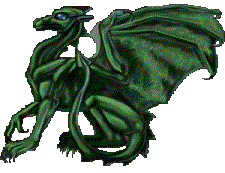
Think
about the pernese dragons. How are they able to see something? In fact, the best
explanation is there is no retina but instead the light receptors are
distributed homogeneously in the eyes. This means a photoreceptor near the
surface can see the object far away and you go deeper into the eyes, the
photoreceptors are able to view objects that are closer.
This
would also means that the eyes are always focused no matter the distance of the
object (I admit this could seem very strange for most of us, but imagine a photo
where the close objects are as sharp and crisp as the objects far away).
However,
this do not give the same precision as a retina since the dragon cannot have a
dense quantity of receptors without blocking the light; a dense quantity of
cells would block the light for the layers deeper in the eye (to some extant, in
fact, cells are almost totally transparent).
As said
above, the advantage would be to be to always have the close and far object
focused at the same time and having a great deep perception even with a single
eye. I explain, for human and some other creatures having a binocular vision,
this is extremely useful for evaluating deepness but if your eyes are focussed
on every distance all the time and if your brain is able to tell which signals
from which "layer" of photoreceptors, then the brain no longer need
two eyes to know the "exact" distance between the creature and an
object. This would allow the dragon to have his eyes slightly more on the side
and have a greater angle of view without sacrificing their ability to determine
deepness.
Another
advantage would be to increase the angle of the eyes, bird have their eyes on
each side and human right in front. We humans with our eyes squarely in the
front of our heads, can see about 180 degrees, but we need to direct our eyes
into the direction of the object to have a clear picture. The crystalline type
of eyes would be focused not only for object of all range but also in all
directions, this means once you come into their angle of vision, it is like if
the dragon was looking directly at you all the time while we cannot describe
very well a person standing in the corner of our vision.
The main
disadvantage would be their inability to have one point where all their light
receptors can be gathered. Owls for example have a very dense retina and this
allow them to see small creatures (such as mice) even if they are very far from
them. In a crystalline eye, this situation cannot exist, they can have a good
visual acuity but not as high as the animals that are renown for their vision.
Does this means a dragon with such eyes cannot have a great vision? Absolutely
not, again, we humans have a vision angle of 180 degree and about 140 degrees of
binocular overlap. Dragons with crystalline eyes could have an angle of vision
around 220 degree (i.e. the eyes slightly on the side) and an overlaps of 110
degree. The object inside the overlapping degrees of both eyes would greatly
increase the resolution of the object while the remaining angle of vision would
be less defined (but much better defined than the visual acuity of the corner of
our eyes). The degree where the vision of the dragon overlap would be equivalent
to the area of sharpest focus and would be obviously much greater than our.
Glowing
crystalline eyes?
Glowing
eyes without slit are nonsense, I have see some trying to explain the phenomena
but their explanation contain several flaws that make the theory highly
questionable. Let face it, this is often used to show good/bad guys in manga and
other cartoon but this remains very unrealistic. In fact, if the creature had an
iris, it would be the reflection on the iris that would give the impression of
glowing eyes. This is where the idea came from but as you all surely noticed,
the "glowing" eyes of a cat in the dark do not really glow; it is just
a reflection of the light. Now, imagine now that your pupil would glow, you
would literally blind yourself by the light emitted but also by the reflection
of this light back to you. The best example I can give is at night when you are
inside your house, if you look outside with all the lamp turned on, the glass in
the window will acts like mirror. In other words, if you need to look outside,
it is easier when there is no light inside. Same thing for the eyes, if you have
a light source inside the eye, this would 1) blind you by activating the
photoreceptors around the light source, and 2) your own cornea would behave like
a mirror and reflect you back the light you emitted thus blinding you even more.
In a crystalline eye, the light emitted by the "crystalline" liquid
would trigger photoreceptors that are surrounding the light source thus
completely blinding the creature in the process.
All
this to says, that artistically, this give dragons and fantastic look but
scientifically there is so many problems generated by this type of eyes, that it
would be a lot of trouble to gain no advantage over the other types of eyes...
Many
can wonder in which class the dragons can be categorized. The dragons cannot be
considerer as reptiles because they are active and they are warm blooded, and
they cannot either be mammals [because they lay eggs (Monotrème like "Echiné
à bec droit", are the only exeption to the rule because it are only the
mammals to lay eggs) and they do not produce milk ] and even less be birds
(because they have scales and six members). However, the dragons have elements
of each of these classes (reptiles, birds and mammals):
Birds:
hollow bones, lay eggs
Reptiles: lay eggs, have scales
Mammal: four chamber heart, specialized teeth
Unknown: six members (2 pair of legs/arms, one pair or wing)
Thus, the
dragons would be categorized in their own class... It would be a mistake to
consider them in the current class because they do not answer the physical
criteria requiered to belong to one or the other.
For their
evolution, I would like first to put something at light: if you believe that the
darwinism is only a theory, read this
BEFORE contacting me by electronic mail for saying that it is only theory
without good grounds.
Their
evolution according to the most plausible assumption goes up with the first
primitive reptiles, when those divides to follow different paths of evolution as
to become the dinosaurs (which became the actual birds), the mammals and other
better adapt reptiles. The dragons separate either from the dinosaurs or right
before the mammal junction which gave some kind of reptile
with mammal appearance (which look strangely close to a dragon without
wings). With a few tens of a thousand of years of evolution, some beneficial
mutations could have given them wings that have helped them to survive. This new
branch in the evolution could explain the evolution of the dragons.
Note of the author: This section is still suject to discussion. Therefore, these
informations are subject to change without notice.
|
The
breath weapon of a dragon is not a magical thing that spread out of
no-where but had a more scientific explanation. When we eat our body by
digesting created a gas know as Methane (CH4), dragon unlike human and
other animal store this gas into another kind of "lung" that
will serve as a bag/canister to held the gas that will be later mixed with
a small amount of phosphor (P4) that has the propriety to ignite in fire
at the contact of air. When the dragon wants to breathe fire, the methane
is release into the lung and when the gas is in the air, the phosphor
ignites and also puts the methane in fire. |
|
Some
dragons breathe a cone of frost, the explanation for this resides also in
the food that the dragon ingests. The food is break down into the stomach
primary for nutrition but the remain bear some chemicals reactions that
will give a gas, I suppose to be Nitrogen (N2) (I have not yet found the
exact composition of it but I continue to work hard to find the most
probable natural refrigeration gas), the gas is compress by extremely
strong muscles, exactly alike the base system of a refrigeration system,
the dragon doesn't need to thing for it because it is spontaneous and
painless. When a dragon needs to freeze an opponent, the highly compressed
nitrogen, that almost reach the liquid state, is release in the lungs and
when the gas comes into air, it uncompresses at an unimaginable speed.
That result in the gas absorbs all the heat in is environment. This cause
the temperature in the breath to drop to an average of -50 °C (more test
had to be made to know a more exact °T), anyone caught in the path of the
breath without heavy heat protection are at least seriously injured and
only death remain for the weaker one. |
|
The
easiest of them, all organic creature secrete gastric acid to break down
the food, dragon who can spit acid have a special organ that produce a
powerful acid (probably HCl) that the dragon release when he breathe, the
opponent is burn by the acid, even with the best armor usually make of
metal that make bad reaction with acid. |
|
For
other breath weapon least know follow the same principle and don't need
much detail about them. |
 Fire
Breather:
Fire
Breather: Cold/Frost
Breather:
Cold/Frost
Breather: Acid
Breather:
Acid
Breather:
The
reproductive system of these creatures is internal, it means that at the
look of their external physiognomy, it is hard (not to say nearly impossible) to
determine if this dragon is a male or a female, only the general behavior and
the small change in their color can provide informations about the dragon's
gender. Dragons lead egg like reptiles and bird, eggs are protected by a hard
shell that with time will weaken to let the new baby dragon break it more
easily. The incubation period of these creatures is mostly unknown; some egg
will hatch in a year other two and some more than five year. The dragons eggs
are rich in calcium and I suppose that the newborn dragons eat is shell to not
waste the nutriment in it.
The
mating process is known as dragon-slide: the two partners fly high in the sky
and after a moment they grab each other and close their wing and make free-fall.
Then at less than a hundred feet from the ground they open their wing and land.
The dragons so unusual mating process is mainly because dragons love speed and
risk, and add these to the pleasure of love... you have a sensation that human
could never enjoy. (Too bad, you should have born dragon).
Dragons
tend to be loner by nature or by obligation, we can say without a big inaccuracy
that dragons are not very populous on Earth, not so many lucky people have seen
dragons (see the Activity
on Earth page). Dragons pass much of their time alone in their lair, they,
during this time, learn about their environment and how to use it wisely.
Because they are alone a great deal of time, most of them enjoy company of other
dragons and even human as long as they hadn't come in the goal of stealing or
conquest. It may be possible that dragons have some sort of council leaded by an
elderly dragon but this yet has to be proven.
I
swear on my honor that if I meet one personally I will ask.
|
Man's
craving for power and religious beliefs have kept Europe engulfed in
interminable and bloody struggles. The dragon lords could not understand
the reasons for man's self-destructive behavior, and kept well out of the
way, retreating to remote hiding places far from all this confusion. Shrouded
in mystery, the dragon's trail remained lost in the obscurity of legend. We
could wonder what would happen if the dragons reveal themselves to the
eyes of the humankind... Would we be able to accept another form of
intelligence probably far superior to our or would we feel the need to
fight those, who at the end, could come to our rescue, and this under the
only pretense that these beings make umbrage to us...? |
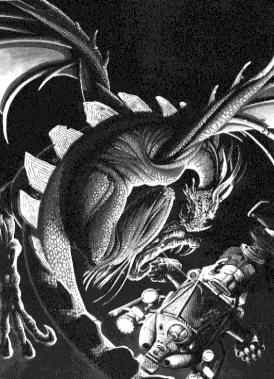 Throughout
history dragons and human beings have been unable to live peacefully side
by side. As a result, mankind has not been able to benefit from ancient
dragon knowledge.
Throughout
history dragons and human beings have been unable to live peacefully side
by side. As a result, mankind has not been able to benefit from ancient
dragon knowledge.
|
The
dragon feels he never has enough jewels and he finds it difficult to part
voluntarily with a single one of his treasures. Even though, for example,
he gives jewels to the favorites in his family, he does it purely because
he knows that the young maidens cannot remove the jewels to the outside
world. He is very jealous of his belongings and guards the treasure he has
built up over the years in large storerooms. He keeps detailed inventories
of all his possessions so that he can be alerted immediately if a single
object goes missing. Jewels
serve a specific purpose for the dragon in that he usually sleeps on a bed
of gems and luxurious fabrics, such as silks and velvets. For this bed, he
never uses soft stones like pearls and emeralds, as they are too fragile. Another
theory says that dragons also hoard "precious" items for reasons
other than just simple obsession. At a level we humans are incapable of
feeling, different metals and other items "resonate" at certain
levels, especially gold and silver. The dragons could use this resonation
to their advantage, controlling it, manipulating it. In a nut shell, it
enhanced their already remarkable "mystic" powers. In
addition to the enhancing powers, this "resonation" also had the
same addictive effect as a "rush" in humans. Hence, the more a
dragon acquired, the more he/she wanted. This also allowed their immediate
detection of any missing piece. |
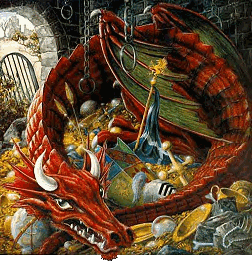 The
dragon is a great lover of art, especially of gold and silver, and work,
and he loves to hoard treasure. However, he is not renowned for his love
of manual work, preferring intellectual activity by far. That is why he
does not devote himself to creating jewels, but only to "acquiring
them" from human beings through various methods. Robbery, looting,
trade, barter, fraud - by any means fair or foul which enables him to come
by the jewels and precious stones he covets.
The
dragon is a great lover of art, especially of gold and silver, and work,
and he loves to hoard treasure. However, he is not renowned for his love
of manual work, preferring intellectual activity by far. That is why he
does not devote himself to creating jewels, but only to "acquiring
them" from human beings through various methods. Robbery, looting,
trade, barter, fraud - by any means fair or foul which enables him to come
by the jewels and precious stones he covets.


There is copyrighted material here, do not copy the work and use on other site.
Have you notice that this page needs some pictures, if you want or have some
related with the topic here or on the other page, please contact me.
Send any idea or comment to

Click on any picture on this page to see it at their full size
1:
Introduction
2: The Maps
3: The Encounter
Part.1
4: The Encounter
Part.2
5: Some Modern Dragon
6: Dragon of Future

 ALERT!
EVERYONE TAKE UP FIGHTING POSITIONS!
ALERT!
EVERYONE TAKE UP FIGHTING POSITIONS!
Just
kidding, dragon are not the alien menace that corrupt our government to enslave
everyone, dragon sighting is just a visual contact or, for the lucky one, a
social contact with dragon that have nothing to do with conquering Earth or some
other stupid things like that.
Many
dragon-sighting have been reported in the several past decade, you will probably
think these guys are just good enough to go in a nut house but... in China they
found a skull with horn that have been mistakenly labeled as one of the rare
tyrannosaur with horn, also they found a mysterious carcass on beach at
Framboise, N.S., in July, 1976, that was looked as a sea-dragon. If you're not
convinced with that go see Encounter
incident.
You can
see on the map the approximately location of the sighting. Why approximately
location when we known at the miles near, the exact place of the sighting...
simple, we had prove that they have exist but we are not sure if they are still
alive today, so if they exist in this world we ABSOLUTELY NOT want them to be
catch by some evil businessmen and use them as main attraction in zoo or other
amusement park for make big buck at the detriment of an very intelligent and
social creature. Knowing that if we say that a dragon has been seen in the
Nevada, you will need luck to find him/her.
Dragon
Sighting in the past 200 years.

Encounter
Incident
DRAGONS AS SEA SERPENTS
Throughout
history, water dragons have often been sighted, with the most recent incidents
dating back to the beginning of the twentieth century.
The
most scientifically reliable description is that of Peter Karl van Esling, the
director of The Hague Zoo, who gives an account of a water dragon sighted during
a voyage to collect marine species in the Atlantic in 1860:
We
saw a gigantic reptile, bright blue and silver in colour. He swam gracefully
around the ship before the sailors' eyes, and submerged himself without a
splash. His eyes were enormous, with vertical pupils and an intelligent
expression. They seemed luminous, but this effect could be due to the reflection
from the setting sun.
His
head was adorned with bright blue and green crests. Even though he disappeared
under water and did not see him again, he appeared to measure some seven meters
in length, and on his back we could make out something resembling crest or fins.
I think he was serpent-like, but the sailor beside me thought he saw legs and
claw.
We
baptized him Megophias.
SEA-SERPENTS
(WATER DRAGON) - EAST COAST
Sea-serpents
seem to be a cosmopolitan breed. They share a marked taste for fine weather,
being rarely seen except in warm, sunny weather and calm seas. They prefer to
swim in warm ocean currents, spending the summer month in the Northern
Hemisphere and migrating in the winter to the Southern Hemisphere.
A
great number of sighting of sea-dragon more knows as sea-serpent have been
recorded; numbered among witnesses are such personages as scientists, priest and
bishops.
In
an article he wrote in 1817, the French-American scientist Rafinesque-Schmaltz
wrote of a two hundred foot long sea-serpent seen by Mrs. W. Lee, in 1805, near
Cape Breton and Newfoundland. She stated: "Its back was dark green and it
stood in the water in flexuous hillocks and went through it with impetuous
noise."
The
first recorded sighting in Canada water was on July 15th, 1825, in Halifax
Harbour. It was seen by several people from entirely separate positions. They
described it as having "a body as big as a tree trunk... The animal had
about eight coils or humps to its body and was about sixty feet long."
A
similar creature was seen the next summer by William Warburton, south of
Newfoundland.
On
May 15th, 1833, in Mahone Bay, forty miles west of Halifax, three officers and
two enlisted men of Her Majesty's Navy were relaxing on the deck of a fishing
boat when they sighted at a distance of one hundred and fifty to two hundred
yards:
.
. . the head and the neck of some denizen of the deep, precisely like those of a
common snake, in the act of swimming, the head so far elevated and thrown
forward by the curve of the neck as to enable us to see the water under and
beyond it. The creature rapidly passed, leaving a regular wake, from the
commencement of which, to the forepart, which was out of water, we judged its
length to be about 80 feet; and this within rather than beyond the mark . . .
It
is most difficult to give correctly the dimensions of any object in the water.
The head of the creature we set down at about six feet in length, and the
portion of the neck which we saw, at the same; the extreme length, as before
stated, at between 80 and 100 feet. The neck in thickness equaled the bole of a
moderate-sized tree. The head and the neck of a dark brown or nearly black
colour, streaked with white in irregular streaks.
The
five principal witnesses signed with their names, ranks, and dates on which they
received their commissions:
W. SULLIVAN, Captain, Rifle Brigade, June 21, 1831.
A. MACLACHLAN, Lieutenant, ditto, August 5, 1824.
C. P. MALCOLM, Ensign, ditto, August 13, 1830.
B. O'NEAL LYSTER, Lieut. Artillery, June 7, 1816.
HENRY INCE, Ordnance Storekeeper at Halifax.
SEA-SERPENTS
(WATER DRAGON) - WEST COAST
As
in the case of other Canadian monsters, sea-serpent (or we will call it
Sea-Dragon) sightings were often not reported until years later, when, after
learning of another report, previous witnesses were prompted to come forward and
tell their own stories. Fear of being laughed at is a very strong deterrent to
people speaking out.
After
learning of Major Langley's report, Mr. F. W. Kemp, an officer of the Provincial
Archives, told of his experience the year before. This is his report, as given
to the Victoria Daily Times:
On
August 10, 1932, I was with my wife and son on Chatham Island in the Strait of
Juan de Fuca. My wife called my attention to a mysterious something coming
through the channel between Strong Tide Island and Chatham Island. Imagine my
astonishment on observing a huge creature with head out of the water traveling
about four miles per hour against the tide. Even at that speed a considerable
wash was thrown on the rocks, which gave me the impression that it was more
reptile than serpent to make so much displacement.
The
channel at this point is about 500 yard wide. Swimming to the steep rocks of the
Island opposite, the creature shot its head out of water on the rock, and moving
its head from side to side, appeared to taking its bearings. Then fold after
fold its body came to surface. Towards the tail it appeared serrated with
something moving flail-like at the extreme end. The movements were like those of
a crocodile. Around the head appeared a sort of mane, which drifted round the
body like kelp.
The
Thing's presence seemed to change the whole landscape, which make it difficult
to describe my experiences. It did not seem to belong to the present scheme of
things, but rather to the Long Ago when the world was young. The position it
held on the rock was momentary. My wife and sixteen-year-old son ran to a point
of land to get a clearer view. I think the sounds they made disturbed the
animal. The sea being very calm, it seemed to slip back into deep water; there
was a great commotion under the surface and it disappeared like a flash.
In
my opinion, its speed must be terrific and it senses of smell, sight and hearing
developed to a very high degree. It would be terribly hard to photograph, as its
movements are different from anything I have ever seen or heard of. I should say
its length to be not less than 80 feet. There were some logs on Strong Tide
Island which gave me a good idea as to the size of monster as it passed them. I
took a measurement of one the next day which was over 60 feet in length, and the
creature overlapped it to a large extent at each end. I put a newspaper on the
spot where it rested its head and took an observation from our previous point of
vantage. The animal's was very much larger than the double sheet of newspaper.
The body must have been at least 5 feet thick, and was of a bluish-green color
which shone in the sun like aluminum. I could not determine the shape of the
head, but it was much thicker than the body.
I
did not report my strange adventure except to one or two trusted friends, for
fear of ridicule and unbelief. About a year later, it fell to Major W.H.
Langley's lot to see the same or at any rate, a similar monster in the vicinity
also of Chatham island.
Within
a week of publication of the Langley report, Archie Willis, the news editor of
the Victoria Daily times, had "a dozen letters from other people who said
they had seen the serpent, but had refrained from saying anything about it for
fear of ridicule." One such case was that of "Rusty" Beetle of
Port Angeles, Vancouver Island, who had seen the animal some years before. It
seemed the sea-serpent appeared close to "Rusty's" boat while he was
fishing off Dungeness Spit in Juan de Fuca Strait. The animal was serpentine and
had a body at least forty feet long. The head was like that of a camel or horse
and there was a mane. It swam slowly round the boat for five to ten minutes.
When "Rusted" came ashore he excitedly related the incident to the
boat's owner, who replied: "Rusty, it isn't smart to take a bottle along
with you when you go out fishing by yourself." Disappointed that the boat
owner did not believe him, "Rusty" then told the story to a local
journalist he knew, but the response was the same. "Rusty" had then
decided to keep quiet about the matter.
In 1937
came the report of the monster seen by Mr. and Mrs. Timeus, at Sunset Beach,
twenty-two miles north of Vancouver. This monster turned out to be a Northern
Sea-elephant, one of the strangest and largest mammals in the sea. A sea-serpent
was seen, however, at Sunset bay later that year by two brothers, acquaintances
of the Timeuses, Fred and George Lawrence. The animal had a head like a camel's,
a small neck, and a body about the size of a large barrel. It was between fifty
and sixty feet long. A similar monster had been seen nearly by several
fishermen, who judged its length to be closer to one hundred feet.
Rencent
Dragon Sighting (no more than 10 years)

It
has been said that there is probably no more fascinating creature in the minds
of Men than the dragon. Men have been describeing it since the beginning of
civilization.
The dragons, a creature ressembling to a reptile with wings and a long neck, was
often depicted in stories and picture in Medieval times and much earlier.
Throughtout the second world war, there was a little mention of sea-serpents -
it seem everyone was to busy fighting to notice them. We have to wait the late
90' to see sighting, we must admit that the great developpement in science and
technology discourage many to move foward to tell their story.
Dragons
have been spotted in the Rocky Mountains of Alberta and British Columbia, even
if the witness was uncertain about the true size of the creature, she report to
have seen a giant creature about fifteen feet tall at the shoulder. After
telling to one of her best friend, she merely consider this as a joke. The
creature was in a beautiful shade of dark green and could easily blended with
trees as he been standing by them but the witness report that he was perched on
a rocky outcropping on the side of the mountain.
...He
was fanning his wings slightly, looking quite calmly into the valley below. I
had been hiking up this mountain, when the movement of his head caught my eye. I
had been this way before, and there was a group of trees on the cliff where
there had been none before. I did not believe what I had seen at first, but the
shape was too obvious, and he was parallel to me, about seven bus lengths away.
I was climbing up one rock outface, he was on another.
He
was the most beautiful creature I had ever seen. His head was long, with a large
eye ridge and two smaller bumps with a triceratops-like horn on his nose. At the
back of his head were two large horns, jutting out backwards, and two smaller
horns below them. They were a greyish-white and caught the light like dull
silver. His forelegs were slightly smaller than his hind legs and were gripping
the edge of the cliff. He looked as though he were a quadruped. He had slightly
darker dorsal ridges running from between the longest horns to about halfway
down his tail.
As
I stood there, gaping like a fish out of water, the dragon turned and looked at
me. He cocked his head to the side, almost like a bird, then spread his enormous
wings and vaulted off the cliff. He was absolutely elegant in the air, flapping
his wings several times before banking into a glide and dissapearing around the
side of the mountain. My legs felt so weak that I had to sit down. I have been
camping in those mountains for over ten years, and I have never seen anything to
suggest that dragons might actually exist there. But after that encounter I
began to think about it. What better place for a dragon to live than in the
mountains? There are places in Banff and Jasper that nobody has ever been to,
and there are many elk and deer and possibly even bears for it to feed on.
Plenty of lakes, and the mountains themselves have many hidden caves and the
like. A dragon perching at the very top of the mountain, especially if they
camouflage, could never be seen. I can't imagine my luck at actually seeing one
so close up and so low down in the alpine country. The place where I saw him
lies somewhere in the back country of Banff, beyond The Point, a fairly
well-known hike-in campground.
Another
sight was reported to be seens the February 17, 1998 at Niagra falls Canada. She
was visiting Niagara Falls to try and relax after a trying week at graduate
school. ...It was about 8:00 PM and I was with my Fianance who is the only other
person who saw it. I have no tangible proof- only and overwhelming feeling of
being protected. The next week school went much better and my attitude was much
better. The mist rising from the Horseshoe falss was in the shape of a dragon.
It was a rather large, winged blue-grey dragon formed by the mist of the falls.
A truely rare and beautiful sight.
It seems without doubt that the vast space free from civilization is prefer to
dragons since most recent sighting have been reported these kind of condition
like in Canada.
I got many case of Sea-Dragon sighting but no much about the traditional Western
Dragon, if you have knows of such case or any other dragon related sighting you
can E-Mail us and your case will be add to
the page. Your E-Mail should contain:
1.
The location of the sighting
2.
A general description of what you have seen, metrical details are welcome
3.
Time and Date (very important)
4.
The general description of the environment
5. Any
other useful information, such as newspaper if it is not a recent event.
Some
Modern Dragon
Komodo dragon {kum-moh'-doh}
The
largest living lizard, the Komodo dragon, live only in the vicinity of the
Indonesia, for example, on Komodo island, for which they are named, and on two
other tiny island in the Lesser Sundas group of Southeast Asia, the Komodo
dragon is the world's largest living lizard, occasionally exceeding 10 feet (3
m) in length. Komodo dragons are carnivorous, feeding on animals as large as
small deer and bush pigs. Their long, sharps claws enable them to disembowel
large animals, and their jagged teeth aid them in tearing pieces from their
prey. Komodo dragons, like other large monitors, can be formidable adversaries,
even for humans, if these lizards are actually cornered. Komodo dragons swim
well, sometimes swimming to small isles a half kilometer from shore to prey on
domestic goats.
Surprisingly,
this colossal creature remain unknown to science until as recently as 1912, but
the natives of the region were well award of its existence and also its prowess
as a man-killer. Heightening its dragonesque appearance is its bright yellow
tongue, flickering out of its mouth in faithful facsimile of its mythical,
fire-spiting namesakes.
These
reptiles are endangered and are under strict protection by the Indonesian
government.

La Presse,
Montreal, Saturday, August 23, 1997. In section G-13.
Article available via E-Mail only
As
recently as the mid-1800s, flying snakes of amazing beauty, with ornate feather
wings, were believed to inhabit Glamorgan in Wales.
According
to one old man who lived at Penllyne in Glamorgan and died early in the
twentieth century, the woods around Penllyne Castle contained many of these
extraordinary creatures when he was a boy. They were said to be brilliant in
colour, as if spangled with sparkling gemstones, and, like the peacock's train,
their wings often bore eyes; some also had rainbow-hued crests.
Yet
despite their exquisite appearance, the winged serpents were slaughtered by the
local people as if they were merely vermin because they preyed upon the farmer
poultry. Indeed, the old's man father and uncle has killed several when he was a
youngster. Now, they were apparently extinct. Flying serpents were also reported
at Penmark Place, where one elderly woman claimed that there had even been a
"king" and "queen" of these winged wonders.
If
such serpents really did exist, what could they have been? Millions of year ago,
Britain was home of Kuehneosaurus, and elongate lizardlike beast, whose ribs
were extended to for a pair of membranous winglike structures that may have
enabled it to glide through the air. Today, a similar creature still exist in
the humid jungles of Southeast Asia, and is aptly knows as draco volans, or
"flying dragon". It is not native in Europe, however, and even if some
had escaped from captivity into woodlands of Wales, they would not have survived
in its climate.
It
has been suggested that brightly colored serpents with feathered wings spied in
the Vale of Edeyrnion in 1812 may have been cock pheasants, which were
unfamiliar there. But this theory does not explain the serpents' liking for
poultry, and it is not likely that a pheasant could be mistaken for a flying
snake.
There
might once have been proof of their existence, for the Penmark woman stated that
her grandfather had killed one of these beasts and kept its feathered skin
until, after he died, his relatives discarded it. If they had been eager to do
so, science may have been unable to unveil the identity of Wales's winged
serpents.

We need not mourn morosely the dragons of the past, nor need we look with
disappointed eyes on their zoologically uninspiring namesakes of the present.
For
there are still bona fide, corporeal dragons, such as the long-neck, sea lizard,
serpent whale, artrellia, inkhomi, tatzelworm and others of their cryptic kind
to torment and tantalize the staid world of traditional zoology. And these
creatures of controversy offers good reason indeed for believing that the future
still holds many great surprises and joys in store for the dedicated
dracontologist.
Similarly,
far from diminishing in appeal as an irrelevant anachronism with the rapid
approach of the ultra-scientific twenty-first century, the image of the dragon
is experiencing a profound upsurge in international popularity that no human
superstar could ever emulate. Today it is stunningly evoked and harnessed by
modern technology for every conceivable purpose, including cinema, the toy and
fashion industries, CD-ROM and promotional publicity campaigns of breathtaking
artistic splendor.
It seems
certain, therefore, (St. George notwithstanding) that the dragon -the embodiment
of dynamic, uncompromising, irresistible power- will continue to evolve,
diversify and populate our planet for a long time to come.

A late 20th-century
dragon: this spectacular poster advertises Pirelli's "Dragon GT"
motorcycle tyres.
 |
 |
 |
 |
 |