|
Home
|
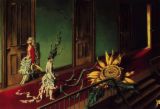
The Pregame Crew Remains Uncharacteristically Silent (Understandingly so) -- The Announcer Bight’s His Lip. The Color Commentator’s Still as A Winter’s Lake With the Absence of Winter Wind Gusts Nearing 90 Miles Per Hour, This Being The Title. (Cafe Rajha)
“Who are you,” she demands in an Eastern European accent.
X equals a man, media good looks, longish dark hair held back by an obsidian faced clip set in blackened antique silver. His mouth speaks a certain sadness, while oddly placed uncontrollable fits of laughter, and manic screaming help to keep away the frown lines. He is sitting on a stool, hunched over his drink in an empty jazz bar--the ceiling fan, bartender cleaning glass with bar rag, empty stage, in a club rumored vaguely in nonexistence. Leaning on the bar, over his drink, he allows her, the questioner, a sidelong glance, taking in the sleek black haired eastern European woman reminding him of a player in a series of artsy films, once as a vampire. The ice chimes in the glass as he tilts it to his mouth. Long seconds pass between her question and his reply. He does in practice, for setting a tempo, assuming control, and cunning creation of calculated artistic effect, absently staring straight ahead at the uneven row of dusty liquor bottles as he speaks, as does the inquisitor.
“They pay me to sit here.”
“Who pays you?”
“Are you Romanian?”
“Who pays you,” she demands, “Explain!”
Involuntarily he glances down as she slowly crosses her legs away from him.
“The owner,” he scans the club, “Lydia, thinks me a living piece of art. You know,” he laughs filmicly, “art to life.” He again sips his drink. “The clientele are drawn to me. I have a unknown quality, an X factor that people see, and want to know. I’m compelling up to a point. I’m mood music-”
“Why!”
“I don’t know... Why do people like Van Gogh?”
“Van Gogh was an idiot!”
“Well I don’t like him much really, but I-”
“Shut up!”
He does.
“You like Van Gogh.”
“He’s OK.”
“You like Van Gogh.”
“Not really,” He stares off into space for a second, Irises, Cafes, skies deep blues, and Starry Nights, turn like pages across his mind. “Well. Yes . . . I do like Van Gogh. Even his works I detest--the sunflower paintings still express something so real, raw, so ugly. It’s scary viewing that stark ocre sky, but I like his-”
“You like,” she repeats with a smug smile. “It’s a safe choice--you see a few works, the lines, a clearly defined style, beautiful paintings, derive comfort in his work as you might a sofa, and can more or less extrapolate the rest. Not much change going on. He did not have to be so miserable. It perpetuated itself, caged him, he looped the oppression round and round again until the feedback consumed him.
“So you’d rather somebody pretty painting like Monet?.”
“No.” She pauses to sip her drink, and smiles. “I think all those impressionists were just a nearsighted bunch, painting the world out of focus, just as blurry as they saw it.”
X smiles.
She lingers on his face and than looks past him squinting as if trying to make out the players on the stage. “You ever take your glasses off?”
“I wear contacts.”
She huffs impatiently. “Well. Contacts then?”
“Sometimes.”
“How does the world look without them?”
“Blurry.”
“That light,” she points to a green fixture upon a far wall, “how does it appear?”
“It’s looks like a lit green sconce on a wall. It’s pretty enough.”
“I see a green firework explosion halted in the sky,” she says. “How bout that person at the end of the bar?”
“His face is weathered. He looks like he drinks too much. Seems very unhappy. Why, what do you see?”
“I see a formless blur,” She says smugly as if making a point, and seamlessly resuming the art discussion, “I like the Surreal, and Dada... You see those old photographs of the surrealists all together, Max Ernst marries Dorothea Tanning, Duchamp, A Joseph Cornell collage in a private collection of a descendent of Ives Tanguy, or Dali just standing there mustached and all alone. If you wished for adventure, would you walk through the lonely world of a Van Gogh landscape, visiting, the mundane farmer, the indifferent prostitute, see his empty bedroom, or the stern uniformed man, seeing blank look on the people’s faces who did not understand, and ultimately rejected him, or would you jump terrified into that Dali still, looking with a perverse wonder at that ominous long shadow standing in a misplaced doorway, stepping slowly to meet that arcane figure that stands between you and that light?”
“But look what Van Gogh gave to the world!”
“That alienated, dejected face in one of his self-portraits, viewing a brilliant field of blue irises, his hands clamping a brush to the canvas that permanently separates himself from the essence, consigned to always be a viewing it from a distance. He gave the world syphilis and idealized pain. He was foolish because there was no learning, no steps, no graduation, or means of ascension from the desolation. He found his special niche, a pretty enough, stylized loneliness digging in to never to veer away. Do you imagine his ever being a touch away from contentment, an arm’s length from awe, a few paces from truth? Where’s the learning?”
Words escape X in an attempt for an answer, as did many of the artists of mention, the name Dorothea Tanning seemed familiar, the disturbing phrase birdpeople people flashed to his mind in a wash of orange in the name of Max Ernst, but that was all.
Breathing in, she closes her eyes. “Imagine a spiral staircase-” His eyes absently peer, sidelong, to the tendons in her neck throbbing with each inflection. “And every flight you rise, you see a painting that allows you to climb to the next. You stop, look at a The Irises, touching Van Gogh’s loneliness, and graduate to the third floor.” Startling him with her sudden notice she turns to face him. “He didn’t allow this. You’d be on the second floor, go to the third, the fourth, and you think you’re rising, but would suddenly regress to the drab basement, where the bygone janitor’s tiredly mopping the floors. You’d be viewing The Potato Eaters again. No doors, no building, just a lonely stairwell rising like a tower, and a drab basement with a overworked boiler running day and night to heat the absence of rooms. Don’t you see?”
X is frames an intellectual reply involving a some recycled about the Sidewalk Cafe. Conversation’s what he good at, but the inquisitor seems to be intentionally stifling this empty prearrangement of word. “And what makes you so special anyway?,” she asks.
He sighs. “I’m kind of a curiosity, a spectacle, more or less special. I’m here,” he gestures to his surroundings, “but I’m not quite a member.”
“I did not need permission to enter here!”
“But you manage it in a non official capacity! People would be crowded before in a club, in vogue, the bouncer would be barring the door, but you’d waltz up in your designer black dress, and he’d soundlessly glide aside, no questions asked. All the lesser people would understand, and envy you. There weren’t any forms, no invites, RSVPs, you weren’t placed on any lists, but you are privy to be here”
“What do you mean!”
“Do you drive?”
“No. I am driven”
“What’s your chauffeur’s name?”
“I don’t know... Bill,” she seems to make up the name, it emerging heavily accented.
“Do you pay taxes?”
“I don’t need to. I do not work.”
“Property taxes?”
“I don’t own anything.”
“See!”
The bartender, a serious, strong armed man, lumbers over, taking X’s glass, adding ice, and pours abruptly. X watches the cubes swirl around the glass, crackling in the sudden swirling shock and bath of cheap Scotch. “On the house,” he threatens flicking the bottle up and away with a light trickle of liquor splashing across X’s face, with a sting in the eye.
“I thought they paid YOU,” she said referring to the on the house comment, and X thought her accent was charming. Looking her in the eyes, he smiles, and her face softens.
“I pay for my own drinks.”
“Why.”
“Because I drink too much-”
“And loose control,” she continues with a smile and hint of admiration, slowly uncrossing her legs.
“No.”
“You begin to slouch and stumble,” she adds again smiling.
“No I- My posture improves, I begin to breathe deeply, becoming calm, I think clearly, this clarity begins distressing me, I grow, conspicuous, self conscious, suspicious, take to introspection, seeing conspiracies, paranoia, beginning to analyze things overmuch, until they have to throw me out.”
“Throw you out?”
“Yeah, they have a wonderful time laughing as they beat me up. They say that it’s my fault,” he makes a sweeping gesture, “all of it, that I bring it on myself, and then toss me into the dumpster. When I get out the club’s gone. They’ve broken my ribs.” He gulps his Clan McGregor, grimaces, than smiles as if each deliberate action meant something. “But they’re always careful with my face. They say it’s good for business”
“But why must they beat you up?”
“Cause they like to, for being too rational, too controlled, because, they say, it, my problems, all problems, are my fault, for thinking so much that it begins to inhibit my actions, to unravel the fringe and tentative mind set that allows me to sip my whiskeys, and sample this charming atmosphere.” He gestures widely to the club around. “And when I return the night next they all laugh at me saying that they are the true artists, basking in the aesthetic effect of their beatings on my pretty face, it enhances the atmosphere, and say I can anchor the style, while, they love to mention that I do not often adhere to their stricter standards.” he trails off, his left hand running down the day’s stubble on his chin, comforting a past nights hurt. “Do you like to read?”
“It’s my weakness,” she smiles. “I have rows of books,” she looks away, squinting off toward the stage, “but honestly,“ she turns back to mischievously confess, ”there’s one I just cannot put down, a book that (X’s mind automatically inserts ‘seems to’ here) subtly changes with every reading. It evolves really.”
“Do you watch TV?”
“Why would I!”
“See! While I am a living piece of art work, you are living art. You don’t wait on line, pay your rent, get pulled over, drive, go food shopping,” glancing down, ”work out for those legs, get pregnant, buy maxi pads, do you even menstruate?”
She looks confused as if she had never given it much thought. “Of course I menstruate!”
“What does it feel like?”
“It causes turmoil in my life,” she declares certainly.
“How?”
“I’d be in the middle of the perfect love affair, and it would seem like the only reason why a beautiful person would appear suddenly ugly to me. A voice usually loved, eagerly anticipated, would scratch across my mind with her fingernails.”
“But you never actually menstruate?”
“Of course I do!
“It just happens in theory, unconsciously, until you need to draw that little thread of motivation to weave into that wide screen drama of yours. I had an acting teacher once who used to look at me in dismay, mid monologue, demanding to what!, while I stood alone on the stage, groping for words, speechless. He wanted to know the motivation behind my actions, but in this play: Your Life-!” The bartender lumbers closer, threatening again and X to avoid premature beating instinctively switches gears to safer ground, turning to her. “You have nice eyes.”
Leaning toward him she says, “I thank you.”
X is temporarily taken with her white, slender shoulders, while the strong armed bartender, his broad shoulders seemingly coiled tightly with the tension of a rousing story of his own recently a novel of threatening he now edges away.
It’s growing late enough that the club begins to heat up. The rhythm conversation between X and the Inquisitor, perhaps is both inspired by and fueling this. On the stage a cool quartet backs up a, pale brunette, singing of pain derived plainly from her own compellingly tragic film noir experience, her voice being laced with a four pack filterless grind, an also factor for her billboard slim waist, and drop-dead hips.
Comforted by their surroundings; conversation, music and feeling an intrical part, and seed of the event unfolding event around them, the couple--the inquisitor and X, continue to converse artistically about trivial things--their lives, childhoods, dreams, desire, like the exposition in a movie theater melodrama, or the foreplay to the foreplay, a lapse of self, art to life.
Jazz plays. Time passes.
“Tell me why they pay you,” she asks again with a playful smile
“To keep people like you coming back.”
“Why am I so special?”
“Because other men watch you smiling at me, and want to be smiled at in the same way. Your voice weaves a spell, your smile melts the marrow in their bones. They see you speaking to me, and want to be away from their wives, quit their jobs, get drunk, pull bank heists, get paid 40 dollars a day, with expenses, while you toy with them and drag aesthetically on cigarettes in black n white.” He slowly exhales an imaginary smoke ring. “Filmic.”
She echoes “Filmic,” and breathes in slowly as if pulling the absent smoke ring from the air. “And why are you so special?”
“I dunno... I’m compelling to a point.”
“To a what point!”
“Sort of that throw away compelling, like a slender blond on a billboard with a cigarette held suggestively in her mouth. I sell the smokes. I attract them, I speak a unique perspective, I’m smart, they think I’m the solution for all of their problems, but I’m only a quick fix nicotine appetizer, an artsy short film, immensely enjoyed by the more eccentric members of the audience, but easily forgotten when the feature begins. An afterthought.”
She leans playfully, suggestively toward him. “Aside from comparing yourself to a women, you’re mixing your metaphors.”
Ignoring her, “And when they’re through with me they’re ready for bigger and better fish.”
“And if I eat the bait?”
“You won’t”
“I want to.”
“You can’t!”
“Why not!”
“I only come and go through the back door, sneak in early, get thrown out later, while your chauffeur’s waiting out front.”
“He’s probably gone to see his lover.”
“See!”
She leans toward him. “Come out the front door with me.”
“I couldn’t hold up my end. I’d be taken away, disintegrate, disappear. I am art living only at best, and why they barely’ll let me in here, but not living art as you are. Your air would burn my lungs, and water would eat through my stomach like acid. My ashes would be scattered by the lesser of your swirling winds.”
“You’re crazy.”
The words come out automatically, unchecked, “Only crazy about you.” He cringes.
But she doesn’t mind his dime-store dialogue, smiling warmly, making his marrow melt.
“See! I couldn’t even hold my end of conversation. It’s simplistic. It’s cliché.”
“Do I speak simplistically, am I so prosaic.” She places her slender hand on his, and he notes a scar warn like a tennis bracelet around her wrist. “What’s the use of speaking without snappy dialogue, or living with the absence of melodrama. We still need it, we love it, and we’d diminish ourselves by not enacting it, but instead watching it unfold on the screen. And you could do it for me anyway.
“I suppose I could,” he says savoring the silk and feeling of warmth of her hand in his.
The couple again continues to converse pulled into a kind of rhythm colored by the music, movement, inflection, laughter and occasional random thoughts of the crowd moving around them, a mood they both perpetuate and fall victim to, giving way to the unconscious wash and tide of the Event.
HALFTIME
THE ANNOUNCER LOOKS TO THE PLAY BY PLAY MAN WHO IS GRIM FACED AND SPEECHLESS. IN HER BURGUNDY NETWORK BLAZER, SHE ROLLS HER FINGER SHRUGGINGLY AND SOME TECH ROLLS THE HIGHLIGHTS TO THE FIRST HALF: IT UNFOLDS MORE LIKE A SLOW MOVING SLIDE SHOW--A MONTAGE OF SENTIMENTAL PIANO TOP INTERACTION STILLS OF x AND the inquisitor, BEGINNING WITH A FAST PACED STROBING RETROSPECTIVE OF VAN GOGH. LATER THE VIEWER IS INTRODUCED TO THE ARTIST DOROTHEA TANNING EN OLD PHOTOGRAPH, AND THAN MAX ERNST. PAINTINGS AGAIN MINGLED WITH STILLS OF THE CONVERSING PAIR, ACCOMPANIED BY AN OLD PHOTO OF THE BEAUTIFUL TANNING, the inquisitor??, ONE CAN’T TELL, as her form seems to evolve in look with the plot, BUT HER PAINTINGS PASS SLOWLY ON THE EYES--DOROTHEA STANDING ALONE LOOKING OUT ON A VAST, WONDERFUL CANYON OF A LANDSCAPE, A WOMAN PLAYING PIANO WITH HER BACK AND NECK ARCHED, HER EYES CLOSED, WOULD BE LOOKING BEHIND HER, A DOOR OPENING TO A REGRESS OF MANY DOORS, TWO LITTLE GIRLS IN A HALLWAY, WITH A LITTLE GIRL SIZED SUNFLOWER, AND MAX ERNST PAINTINGS FOLLOW ACROSS THE SCREEN IN A MANNER DEFYING DESCRIPTION, FOLLOWED BY A WORK WITH A STAIRCASE AND SNAKE, WITH THE WORDS DANGER ON THE STAIRS, FLOATING ACROSS THE SCREEN.
THE SHRUGGING ANNOUNCER SEEMS TO IMPLY WITHOUT SPEAKING THE PHRASE, “NOW. BACK. TO. THE. GAME.”
A blond playboy type sends a over a drink to the Inquisitor with a smile and a wave. He has slicked backed hair, a crooked smile and well chiseled face, that implies at a sure hand touching a straight-razor to his neck, and a close shave.
X realizes that in her nearsightedness inquisitor can not realize such detail. “Have you ever paid for a drink,” he asks.
“People buy them for me.”
“Like him?”
“Sometime.”
“He’s out of your league.”
“Are you?”
Ignoring her, “he doesn’t pay either.”
“What does he do?”
“He runs up his tab, he gets disowned by his wealthy family, and the mob slits his throat on some unsung Autumns night. In black and white you’ll wake up from a restless sleep reading about it in the morning paper that arrives next to that lone red rose on your breakfast tray. Your,” sentence pending as he looks up pretending to read the details in her face, “cheerful French maid would be tiding up the room, opening your shades, informing you of your drawn bath, and with a silent shock you’d spy it on the third page, drop the paper and the vased rose would topple. He’s perfect for you.”
“The mob?,” she says looking frightened, her accented inflection conjuring visions of an torch bearing, angry mass of Romanian peasants as played in a vampire flick--black n’ white.
“Gangsters,” he clarifies.
The tension drains from her face.
The bartender reaches beneath the bar for a gallon of cheap scotch, while a roach scurries around the prism of the bottle.
Pouring another free drink, he then pauses, looks from X to the Inquisitor, sighs angrily and walks away.
“But you pay?”
“Usually.” Apologetically he smiles.
“Maybe you never pay.”
“I pay.”
“Perhaps you just think you do.”
“I pay,” he snaps, “and then they throw me out.’
“In the dumpster.”
“Yes.”
“And the bar disappears?”
“I sleep in the dumpster, or walk on the docks, and when return, the back door’s locked, I go around front and it’s a coffee shop, or tourist gifts shop where the cool jazz club’s used to be, and I go back to the dumpster and it’s been emptied and changed, it’s moved over slightly to the left or right, or not there at all, the door’s not there, I’m not even in the weekend charming harbor town I thought I was in, but behind a strip mall or bowling alley in the Midwest,” joking about the Midwest part, he thinks.
“I think you’re just crazy. You fantasize about a tedious world that doesn’t exist. What tortures you so?”
He picks up his drink, jingles the ice cubes, slams it down on the bar with a splash. “This glass... who makes it.”
“It exists, it’s already made.”
“By whom.”
“What does it matter?”
“Where’s the factory?”
She squints in reflection, a small vein on her forehead throbs with concentration. “I’ve been to a factory.” Closing her eyes in reflection, “on the waterfront, they tied me up. The bonds so tight that my wrists bled.” She rubs her scarred wrist absently in the telling. “And Rick came to get me”
X is instantly drawn in to her story. “He saved you?”
“No, I saved myself,” she affirms proudly, squinting off into the distance. “With a knife, those animals sliced him up, tormented, and killed him in front of me.”
A pool of blood expands on the floor in X’s mind and an aesthetic tear rolls slowly down her adorable cheek. “How horrible,” he says, playing his part, and placing his hand gently upon hers, brushing his thumb across her pretty scar.
She smiles warmly. “And I hunted and killed every last one of them.”
“That’s nice,” he says without sarcasm, enspelled. He had always wanted a beautiful, strong woman who could protect, or avenge him. “You loved him?”
“Yes I did!” Her eyes still closed. “His blood stained the floor of the warehouse and I burnt it to the ground.”
“Warehouse?”
“Warehouse, factory, what’s the difference.”
“In a WAREHOUSE you store things that they made in a FACTORY.”
She waves it away with a casual gesture. “What does it matter, it was an empty building large, with lost echoes. In the shadows, there were rats.”
“Which one was it, a factory or a warehouse?”
“What your problem is, that you’re too concerned with petty detail.”
“It’s not petty,” He lifts his glass. “THIS, they make in a factory.” He removes the blue glass stirrer. “This they make in a factory.” He drops it back into the glass with a cynical clink. “And both, as well as the whiskey in the glass, which I stir with the stirrer, in many uniform bottles,” he gestures to the rows of bottles behind the bar before them, “enboxed, are stored in a warehouse, before being distributed to paying consumers,” a lesson in economics!
She looks at him slyly, “I want you to come home with me.”
Grinding at eye contact for a few hard seconds he pulls his eyes away to eye another couple in animate conversation. “I can’t.”
“Because,” she’s looking around, ignoring, or in her nearsightedness oblivious to the endangered playboy’s second smiling wave, “The air will burn your lungs and the water will swallow you like acid,” She says smiling warmly, but he slumps on the bar. “Maybe you just pretend that they pay you to sit here to justify the money in your pocket, and that look on your face.”
“It has to come from somewhere.”
“Does it!”
“Where do you come from?”
“My parents.”
“What are they like?”
Sighing. “One’s a woman, one’s a man, she was a Romanian peasant, and he an American industrialist. It’s unimportant.”
“Where did they come form.”
As if humoring him, “their parents.”
“And then?”
“Their parents... So what!” She throws her drink with a muffled crash to the floor. Nobody seems to notice. The jazz plays on. A boy promptly arrives to sweep it up.
“Everything has a causal relationship. Everything comes from something.”
“Does it,” she mocks, as a replacement drink soundlessly glides onto the bar, guided next to her hand. She doesn’t seem to notice, but her fingers automatically close around the glass. “People begotten by people, by people, Noah, Lamech, Methuselah, Enoc, Jared, Mahalaleel, Cainan, Enos, Seth, Able, Cain, regressing all the way to Eve and Adam? Did God create them, or are they decedents of apes? Did apes come from dinosaurs-?”
“Rodents-”
“Whatever!”
Beautiful in anger. “What came before the rodents, bugs, algae, early strands of DNA! What then, the big bang? What came before the big bang? Nothing, was it the beginning, or were there a series of previous big bang where the universe disperses to slow listless exhaustion, before the momentum rubberband stretches to it’s tired limits, just before you could say universal heat death, it just as slowly, patiently begins gathering itself together, pressing in on itself forming a slow and tremendous, compacting tension until exploding again? How many times did this happen? A hundred, a billion! Does it act differently every time depending on that particular universal season, like the tides? Don’t you see?”
“In The Times they say that the universe will expand forever.”
The universe is no different from a fishbowl, sediment will settle and something unexpected will swim by to stir it up. Extropy is married to entropy. You could only coast downhill for so long, before an up hill ride.”
What are you a physicist?”
She continues more gently, while X looks away, off to the cool quartet playing some sodden tune reminding him of the drizzle, gusts, and the blowing leaves of November. Off to the side, the vocalist is arguing feverently with the figure of a man hidden in the shadows. She goes to slap him, his hand emerges grabbling her wrist to block the impact.
“When I was a girl my grandmother had an enormous black and white tiled bathroom with two sinks, and a Roman tub, three steps down.”
Probably in her castle.
Lead by the brush-drum beat, the music seems to drift with the rhythm of her voice. “Above the two sinks, was an enormous mirror. I stood before the mirror, and behind me was another mirror.” She pauses. “Have you ever seen your reflection, go back and back and back, mirror to mirror, to mirror, growing smaller ever so smaller, until it seems to curve off into the distance into a place that you can not see?”
“Infinite regress,” he says sharing in this memory.
“What comes after it curves out of your view?”
“More reflections, I suppose, continuing on forever.”
“No!”
“The truth just out of reach, curving off just where you cant see.”
“It doesn’t matter what comes next. Beyond those fleeting poetic, thoughts in that tortured head of yours, it’s simply an ever-changing host of possibilities! Didn’t you ever open your front door just once to a new and different world?”
He thought she was contradicting her entropy extropy speech, but what he thought next he said aloud, “I love you.”
She smiles, flattered, speaking more softly, “you once thought you were the center of the universe, did you not?”
“Not really, I’ve always felt somewhere on the periphery like the Sun holding to the edge of its galaxy.”
“Okay,” she smiles, “Your people, the church, whatever. The world was flat-”
“But it wasn’t. They pushed out and discovered-”
“They didn’t discover, or uncover. One person decided the word was a blue sphere, he calculated the size, others began to believe. It was a fiction that faded to fact. They just shifted the consensus, agreeing upon another. Don’t you see?”
“So the world was flat?”
“You’re just being difficult now.”
He remains silent.
“What do you believe really?”
He stares off into the mirror behind the rows of liquor bottles until deriving comfort in the discovery of his own reflection peering back, meditating on the question, arranging the words carefully before enunciating them. “I believe that if the universe is infinite in size that there’s room for everything to exist. I mean every possibility, everything imaginable, everything unimaginable..., every THING must exist.”
She leans forward. “For example?”
“Somewhere, there’s a million Adolph Hitlers playing ring around the rosie around a large sperm whale.” He frowns at his first example and closes his eyes dream a second. “Somewhere there are an infinite amount of me, in endless mortal battle against another legion of myself.”
“And why do they fight?”
“Choose your brand of motivation, or variation, and it’s happening, will happen, or has been done to death.”
“For instance?”
X looks up high as if considering for the first time the source of light, and the breeze of the slow turning ceiling fan, and swirling smoke. “The general of one me wants to bring us all together, while the leader of the other secretly wants to kill off all of he save for himself.
“So you do believe in the infinite possibilities?”
“In theory-”
“No theory! Have you ever wished you never were born?”
“Quite often really.”
She smiles. He basks in it, wanting her to do it again. “Now close your eyes.” She says gently moving her hand over his eyes, closing them, the throbbing drumbeat, and music rush into his head. Her lips move close to his ear, “And breathe,” she whispers. “D e e p l y.”
He does, closing his eyes, inhaling deeply, and exhaling slowly, in, out, and in again. His head clears. As he opens his eyes, an acute narrow view gives way to a softer wide angle, like photorealistism pulling back, blurring from focus and fading softly to an impressionistic view. He perceives couples, waiters, men poised alone, and a misplaced woman off in the distance with her arm’s outstretched twirling round and around. The calmer he becomes the more unlikely the details, a shift to surreal, with the blank, dark, imposing, figure standing like a searching blank faced, scythe handed mannequin--the personification of Dada, waiting black cloaked, and ready to strike from around the corner. A drab painting on the wall animates, shifting like a broken clock winding down, the subject’s blurred face turns slowly to stare at him. What he ignored as a dirty mirror behind the bottles, and his own reflection, now gives window to an elegant party in a grand ballroom, where the couples, drawn in a variety of formal dress as if hailing from a hodgepodge of century. The dancers soundlessly turn in unison as if to the tune of a music box. From a distance, as if responding to his neglect, and drawn to his notice, a school of painted Braque blackfish swim through the air directly to the transparency, as if waiting to be fed. X follows their collective gaze to a larger fish convulsing, atop the bar.
The inquisitor soundlessly takes his hand pressing it to her stomach.
X is confused, off balanced, but her internal rhythm, like the feel of live beneath his hand, and her gentle face coming into focus to calm him.
“Now close your eyes.”
He does.
“Imagine you’re in the womb. What’s it like?”
Feeling the soft condolence of her womb beneath his hands, he breathes out the word, ”Dark,” while thinking it too negative a mandate. He breathes in deeply to think again.
“Y e s . . . D a r k . . .,” she coaches.
Exhales. He feels a distant pulse through his fingertips. “There’s a heartbeat.” He’s unable to discern whether it’s his own pulse or the inquisitor’s heartbeat.
“Who’s?”
“Mine. . . My mother’s. I feel throbbing and our blood flowing,” deeply inhaling. Oxygen rushes to his head with a white light and indigo rush.
“What is the universe?”
Exhales. “I’m the universe and my heart’s beating is the sun.”
“Doesn’t this sound cliche to you?”
“No.”
“What exists outside of this?”
Inhaling deeply. “I don’t know. It doesn’t matter, everything, n o t h i n g. . .”
“But me,” she affirms, squeezing his hand and when he breathes out deeply again, her soft lips press on his. They kiss, long and hard, he breathes, taking her in and the world, and fears begin to fade. Her hand slides behind his head, his around her back, cool jazz throbbing as if from distant mountainside cafe. She faintly pulls away, and his eyes open to a Devine light, and blur.
“You smell so good,” he says breathing her in deeply.
“You see?”
“I think so.” He says as the room becomes over bright like a distant childhood memberance or the matrix of dream, while startled, unseen birds seem to flock over head.
Immune from unnatural distraction her dark nearsighted eyes lure his away. “Come home with me.”
He’s worried. “I can’t.”
“Why!”
“You come with me.”
“Out the back door!”
“Why not?”
“Shall I spend the night in your dumpster?”
Mocking offention, “What, do I smell? I’m not a homeless person. I have a wonderful apartment: high cathedral ceilings, a cute little green eyed cat. I just went food shopping the other day at the gourmet store. I’ll cook for you, and have a great kitchen. We could steal away, before they throw me out,” he says guiltily smiling at the prospect.
“Food shopping! In a world like a clock; repetitive months, and continuous turning of the same series of four seasons another year away. Have you ever wonder what month comes after December, or season falls beyond winter!
“January, and Spring,” he says dryly.
Bringing her palms down on the bar in frustration. “You’re caught in a loop. Imagine Spring falling to Summer, Summer to Autumn, Autumn to Winter, Winter to Spring. Just hearing them in repetition painful enough, but how many cycles have you repeated?
Being born in winter, X automatically begins the calculations, dividing his age by four, but she interrupts him.
“Consider a world in your universe of infinite possibilities where a new, different entirely unfathomable season comes next, where they do not continuously repeat in an endless cycle. Imagine watching the same film over and over again, but the story is constantly changing. Consider the people around you not aging like a statue exposed centuries to the desert, but bodies, minds, spirits and philosophies in progressive transformation. People shouldn’t be aging but evolving. And even evolution is too constricting, allowing change benign to the eyes of fragile perception.” She looks into X’s eyes as if for a response.
The urge to avert her gaze he fights but he is speechless.
“But that’s the only way they’ll allow change in your world. glacieral. They’re stuck in this endless repetition, caught like a skipping record needle in the trap of consensual expectation. A sonata should never remain the same, wearing a groove in your mind until you tire of it, but changing subtly or shocking you from your complacency with every listen.”
Her words in their complexity jab at a logic in his mind, but like a camera held upon a stretch of highway for a breadth of days, on a highway-side where the rapid film playback sequence shows cars passing as a streak of head and taillights, the sun bouncing in color, in succession past the sky, or revealing the secret of a flower shot from bud to bloom to death and disintegration, or a seed planted grows a tree and succession of branches augmenting at a rate that he can not possibly track, digest, mark, member or possibly understand it all, he retreats, he’s in overload, his mind shuts down.
Warmly, her hand finds his on the bar, and her voice comes softly to his ears,” you’ve seen the Spring, felt the heat of the Summer, opulent crisp of Autumn, and emerging from the calming desolation of Winter, your table should have been set for an entirely new party, but you keep reliving the past hoping to comprehend it from a slightly askew perspective, but you’ve just fouled, being penalized in the game, drawing a card, and being sent back again to Start. When you play a game you don’t try to derive how it was made, deconstruct the painstaking steps of it’s origins, but appreciate it in the playing
Sighing, he looks to an attractive couple in conversation and seated in the shadows. “I can cooperate as far as to where I found this door, a back door while restless and wandering late one cold winters night. The door had a careless stencil reading Cafe Rajha. The dumpster stank of garbage. I thought I knew what it lead to, a chain coffee shop, and figured that it was something that might have existed before, but I pretty much knew the history of this building for years longer than I had lived.” He shifts his gaze from the couple to the players on the stage. “I remember thinking that maybe it was supposed to be a cafe, and an enthusiastic would be owner perhaps painted the door before his cafe never became realized. And then it hit me.”
The inquisitor leans forward.
“The door hit me.”
With a smile she lures his eyes.
“And my gentle friend the bartender emerged to toss some trash in the dumpster. Just before the door slammed shut I stuck two fingers in thinking it too heavy, swinging closed too fast, but I managed to enter your world just on the periphery, but it’s been years that I’ve been coming here. I bang my head on the bar, I concentrate on my breathing, become attuned, observe.” With a flinch of frustration he glances away. “But I’m only a freak curiosity here, I cannot stay!”
“And what would I do if I snuck out the back door to walk the streets of your world!”
“Marry me, get a job. Forget it, I’ll work anywhere to support you and we’ll have children.”
“Children!”
“What’s wrong with children?”
The scene beyond the dusty row of liquor bottles the inquisitor seems to behold.
X is insecure what she’s seeing, her mirrored reflection, the ballroom dance, or something entirely aberrant, and beyond his conceptual prowess. Very softly she speaks, but the band seems to comply in breaking for drinks, or in consummation of far away stage engaged relationships. The inquisitor’s clear voice doesn’t only cut through the resurfacing din, background conversation, commotion, and laughter, but seems help conduct and cast the clutter into something wholly natural and comforting like the distant rumblings of a nighttime rain.
“There was a small girl... Danielle.” She inhales intently. “She was born, aged normally to about eleven, rounding the corner and alluding to twelve. She was eternally a child. Passed down from generation to generation, from wearing petite lace and Victorian velvet, to worn wide legged blue jeans. She assumed the likeness of a treasure, a family heirloom. Relatives cheated, poisoned, fought duels, battles in court for the right to raise her. Danielle spent her time running, and playing in her child’s finery, thinking, daydreaming, never looking past the moment, the day, save for bedtime when she wondered at the dreams she would have and the impending adventures on the following day.” To X she looks. “Remember when you were young and adult practice seemed to you odd, privileged, ritualistic. You viewed their restrained dance with a cocked head wondering why they all, muttered so softly, moved so slowly, and stayed so still?”
He does saying, “I remember cigarettes, shaving, brandy being swirled in snifters, change jingled in pockets, and,” he pauses in epiphany, “I remember bars, any bar being so exotic, privileged. I thought that in there was where it all happened, solitary men hunched over drinks pondering, past night dramas, or adventures to come, women in tight red dresses, powerful men making deals, revealing secrets, like going to church was supposed to be, but cooler.”
“But Danielle didn’t buy into any of that. She studied lonely adults faces when they went into these places. She saw the tension, anger, and frustration swirling about them. None of them seemed happy, save for those around the young and enspelled by youth, or those isolated instances when they forgot the layers of habit, routine, frowns on their faces, scars of adulthood. So she ran around unhindered by temptation and adult thoughts. Her only sadness was that others kept passing her by.
In empathy, “she was lonely in her uniqueness,” he says.
“So she played with countless friends, nephews and nieces, watching them grow and marry, and than playing with their children, all inevitably passing her by. Some of the children seemed to slow around her, but only as if to stretching their necks out in curiosity as if to view some mishap, with their parents shouting in concern to hurry them along, as if jealous and actively attempting to separate them from their childhood, lest they befall the same fate as poor little stunted Danielle. After a time regardless of how privileged she felt it all seemed for nothing without somebody to share it with. She choose to grow for a few years, a few more, adopting adult mannerisms, settling in routine.” She looks to X and draws her finger slowly down a line of his face. “Routine is the root of aging. Your face settles into a pattern.” She points beyond the rows of bottles. “Look in the mirror.”
X does.
“And relax your face.”
It’s difficult not to be self-conscious, but he relaxes beholding a natural frown settling on his face.
“Now smile.”
And he watches his face, his mouth battling away from a perpetual frown that he had never noticed, upward and away into the shape of a smile, the attractive wrinkles aside of his eyes tighten.
“See.”
His eyebrows raise and forehead turns into a washboard of wrinkles.
She laughs. Aging is a series of underused flexibility, the adoption of preferred expressions, stances, philosophies, draw parallels anywhere you choose.”
“They say that vices make the man,” he says recalling a long list of his own.
“So as Danielle grew, she formed adult bonds, friendships, infatuations, caught up in goals, eventually only servant to the currents pulling her further. She became obsessed, frustrated, depressed, attempting to cease her aging, and even pull herself back into childhood, while trying to convince others to do the same, but nobody believed her. realized that life and aging could be ceased by ending a series of habits, but it’s more difficult to learn than that blessed accident of intrinsic non-habit. Have you ever smoked?”
X nods yes.
“That was the dry layer, you knew you needed to remove, it’s stubborn, than alcohol, french fries, brand name loyalty, excessive introspection, thinking, sitcoms, reading, writing, thinking, your morning routine, until food, water and breathing seem pointless. You begin to wonder what’s really necessary. what comes next?
“I was beginning to think that coming here was pointless. I just seemed to waiting for that line of novel that will never be written.”
“It would have remained that way, it was your routine, but you woke up this morning somehow instilling new expectations.”
“But with Danielle they all must have known of her extraordinary childhood.”
“It an occurrence that could not survive the tides of consensus. It faded from the mind of shared reality like an unwritten thought after a good nights rest.”
“What did she do?”
“She aged for a while, dejected, and without confirmation, even she began to doubt her unusual past, with her new parents forming in time behind her, reaffirming her new history, and distancing her unusual childhood. Eventually, nearing thirty, she again managed pulled herself from the tides.” She looks to him. “It’s easy to remain eternally young, but once you’ve lost it you have to work like hell to regain that youth again. Through deep study, meditation, exercise, askew point of views, the surrealists helped, and maintaining a delicate balance between these and every extreme, instead of attempting to pull those alienate others from the world of time and tides, she herself contrived to fade from it forgotten, and founded another.
“And what was this new world like?”
“Inexplicable to the likes of you!,” she says playfully smiling. “There are times, though, thin lines between the events, where the loneliness of her previous existence haunts her. At these times she dons her best black dress, to slum it and hopes to pull another like herself from one world to the next.”
X scans the club for somewhere to rest his eyes save for the inquisitors face. She is his fate, she has his answers, and he hers. There is an absolute in their joining and a violence marrying the unnatural space between them, but also a terror growing at the finality of their apparently inevitable union. “But wouldn’t a child be the perfect consummation, a monument-?”
“I was already the consummation and a perfect couple’s tombstone- Youth abandons the body when as it begins to ignore it, escapes when it begins to die.” Batting her eyelashes, feigning naivety. “Do you want me dead?
Silence.
“Fuck me, get me pregnant, my youth gets scared and runs away, and so we beget children, they beget children, and so do theirs! ”
“I just assumed-”
“You make assumptions murdering our now, stepping back, stepping back, do we die next to one another, adjoining graves, do you go first, or should I. Do I play the sweat grandmother, bask in my grandchildren when, you die, a dowdy old broad, showing old photographs, and grainy reels of film, of my performance art stripping when I was young and virile, and sexier than anybody that anybody could imagine. Do don a pink flowered house coat, cover up my old lady smell with puffy pink powder, longing for the good old days, hoping for, but secretly rooting against my decedents hitting on art, and eternity in life. Do I tell them I was young and idealistic once? Do we crawl back in our respective wombs, de-disperse our makeup to our ancestors, hope for a better next life in reincarnation, pray to a god, go to heaven, or do we collapse our world, run the race of deconstructing our existence, season by season, eternity, by eternity, breath by breath, death by death, or do we build layer upon layer of theory, for as far as we can see, until the lack of reason hides safely over the horizon like a blank faced mannequin?” She rises dramatically, her stool falls back behind her, and holds out her hand. “Come out the front door, come with me!”
“Now you’re mixing your metaphors,” he says nervously, jokingly but, he turns toward the door, and it appears promising, ominous, compelling dangerous. “What’s out there?” He rises and peers afraid over her shoulder.
“Everything, and nothing all at once, whatever we want to live, perform, infinity, an eternity in the moment, whatever! The possibilities are boundless. My words are clumsy, only lawyerly debate, dancing around the blackness, or the absence of the suggestion of my magnificent world. If you want more talk, words, philosophy, set your mind to work, deliberate, think harder, get thrown out, and read a bible when you wake from your dumpster this morning!”
“Will I die?”
“Death is irrelevant--Youth, adulthood, old age, what comes next, reincarnation, nothingness, hell? Maybe, someday, I don’t know, but real life is unhindered by experience, projection, pressure, or expectation. The art is in the moment, life in the detail, when you see a painting do you imagine the work before, when the sunlight’s too bright, or extrapolate the after when the night sky descends? You accept the moment captured as is. If you belittle where you are, you’re mediocre brush strokes will botch the painting. If you stand on point A, focus on point B, you murder an infinity with each step. There is no end! There is no beginning! Just stories, debate, consensus, mediocrity, for scared little children to explain away their fears. The more afraid they come the more their explanations push out, building an ugly twisted cityscape, skyline, but it never ends! I ramble. My words are nothing! Look beyond the reflections and what do you see?
“Infinite regress.”
“No! No theory! Kiss me again!”
He does, losing himself in her natural perfume and embrace. Her lips pull away. His eyes open. She takes his hand guiding him to his feet.
“Now come.”
They begin walking towards the front facade, towards the two enormous wide arched doors of polished chrome and panes of glass. The valet swings them open, upon their approach. A limo is waiting out front. He sees his reflection in it’s blackened windows, the arched doors, and the inversed, deep, red, neon, reflection of words slowly blinking ominously above--Cafe Rajha. Cafe Rajha. Cafe Rajha. X nervously glances back and in retribution the bartender leaps over the bar in critical pursuit.
“Ignore him,” her voice whispers in his ear. “He’s of your mind.”
Turning toward the exit, well beyond the angry face of the sidewalk, beyond the doors of the cafe, the stars stand large and brilliantly in the sky, and the clouds swirl far off and furious, as if torn from the page of a Van Gogh painting.
“Breathe,” she coaches, clutching X’s arm.
He does.
“Don’t consider... Don’t deliberate,” she whispers.
What goes through his mind? His home, his car, his work, his mom, the rent , his friends, his books, music, sleep, ambition, hidden femininity and future, dinners, breakfasts, the occasional smoke, his words, his cat, his nightly jazz club drinking binge, the subsequent beatings, his desire to be a black man singing the blues, his longings for the promise of romance, well he’s got that now, but his feet lock dead. “I can’t,” he says voiceless, he’s forgotten to breathe, fearing the loss of all his desires, vices, and fearing for his life.
“Close your eyes,” she says, with uncertainty in her voice, a tension, and waver in her grip. “All that does not matter,” she says as if reading the confusion in his mind. Her hold on his arm flexes from firm, to gentle, to firm again.
Panicking, “I cant.”
“You write your steps, which way they walk. The past is fiction, the future inconsequential. You are in control,” she coaches faintly her words coming hesitantly.
“Can not!’ He declares almost frantically, feeling her fragile hold on his arm, and waning strength of her support.
She begins to cry, moves to comfort him, but weighted, strong, sure, authoritative, hands come down hard on his shoulders, pulling him back, hard and away from her grasp.
“Wait!,” he yells, them pulling him backwards, while the illumed sight of the door seems to calm him, or does his head hit on the table? Something warm, real, comforting--his mortality washes down his neck.
The scene filmed now for the reader in black and white:
As a tenor sax blares furiously in ending. X sees her, the inquisitor collapse, her perfect legs are twisted as if broken on the floor. X sees her, the inquisitor, as a mirrors reflection, shattered and watching him being dragged away.
He screams one last time, “Wait,” while being pulled toward the back door.
She and the blinking inversed reflection of Cafe Rajha fade from his view. The certainty of his surrounding flicker for a long second, and the music ends.
Fade to black.