Fair use is one of the most important aspects of copyright law. It is an express limitation on the copyright monopoly to accomodate the progress of public learning. Unfortunately, current copyright laws give little concrete gudance as to whether a use is fair or infringing. In this chapter we will discuss what fair use is and how to utilize it to your advantage.
Part I: Why Fair Use?
As we have discussed, copyright law is a powerful means to incentivize authors to create important works to the end of enriching public knowledge. However, it is easy to imagine how copyright enforcement could conflict with the overall goal of copyright law. For example, what if a school teacher needs to copy a story from a published book of short stories to teach his class? Without fair use, this teacher would have to search out the author and publisher of the story before he could effectively teach � in addition to paying a potentially stiff licensing fee. In this situation, copyright law is hindering rather than enabling general learning. Fair use was developed to trump copyright law in these situations.
For a humorous example and explanation of fair use (and copyright in general), Professor Eric Faden of Bucknell University created the following video:
Part II: The Four Factor Test
Congress could have listed detailed situations where fair use applies and copyright owners take a back seat. But imagine trying to cover every situation where copyright law could impede learning! Instead, Congress listed four factors which determine whether a specific use is fair or infringing. It is important to note that a judge or jury will balance the four factors � not any one will make or break your case for fair use. To help explain how these factors apply, imagine that a portion of Annie's novel has been copied by Terry Teacher, a local high school English instructor.
Factor 1: Nature And Character of the Use
The first factor is the purpose and character of Terry�s work. This factor is often used to mark criticism, parody, teaching, or any of the notions expressed in �107 of the copyright law. We want to encourage these uses and so fair use gives more freedom here. In addition, the first factor looks to whether the use is for an overall commercial purpose. As a general rule, if your use of the work adds new value to the work, you will have a better fair use claim. On the other hand, if you use a copyrighted work to make money, fair use is less likely (but not impossible). To illustrate, here are some examples of fair use.
In a famous case, 2 Live Crew made a parody of Roy Orbison's �Pretty Woman� in which they copied a significant portion of the music and lyrics. The transformative nature of their parody excused any copying that they did. For your own enrichment, I've provided links to these songs via Columbia Law School's Music Plagerism Project.
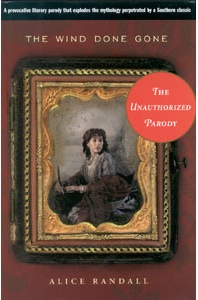
Another famous case involves Alice Randall's "The Wind Done Gone," a parody of Margaret Mitchell's "Gone With the Wind." Here's a picture of Randall's book:
Note the large orange sticker proclaiming "The Unauthorized Parody." Mitchell's work tells the story of Scarlett O'Hara who lived in the South during the Reconstruction era. Randall's novel covers the same story, but from the viewpoint of Cynara, a plantation slave. Even though Randall used the same characters, and in some instances the exact same lines of dialog, her use was fair because her work was a critical commentary of the social life that "Gone With the Wind" portrays. In this case, Randall was allowed to take a large portion of Mitchell's work because it was necessary to create an effective commentary.
If you are evaluating whether your use is fair, ask yourself the following questions: does my use serve a different purpose than the earlier work? Does my use add something valuable to the original work, like new insights or understandings? Have I added creative thoughts that transform the meaning of the original work? See if you can describe your use as criticism, comment, news reporting, teaching, scholarship, or research. If so, then your use will likely be fair.
Factor Two: The Nature of the Copyrighted Work
The second factor is the nature of Annie's work. In general, copyright law does not protect facts and ideas. If the copyrighted work is informative or functional, such as a biography or news report, then a fair use defense seems more likely. On the other hand, if the copyrighted work is deemed �creative� (i.e. a fictional novel) then the second factor will weigh against fair use.
In addition, fair use is more likely when dealing with a published work rather than an unpublished one. Judges feel strongly that authors should be able to determine when their work first reaches the public.
Factor Three: The amount and substantiality of the portion used in relation to the copyrighted work as a whole
The third factor deals with how much of Andy�s work appears in Terry�s work. As a general rule of thumb, less is better. Nevertheless, there are cases in which a using an entire work is still permitted. Parody, for example, requires using a significant portion of a work for the parody to be effective. The value we derive from parody is important enough to overcome the copyrights in the original work.
There is also a qualitative limit to how much you can use. Try to avoid taking "the heart," or most important part of a work. If you use the most exciting portions of a novel, nobody will want to buy it after reading your work. As a general principle, take only what you need to make your point.
As a side note, copyright law recognizes a "de minimus" exception to the exclusive rights. This applies when what you've used is too small to be copyright infringement in the first place. If you have only taken a few words or phrases then there will be no infringement and no need for fair use. I bring it up here since we are talking about how much of a work you can use.
Factor Four: The effect of the use upon the potential market for or value of the copyrighted work
The fourth factor is sometimes the most influential. It considers the effect your use has on the market value for the copyrighted work. In general terms, is the copyright owner losing money? Fair use is less likely if the new work competes with the original or if fair use is claimed to avoid paying licensing fees. At the same time, there are limits to the inquiry. For example, a thumbs-down review of a book can hurt sales and cause the writer to lose money � but that is not the kind of harm we are worried about. Here the writer loses money because his book is bad and not because copying lowered the value of the work. In our situation, Terry�s copying of Annie's work probably won�t hurt the market value of the book overall and so this factor won't count against Terry.
If you own the copyright, instead of thinking of how another's use could hurt the value of your work, try thinking of how to collaborate and promote business opportunites. Turning a competitor into a collegue can infuse additional creativity into your work and harness the positive buzz that creative collaboration produces. This, in turn, might open up new channels of revenue. This approach won't always work - there are certain individuals who make better defendants than business partners - but in today's digital society, the old fashion approach may not be the best for your business. See my unsolicited advice in chapter 3.
Balancing the factors
In litigation, a court will balance all the factors and decide if your use was fair. Because there are so many variables, it is tough to know exactly how things will pan out. But to give you a some idea, I've made a chart diagramming the factors. The blue column are factors that weigh towards fair use and the red column weighs against fair use. For a rough estimate, see how many factors apply to your situation. This is an innacurate assessment but it should give you some idea of what would happen.
Factor
For Fair Use
Against Fair Use
Purpose and Character of Use
Non-profit
Commercial
Educational/Teaching
Transformative
Criticism/Commentary
Parody
Nature of Copyrighted Work
Factual
Fictional
Published
Unpublished
Highly Creative
Amount used
Very little used
A substantial portion used
Portion used not central to work
Portion used is the heart of the work
Amount is appropriate for nature of use
Overall Market Effect
Lawfully acquired original work
Impairs market for
licensing
Few overall copies made
Impairs market for derivative works
No significant effect on the market
Creates a substitute good in the market
No similar product
Affordable licensing methods available
No existing licensing
method
If you feel your case is in a grey area (or in this case purple), I recommend visiting your friendly copyright lawyer for specific analysis of your situation. In addition, Stanford University disscusses risk management suggestions for these grey/purple areas. More on that below.
There are other helpful references on the web. I'll cover some of these in more detain in the next section. But for now I'll mention a couple and hold my comments for part III. Indiana University has created a helpful Fair Use Checklist for a quick visual reference of where you might stand on the issue. If you would like to read more examples of what is and isn't fair use, visit Stanford University's Copyright and Fair Use Page. Their Fair Use webpage is really well done. Georgia K. Harper has written a website which provides some “Rules of Thumb” guidelines as well as an alternative view of the fair use factors.
If you'd like to see some numbers and a clever visual interpretation of the fair use factors, Benedict O'Mahoney created a nifty "Fair Use Visualizer." While his results may or may not accurately reflect what a judge will think, the visualizer can provide a suggestion of how the factors could work together. If nothing else, it gives you a quantitative response. I suggest reading his methodology if you want to rely on his results.
Part III – More Help, Please!
The problem with explaining the four fair use factors is that the law really doesn’t provide much guidance to a specific person on a specific issue. Luckily, there is a lot more information and examples published on the internet which can provide better insights and suggestions and help you navigate these tricky waters.
However, not all websites accurately describe the legal scene. Some sites spin fair use narrowly to serve a specific interest, and some just make honest mistakes. To help you sort out what is accurate, and what is not, the following segment will review some of the more popular websites on fair use. That way, as you learn more about fair use, you’ll be guided by accurate information.
Top Google Hits
First, here are some of the top websites found through a google search with the term “fair use.” I start with these because they are the sites most likely to be read.
1. Wikipedia. This user generated encyclopedia provides a thorough analysis of fair use with multiple examples from existing case law. Looking at their text, I would emphasize that fair use derives from the purpose of the copyright act, and not just the first amendment. This is important because some uses of copyrighted material will be covered by fair use even if it doesn't fit well with the first amendment. Wikipedia does mention this in a later paragraph, but the point is important enough that I want to reiterate it. I also recommend reading the "common misconceptions" section.
Unfortunately, the article doesn't explain the role specific people play in copyright, such as teachers. Fair use was designed with teaching in mind, and that makes a big difference between what a teacher can do and what a corporation can do. If your job or work places you in a category where your efforts comment, teach, criticize, or otherwise enrich public learning, you have extra room to maneuver.
Wikipedia also provides multiple links to other websites for further reading. I’ve covered many of them within this website and recommend viewing the others for quality information. Usually (though not always) a website with accurate information will link to other accurate websites and vice versa.
2. U.S. Copyright Office. These are the folks to whom you apply to register your copyright. They post a copy of the copyright laws, which is helpful, but their commentary on fair use is not very thorough. What little they say, however, is accurate.
3. Stanford Copyright & Fair Use Center. This website provides a wealth of quality information about copyright and fair use (as its name implies). For purposes of this chapter, I will confine my comments to the fair use portions. Here’s a statement I’d like amend. They state “If it's not a fair use, then you are infringing upon the rights of the copyright owner and may be liable for damages.”
This is not necessarily true. Fair use applies ONLY if you have used the work in an otherwise infringing manner. For example, if I use all the ideas and facts in a work, as long as I haven’t copied the expression of those ideas, then there is no infringement regardless of whether or not fair use would apply. Remember, fair use saves you from the §106 rights – if you haven’t violated those then you are not infringing no matter what.
From a practical standpoint, I recommend their “Disagreements Over Fair Use: When Are You Likely to Get Sued?” page. Lawsuits cost money, even if your use is legitimate. For some people, a lawsuit itself is simply too costly to risk. I would add other suggestions to lower your chances of a lawsuit (and increase business), such as:
Attribute your source. Copyright law does not require it, and attribution won’t save you in a lawsuit. But giving credit where credit is due will make is less likely that the author gets upset and sues in the first place.
Highlight the value your work brings to the original work. If artists recognize that your work is free advertising or increases the value of their work then they are less likely to make a fuss about it
Propose a future joint-endeavor. Creating a lucrative business opportunity will establish a relationship of trust and provide an avenue of prospective revenue. Once the author sees you as an ally rather than a competitor, the lawsuits and lawyers will significantly diminish.
4. University of Texas’ Crash Course in Copyright. This website takes a different approach and provides more specific guidelines then the four-factor legal test. The downside is that, in order to provide concrete rules, they only explain cases that arise in the university context. Also, their approach runs on the conservative side – which is useful if you want to avoid a lawsuit even if that means foregoing some uses that could be fair. This is the general complaint I have against many of the "educational" fair use pages. While there is nothing wrong with taking a conservative stance, school boards interpret the already conservative statements narrowly when drafting school policies. Teachers then add their own limiting interpretation - which means they forgo uses that would be fair. Who loses? We all do.
5. Fairusenetwork.org. This is a website created by the NYU school of Law. Their fair use discussion covers the four factors and provides a couple extra examples for illustrative purposes. But what may be more helpful is their blog which provides current cases and controversies surrounding fair use. The value comes from seeing where current judges are drawing the line for fair use to see larger trends. Plus, you can drop interesting copyright trivia at dinner parties!
In addition, this site hosts useful information about cease and desist/takedown notices. I’ll talk about these more in chapter 5. Also useful is their “Directory of Legal Guides for Creators of All Kinds.” This page provides links to copyright guides tailored to specific mediums, such as bloggers or historians.
6. The Copyright Management Center. This website begins with a disclaimer that it will be going down soon – since this material will soon become unavailable I will give only a brief analysis. One helpful resource is a “fair use checklist” which tracks the four-factor legal test. One advantage of using their site is that you will have a written record of your endeavors to follow copyright law. This can be useful evidence in avoiding a lawsuit or establishing your good faith effort to obey the law. Even after this site disappears, you can continue to document your good faith efforts independently.
7. Fair Use in a Nutshell. Lloyd J. Jassin expands the normal legal analysis of the fair use factors to include helpful suggestions from a practical standpoint. For the most part, his points are sound but I’d like to add one thing. He states “[b]eing a non-profit educational institution does not let you off the hook. Even non-commercial users can be sued if the use exceeds the bounds of fair use.” While a non-profit educational institution can indeed be sued, the copyright owner must still prove infringement. And if you have a good faith belief your use was fair any penalty will be minimal. See chapter 6. In fact, the reward a copyright owner would receive is probably much less than his attorney’s bill – so the risk of a lawsuit is even smaller. Who you are does play an important part in your risk analysis and fair use determination.
Other sites
Continuing on, I’d like to briefly mention a couple of websites I recommend you visit – and also a couple I'd avoid. On the whole, these websites either provide a clear picture of the law, practical and understandable advice for application, or (for the bad sites) a false or misleading statement about what you can or can’t do. I include the negative sites as well as the positive ones to point out prevailing viewpoints that simply should not exist and run against the underlying point of copyright law.
First, please read Susan Kornfield's “Fair Use in an Era of Competing Copyright Stakeholders.” She does a remarkable job explaining copyright law and fair use in an understandable way. Her information relates to several of the chapters in this webpage. After you have finished reading it, forward it to your friends and associates. Changing public perception of copyright law is half the battle.
If you are a teacher DO NOT rely on The Educational CyberPlayground. This site was #2 on a google search for "copyright for teachers" and appears on its face to be a helpful guide. But the information they provide is misleading. Let's start from the top. They boldly display "You have permission to cite." I have no idea what they are talking about. Copyright protects creative expression, not whether someone can cite a source or not. If you happen to click on their "permissions" link, you arrive at a page that states:
"Requests from people who want to take one of the Educational Cyberplayground url's information then modify it for a particular audience, and redistribute will be refused."
First, information isn't even copyrightable - facts and ideas are specifically excluded. Second, of all websites, you'd think this one would acknowledge the possibility of fair use of any copied expression. The point is, I can think of many situations in which they would refuse permission when they have no right to refuse!
I'll skip to the main point I want to make. This website proports to instruct teachers how much of a source they can use in their classroom, according to copyright law (i.e. "Up to 10 percent of the total or 1,000 words, whichever is less."). There is absolutely no legal basis for this claim. If a teacher incorporates portions of a news article to teach about current events, she can use 11% if she needs to - in fact, she could probably use the whole article. The whole point of copyright law is to provide articles for teachers to use!
Unfortunately, this problem is present on many webpages. Several of the top hits on my google search had these same remarks (for example, the University of Maryland University College ). These guidelines are absolutely not what the law requires. If you haven't already, read Susan Kornfield's article. She explains how these guidelines came about and why they are not the law.
At first, a set of guidelines may seem like a good idea. But there is a problem hiding in the details. These guidelines are very conservative and narrow the field of possible fair uses. Those who follow them will likely stay on the safe side of the line, restricting fair use even more. The problem arises when this conduct becomes the norm, so that the artificially induced behavior becomes the standard against which fair use is measured. When this occurs, we have frustrated the very purpose of copyright law.
While I am on this negative note, please avoid Music United. They spin copyright law more than the Harlem Globetrotters spin a basketball. They are very interested in squashing any use, legitimate or not, that doesn't pay them more money. That statement is probably exessively cynical, but I'm very unhappy with how they portray copyright law. If you read it, please feel free to disregard anything they say.