Internet Business Foundations
Chapter 8 - IT Project Management
Project: A sequence of tasks that have to be done to carry out a desired task in a specified time. Project elements include schedules, costs and performance schedules.
Project Management: Applying skills and processes to achieve deadlines and desired outcomes.
Task: A unit of work that must be carried out within a project.
Resource: A person, device, computer program etc. available for carrying out a task.
Scope: The work required to carry out a particular task or project. When this is extended gradually, surreptitiously, it is called scope creep.
Stakeholder: A person with a vested interest in the success of a project, or influence (positive or negative) over its success.
Planning skills sequence:
- Identify the project stakeholders.
- Acquire the right staff/skills for the project.
- Develop and manage teams.
Skills needed:
- Organisational skills - manage the project plan, ensure tasks start and end on schedule, manage a variety of tasks simultaneously.
- Communication skills - gather requirements from client, communicate progress to clients and other team members.
- Problem solving skills - identify current and potential problems, make appropriate (often difficult) decisions on time.
Project Management Phases
-
Initiation - sets the foundation for the project.
- Conduct a needs analysis to identify customer requirements.
- Determine
- project objectives, goals together with deadlines ("deliverables"), final and intermediate tasks,
- assumptions (factors considered true for the purposes of the project),
- constraints (factors putting limits on one's options). The major constraints are time, resources (budget, equipment, personel) and scope.
- Determine a statement of work (SOW), which outlines project objectives for each task to ensure objectives are met. Clearly defined goals and plan agreed-on by all.
-
Planning identifies tasks required to achieve goals, estimating time needed and task dependencies.
- Project schedule - dates when tasks must be completed, goals met.
- Project team - individuals, possibly from different departments, with different responsibilities/priorities (e.g. accounts, marketing, IT). Appoint a project manager.
-
Execution and Control - delegating tasks, co-ordinating activities, producing action plans and status reports, managing conflicts of interest. May need to adjust project plan or, in extremis, terminate the project.
- Closing - evaluating whether project has met requirements.
- Test the project! (Quality Assurance)
- What can be learned from it?
- Evaluate the performances of team members
- Future recommendations.
- The final step is to get a formal acceptance from the customer.
- If the project is successful, consider saving it to use as a template in future.
| The Project Triangle Each element competes with the others. |
 |
Project Management Software - stores schedule information in a database.
- Stores the following information: Project start date, project calendar, necessary tasks and their durations, resources and their costs.
- Can compare actual performance with planned performance.
- Alert you if project is behind schedule or above budget.
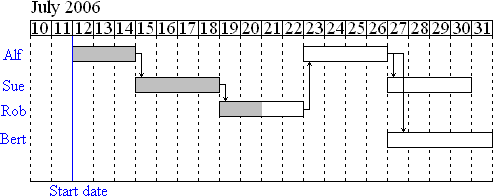
Gantt charts - visual representation of task dependencies.
- Horizontal axis = time line, vertical axis = team or team member
- Arrows link tasks to indicate dependency (one must end before the next starts).
- Vertical lines indicate scheduled start and end dates for project.
- Shading the portion of tasks that are completed.
Documenting Projects
- Paper Trial - printed record of which members worked on which tasks, when they started/finished. Team members should sign and date the documents. This promotes team member accountability.
- Issues log - list of problems that needed to be passed on to management or people outside the team. Use this to justify any changes/delays beyond the team's control.
Quality Assurance - Does the project meet the client's requirements? To assure the quality of the project
- Separate duties (or Segregate duties). Verify each step of the project independently. Allow a team member working on one task to test the work done by another member on another task.
- Adhere to ISO 9000 standards, produced by International Organization for Standards, an international quality benchmark.
IT Business Implications
- Possible organisational rules and policies include:
- You can initiate a project only when a form is submitted to do so.
- Rules about employees working overtime while systems are being altered.
- Training employees to use the new system may take them away from their existing duties.
- Rules about strict documentation of tasks.
- Rights of IT professionals include: access to tools needed, clear and detailed objectives and instructions.
- Duties of IT professionals include: provide services and products on time, on budget and securely, plan service and product installations, conduct training so as to minimise disruption.
Effects of IT projects on productivity
When IT projects affect systems that employees use,
- inform employees about systems affected, the starting and ending dates/times.
- Provide alternatives for when systems are offline.
- Perform tasks during off-peak hours to minimise disruption.
- Provide training and support for the new system, answer questions and solve problems.
When IT projects are managed properly:
- Employee productivity is minimised
- Transition to the new system is swift and smooth.
- Fewer problems occur, needing less IT support.
- Good will is fostered among departments, who view IT as a useful service.
Return on Investment (ROI) - How long will the project take to pay for itself?
- Project manager is responsible for justifying costs and explaining its benefits relative to the costs.
- Will the system translate into greater sales?
- Will the system attract more customers?
- You should provide evidence to answer these questions.
Project Management Institute (PMI) - a non-profit organisation that publishes standards and offers training in project management.
Project Management Body of Knowledge outlines 9 topics that define project management:
- Project Integration Management - all project elements are co-ordinate by the project plan.
- Project Scope Management - define tasks and resources needed to meet objectives, identify budget constraints.
- Project Time Management - define task durations to ensure task is completed by the deadline.
- Project Cost Management - control expenses to ensure budget is met.
- Project Quality Management - proper quality assurance and testing to make sure requirements are met.
- Project Human Resources Management - assign tasks correctly to team members to maximise efficiency.
- Project Communications Management - communicate information and project status among the team promptly.
- Project Risk Management - analyse risks relative to ROI to determine whether to proceed/terminate the project.
- Project Procurement Management - obtain resources needed to meet goals.