| What's in a Name? |
|
The
earliest reference to the O'Davorens in print is in the Annals of the
Four Masters in the year 1364, where the death of Giollananaomh Ua
Duibhdabhoireann, ollamh (professor) of Corcomdhruadh in Brehon
law, is recorded. The members of the sept held this high and responsible
office continuously down to the general debacle, which followed the
rising of 1641. "They were scholars by descent and profession
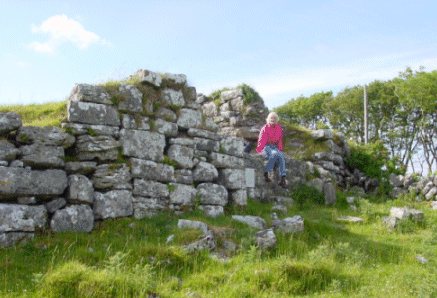
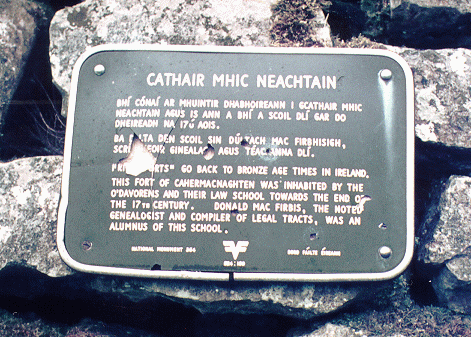
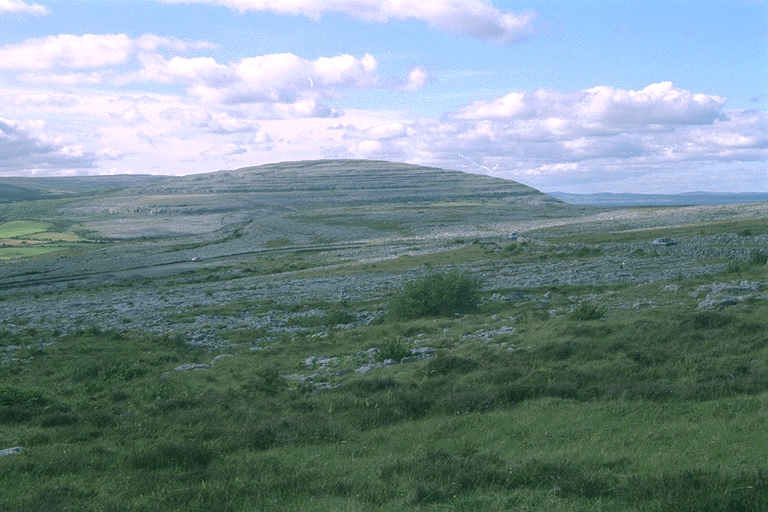
and the pen achieved their glory, not the sword." The name Dubhdabhoireann literally means the dark (people) of the two Burrens. "Burren" means "rock" in the Irish language. "The Burren" is a dominant limestone outcrop in County Clare and the Davoren Law School at Cahermcnaughten, the only significant monument to the family in Ireland, is located in the Burren some two kilometres from the turn off at the top of Corkscrew Hill between Listoonvarna and Ballyvaughn.
O'(Davorens) have been recorded as living in this region of County Clare since 1317 and probably their ancestors before them. A visit to this region today, will still find businesses and hotels owned by Davorens. |
 |
 |
|
The Burren |
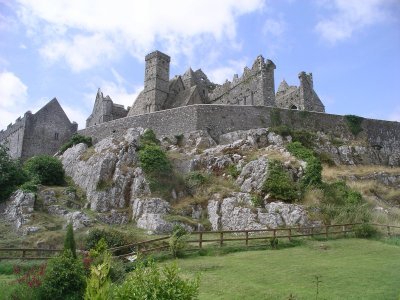
Cashel |
| However
it is more likely that the Rock of Cashel is the source of the name.
Caisel or as it is now, Cashel, in County Tipperary, was the traditional
home of the Eoghanachti who ruled the Southern half of Ireland until the
rise of the Dalcassians The Eoghanachts' forefather Eogan, was believed
to have been exiled in Britain and returned to establish a federation of
dynasties in the 7th Century who conquered and ruled Munster from their
fortress at Cashel. The O'Davorens, belonged to the Eoghanacht stock
claiming name and descent from the son of Aengus, King of Cashel, slain
976. The Dalcassians supplanted the Eoghanachts in 978 led by Brian Boru. |
|
The
Davorens hereditary line is also linked to the Dalcassian clan as the
hereditary links below show. More on the Dalcassians on the link Dalcassians EOGHANACHT
Race of Eoghan Mor, son of Oilioll Olum, King of Munster in the 3rd
century, which was sub-divided into E. Chaisil, E. Locha Lein, E. Aine,
&c., and to which belonged the chief families of South Munster.
DAL
gCAIS Race of Cas, the sixth in descent from Cormac Cas, son of Oilioll
Olum, King of Munster in the 3rd century; the name of the great clan of
Thomond, or North Munster, which embraced several distinguished families
and of which the O'Briens were the chiefs. Dr
Edward Maclysaght in his book "More Irish Families" states:
"O'DAVOREN. Formerly a flourishing Thomond sept, the O'Davorens
have now dwindled to small numbers but are still found in Clare and the
adjoining county of Tipperary. They are described as formerly a learned
brehon family seated at Lisdoonvarna, where they had a literary and
legal school, among the pupils of which was Duald MacFirbis, the most
distinguished of that celebrated family of Irish antiquaries. The Four
Masters record the death in 1364 of Gillananaev 0 Duibhdabhoireann, (as
the name was originally spelt), chief brehon of Corcomroe. It was first
anglicised phonetically as O'Duvdavoren and later shortened to
O'Davoren. The " Wars of Torlough " mention Coradh mic
Dabhoirenn, i.e. Davoren's weir near Corofin, in 1317. Dubh (black) an
da Bhoireann (of the two Burrens) is the suggested derivation of the
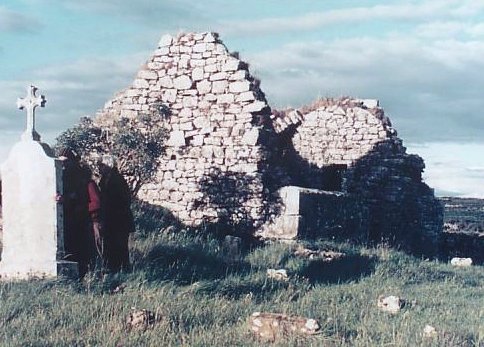
name.The O'Davorens had a mortuary chapel in the now vanished church of
Noughaval in north Co. Clare."
The
genealogy of the O'Davorens is well recorded thanks to Dr George U
Macnamara a genealogist in a series of papers entitled “The
O’Davorens of Cahermacnaughten”
His wife was a "Davoren" which no doubt inspired his
research. There is a tribute to him at the museum at Corofin. Much of
the information contained on these pages relates to a series of articles
written by him. An original copy of the papers is in the library at
Trinity College. You
can download a PDF file of this 55 page document from this site. The
O'Davorens of Cahermacnaughten
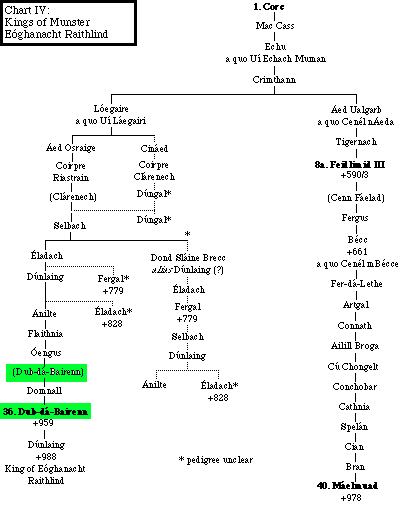
See also chart "Kings
of Munster" Dr
George U Macnamara wrote, "the sept was at all times, a small
one, and consequently did not hold much land. In 1641 they were confined
to the parishes of Noughaval and Rathborney, with the exception of one
townland, or part of townland, in Carran. They, were all ruthlessly
evicted by the Cromwellians, but after the Restoration some seem to have
got small grants as 'transplanted papists." (The latter refers to
Cromwell's Connacht or Hell decree and could supply the clue as to why
my ancestors found themselves in Ogonolloe). Dr
George U Macnamara's document is interesting as an insight into the
history of the Davoren's and their law school at Cahermacnaughten and
because of the detailed genealogy presented by Dr Macnamara, provides a
tool to perhaps discover one's roots (if one is a Davoren of course). The
importance that the Irish placed on recording and preserving the true
descent of the male line was due to the fact that every male member of
the ruling family was "King stuff" entitled to his proper
share of the tribal land. So apart from pride of birth, in a more
pragmatic sense, with constant threats to the existence of his seniors
through war or plague, there had to be incontestable proof of
succession. The process of recording and maintaining genealogies
remained part of the Irish culture long after the English had
confiscated their lands and entitlements. Knowing one's place in history
remains important to Irish people, as those who visit this and other
pages related to Irish genealogies will agree. As
the O'Davorens were a ruling family, their pedigree was maintained
through to the 18th century. The situation was more likely that through
poverty, starvation and being deprived of education, survival became
more important than maintaining pedigrees. Two or three generations of
this transformed most of the old stock into peasants. The O'Davorens
suffered better than most and had obtained lands: According to Dr
Macnamara,”the O'davorens had not undergone the process of complete
Anglicisation, nor had they lost their family pride. In a word they had
not become marmedukes- to which is probably due to the preservation of
the pedigree.” The
original pedigree was owned by Dr Macnamara and is believed to be the
only Davoren pedigree in existence. Download
Chart
pedigree of the O'Davorens Dr Macnamara extended the original pedigree to 1912. (This information is included in the PDF file.) I was contacted by the, now deceased, New Zealand wife of an descendant of the Reverend Michael Davoren, mentioned in the research by Dr George U Macnamara. She had traced and recorded her family's line to present times. Of course most of us Davorens, or the various derivations of the name, are not direct descendants of Aodh son of Giollanaomh og, one of the brothers who made partition of their father's lands in 1606 or of the other brother, Cosnamhach, as recorded by Dr Macnamara and it is unlikely any records exist to connect most of us (Davorens) to the ancient Kings of Ireland. Modern Gene Technology makes it possible to find these connections if they exist. There are currently many DNA projects being sponsored by Family Tree DNA. Each Surname project has a program Administrator. Recently I was contacted by Tighe O'Donoghue the Co-ordinator of tribal history for The O’Donoghue Society, and in that capacity is engaged in on-going research. He also believes that the O'Davorens like the O'Donoghues are descended from the King of Munster (Cashel) who was grandson of Aengus, King of Eoghanacht of Rathlind. This link is confirmed in the Chart Pedigree of the O'Davorens. He believes that I (and other Davoren's) might find it worthwhile to discover if they share the same ancestry as the O ‘Donoghues Mor, Princes of Loch Lein, who, too, were of the Eoghanacht of Rathlind. A simple test offered by the FTDNA (Family Tree DNA) in conjunction with the O’Donoghue Society, will read your genetic profile and tell you whether you share the illustrious ancestor Dubhdaburren II. You can contact the O’Donoghue Society for further information. As
links have already been verified to a number of Dalcassians families and
the Davoren's have a common ancestor to them, it is possible to
determine conclusively (or otherwise) if you as a Davoren, are
genetically linked to the ancient Kings of Ireland. Unfortunately there
is no land, title or crown to go with this knowledge.
|