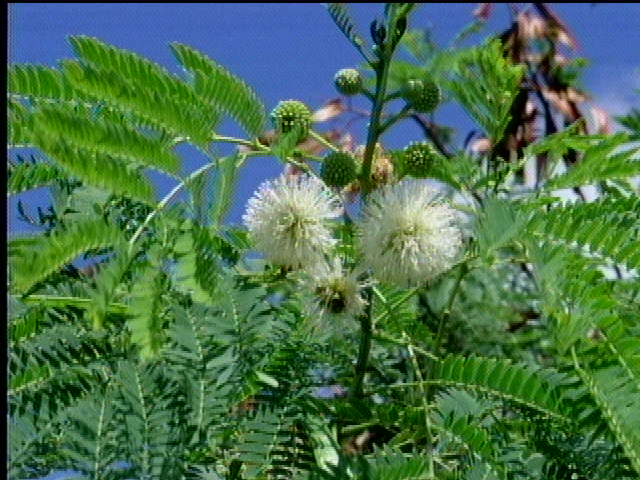
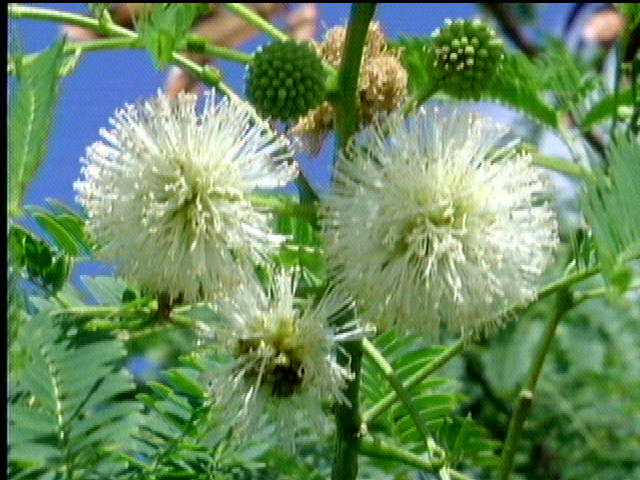
Leucaena leucocephala
Family: Leguminosae (Fabaceae)
Description: Arborescent deciduous small tree or shrub, to 20 m tall, fast-growing; trunk 10�25 cm in diam., forming dense stands; where crowded, slender trunks are formed with short bushy tuft at crown, spreading if singly grown; leaves evergreen, alternate, 10�25 cm long, malodorous when crushed, bipinnate with 3�10 pairs of pinnae, these each with 10�20 pairs of sessile narrowly oblong to lanceolate, gray-green leaflets 1�2 cm long, less than 0.3 cm wide.
Flowers: Numerous, axillary on long stalks, white, in dense global heads 1�2 cm across; fruit pod with raised border, flat, thin, becoming dark brown and hard, 10�15 cm long, 1.6�2.5 cm wide, dehiscent at both sutures; seeds copiously produced, 15�30 per pod, oval, flattish, shining brown.
Found: Native throughout the West Indies from Bahamas and Cuba to Trinidad and Tobago, and from southern Mexico to northern South America. Naturalized northward to southern Texas, California and southern Florida, and southward to Brazil and Chile: also naturalized in Hawaii and the Old World tropics.
Note: Leadtree is valued as an excellent protein source for cattle fodder, consumed browsed or harvested, mature or immature, green or dry. The nutritive value is equal to or superior to alfalfa. Leadtree has gained a favorable reputation in land reclamation, erosion control, water conservation, reforestation and soil improvement programs, and is a good cover and green manure crop. The leaves, used as a mulch around other crops, are said to significantly increase their yields. Seeds yield about 25 percent gum worthy of commercial investigation. Seeds after softening are strung as beans into various items of jewelry for tourists in Puerto Rico and the Virgin Islands. In the Philippine Islands, young pods are cooked as a vegetable and seeds are used as a substitute for coffee. Ripe seeds are sometimes eaten parched like popcorn. Wood is hard and heavy (sp. gr. 0.7), the sapwood light yellow, the heartwood yellow-brown to dark brown, used for fuel or charcoal. Plants are used in some countries for shade for black pepper, coffee, cocoa, quinine, and vanilla and for hedges. In many places, however, renegade seedlings have created a noxious weed situation. The dipilatory chemical mimosine has been used, experimentally at least, to shear sheep.