
PRESENT PERFECT
Use Present Perfect to express:
1st FACT IS MORE IMPORTANT THAN WHEN.
I have broken my leg. So, I can’t walk (my leg is broken right now)
2nd AN ACTION/STATE THAT STARTED IN THE PAST AND CONTINUES UP TO THE PRESENT.
I have worked here since 1990 (I still work here).
FORM:
TO WORK WORKED WORKED
|
AFFIRMATIVE |
QUESTION |
NEGATIVE |
|
(I,YOU) + HAVE/HAS + 3RD COLUMN (PAST PARTICIPLE of the main verb) I HAVE WORKED A LOT. (I’VE)
YOU HAVE WORKED A LOT.(YOU’VE)
HE HAS WORKED A LOT. (HE’S WORKED A LOT)
SHE HAS WORKED A LOT(SHE’S WORKED A LOT)
IT HAS WORKED ALOT (IT’S WORKED) |
HAVE/HAS + (I,YOU) + 3RD COLUMN (PAST PARTICIPLE of the main verb) HAVE I WORKED A LOT?
HAVE YOU WORKED A LOT?
HAS HE WORKED A LOT?
HAS SHE WORKED A LOT?
HAS IT WORKED A LOT? |
(I,YOU) + HAVE/HAS + NOT+ 3RD COLUMN (PAST PARTICIPLE of the main verb) I HAVE NOT WORKED A LOT (I HAVEN’T)
YOU HAVE NOT WORKED A LOT. (YOU HAVEN’T)
HE HAS NOT WORKED A LOT. (HE HASN’T WORKED A LOT)
SHE HAS NOT WORKED A LOT(SHE HASN’T WORKED A LOT)
IT HAS NOT WORKED. (IT HASN’T WORKED) |
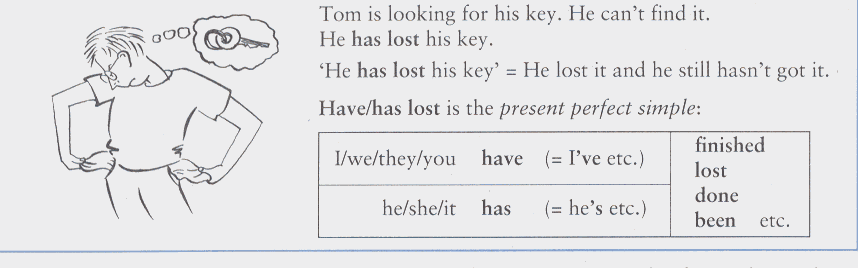
The present perfect simple is have/has + past participle. The past participle often ends in –ed (finished/decided etc.), but many important verbs are irregular (lost/done/been/written etc.).
When we use the present perfect there is always a connection with now. The action in the past has a result now:
.'Where's your key?' 'I don't know. I've lost it.' (I haven't got it now)
.He told me his name but I've forgotten it. (I can't remember it now)
.'Is Sally here?' 'No, she's gone out.' (she is out now)
.I can't find my bag. Have you seen it? (do you know where it is now?)
We often use the present perfect to give new information or to announce a recent happening:
.Ow! I've cut my finger. .
.The road is closed. There's beeen (= there has been) an accident.
.(from the news) The police have arrested two men in connection with the robbery.
-You can use the present perfect with just, already and yet:
Just = 'a short time ago':
.'Would you like something to eat?' 'No, thanks. I've just had lunch.'
.HelIo. Have you just arrived?
We use already to say that something happened sooner than expected
.'Don't forget to post the letter, will you?' 'I've already posted it.'
.'What time is Mark leaving?' 'He's already gone.'
Yet = 'until now' and shows that the speaker is expecting something to happen. Use yet only in questions and negative sentences (see also Unit 110C):
.Has it stopped raining yet?
.I've written the letter but I haven't posted it yet.
Note the difference between gone (to) and been (to):
.Jim is away on holiday. He has gone to Spain. (= he is there now or on his way there)
.Jane is back home from holiday now. She has been to Italy. (= she has now come back
from Italy)
The present perfect simple is have/has + past participle. The past participle often ends in -ed
(finished/decided etc.), but many important verbs are irregular (lost/done/been/written etc.). For a
list of irregular verbs, see Appendix 1.
When we use the present perfect there is always a connection with now. The action in the past
has a result now:
.'Where's your key?' 'I don't know. I've lost it.' (I haven't got it now)
.He told me his name but I've forgotten it. (I can't remember it now)
.'Is Sally here?' 'No, she's gone out.' (she is out now)
.1 can't find my bag. Have you seen it? (do you know where it is now?)
We often use the present perfect to give new information or to announce a recent happening:
.Ow! I've cut my finger. .
.The road is closed. There's been (= there has been) an accident.
.(from the news) The police have arrested two men in connection with the robbery.
You can use the present perfect with just, already and yet:
Just = 'a short time ago':
.'Would you like something to eat?' 'No, thanks. I've just had lunch.'
.HelIo. Have you just arrived?
We use already to say that something happened sooner than expected:
.'Don't forget to post the letter, will you?' 'I've already posted it.'
.'What time is Mark leaving?' 'He's already gone.'
Yet = 'until now' and shows that the speaker is expecting something to happen. Use yet only
in questions and negative sentences (see also Unit 110C):
.Has it stopped raining yet?
.I've written the letter but I haven't posted it yet
Note the difference between gone (to) and been (to):
.Jim is away on holiday. He has gone to Spain. (= he is there now or on his way there)
.Jane is back home from holiday now. She has been to Italy. (= she has now come back
from Italy)
Exercises
7.1 You are writing a letter to a friend. In the letter you give news about yourself and other people.
Use the words given to make sentences. Use the present perfect.
Dear Chris,
Lots of things have happened since I last wrote to you.
1 I/ buy / a new car I’ve bought a new car
2 my father / start / a new job
3 1/ give up / smoking
4 Charles and Sarah / go / to Brazil
5 Suzanne / have / a baby
7.2 Read the situations and write sentences. Choose one of the following:
arrive break go up grow improve lose
2 Margaret can't walk and her leg is in plaster. She...
3 Maria's English wasn't very good. Now it is much better.
4 Tim didn't have a beard last month. Now he has a beard...
5 This morning I was expecting a letter. Now I have it...
6 Last week the bus late was 80 pence. Now it is 90...
7.3 Complete B's sentences. Use the verb in brackets + just/already/yet (as shown).
1 A Would you like something to eat? B: No, thanks. I have just had lunch. (just/have)
2 Do you know where Julia is? Yes, I_____ her. (just/see)
3 What time is David leaving? He ______ (already/leave)
4 What's in the newspaper today? I don't know. I ____(not/read/yet)
5 Is Ann coming to the cinema with us? No, she____the film (already/see)
6 Are your friends here yet? Yes, they _____(just/arrive)
7 What does Tim think about your plan? I ____(not/tell/yet)
7.4 Read the situations and write sentences with just, already or yet.
1 After lunch you go to see a friend at her house. She says 'Would you like something to eat?'
You say: No, thank you.I’ve just had lunch(have lunch)
2 Joe goes auto Five minutes later, the phone rings and the caller says 'Can I speak to Joe?'
You say: I'm afraid ... (go out)
3 You are eating in a restaurant. The waiter thinks you have finished and starts to take your plate away. You say: Wait a minute! ______(not/finish)
4 You are going to a restaurant this evening. You phone to reserve a table. Later your friend says 'Shall I phone to reserve a table?' You say: No, __________it. (do)
5 You know that a friend of yours is looking for a job. Perhaps she has been successful. Ask her. You say:_________? (find)
6 Ann went to the bank, but a few minutes ago she returned. Somebody asks 'Is Ann still at the bank?' You say: No,_______ (come back)
7.5 Put in been or gone.
1 Jim is on holiday. He's ________to Italy.
2 HelIo! I've just _______to the shops. I've bought lots of things.
3 Alice isn't here at the moment. She's____ to the shop to get a newspaper.
4 Tom has____ out. He'll be back in about an hour
5 'Are you going to the bank?' 'No, I've already ____ to the bank.'
Present Perfect and Simple Past
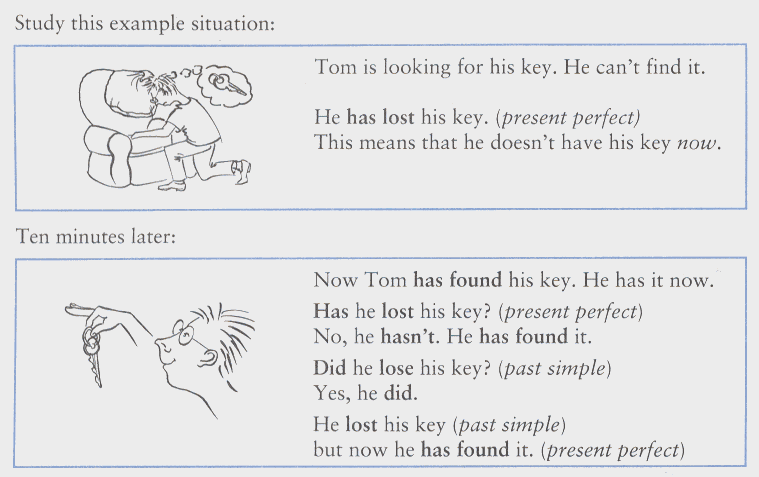
THE PRESENT PERFECT IS A PRESENT TENSE. It always tells us something about now. ‘Tom has lost his key' = he doesn't have his key now (see Unit 7).
THE PAST SIMPLE TELLS US ONLY ABOUT THE PAST. If somebody says 'Tom lost his key', we don't know whether he has it now or not. We only know that he lost it at some time in the past.
Two more examples:
.Jack grew a beard but now he has shaved it off. (so he doesn't have a beard now)
.They went out after lunch and they've just come back. (so they are back now)
Do not use the present perfect if there is no connection with the present (for example, things that happened a long time ago):
.The Chinese invented printing. (not 'have invented')
.How many plays did Shakespeare write? (not 'has Shakespeare written')
.Beethoven was a great composer. (not 'has been')
Compare:
.Shakespeare wrote many plays.
.My sister is a writer. She has written many books. (she still writes books)
We use the present perfect to give new information (see Unit 7). But if we continue to talk about it, we normally use the past simple:
.A: Ow! I've burnt myself.
B: How did you do that? (not 'have you done')
A: I picked up a hot dish. (not 'have picked')
.A: Look! Somebody has spilt milk on the carpet.
B: Well, it wasn't me. I didn't do it. (not 'hasn't been...haven't done')
A: I wonder who it was then. (not 'who it has been')
EXERCISES
13.1 What has happened in these situations?
1 Jack had a beard. Now he hasn't got a beard. HE HAS SHAVED OFF HIS BEARD.
2 Linda was here five minutes ago. Now she's in bed. She______
3 The temperature was 25 degrees. Now it is only 17. The temperature_______
4 The light was off. Now it is on. Somebody____
5 The tree was only three metres high. Now it is four. The tree _____
6 The plane was on the runway a few minutes ago. Now it is in the air.
The plane ________
13.2 Put the verbs in brackets in the correct form, present perfect or past simple.
1. ‘Where’s your key?’ ‘I don’t know. I’ve lost it.’(lose)
2 I was very tired, so I lay down on the bed and went to sleep. (be)
3 Mary____ to Australia for a while but she's back again now. (go)
4 'Where's Ken?' 'He_____ out. He'll be back in about an hour.' (go)
5 I did German at school but I ________most of it. (forget)
6 I meant to phone Diane last night but I _______(forget)
7 I _____ a headache earlier but I feel fine now. (have)
8 Look! There's an ambulance over there. There____ an accident. (be)
9 They're still building the new road. They_______ it. (not/finish)
10 'Is Helen still here?' 'No, she _________ out.' (just/go)
11 The 'police________ three people but later they let them go. (arrest)
12 Ann_______ me her address but I'm afraid I it. (give, lose)
13 Where's my bike? It________ outside the house. It________ !
(be, disappear)
14 What do you think of my English? Do you think I ________? (improve)
13.3 Are the underlined parts of these sentences right or wrong? Correct the ones that are wrong.
1 Do you know about Sue? She's given u12 her job. RIGHT..
2 The Chinese have invented printing. WRONG. The Chinese invented
3 How many plays has Shakespeare written? ___________
4 Have you read any of Shakespeare's plays?
5 Aristotle has been a Greek philosopher.
6 Ow! I've cut my finger. It's bleeding.
7 My grandparents have got married in London.
8 Where have you been born?
9 Mary isn't at home. She's gone shopping.
10 Albert Einstein has been the scientist who has developed
the theory of relativity.
13.4 (Section C) Put the verb into the most suitable form, present perfect or past simple.
1 A: Look! Somebody has spilt (spill) coffee on the carpet.
,B: Well, it wasn’t (not/be) me. I didn’t do(not/do) it.
2 A: Bem_________ (break) his leg.
B: Really? How ________(that/happen)?
A: He ____(fall) off a ladder.
3 A: Your hair looks nice.________ (you/have) a haircut?
B: Yes.
A: Who_______ (cut) it?________ (you/go) to the hairdresser?
B: No, a friend of mine__________ (do) it for me.
Present perfect and past (2) (I have done and I did)
Do not use the present perfect (I have done) when you talk about a finished time (for example, yesterday / ten minutes ago / in 1985 / when I was a child). Use a past tense:
.The weather was nice yesterday. (not 'has been nice')
.They arrived ten minutes ago. (not 'have arrived')
.I ate a lot of sweets when I was a child. (not 'have eaten')
.A: Did you see the news on television last night? (not 'Have you seen')
B: No, I went to bed early. (not 'have gone')
Use a past tense to ask When...? or What time...?:
.When did they arrive? (not 'have they arrived')
.What time did you finish work?
Compare:
Present perfect
.Tom has lost his key. He can't get into the house
Here, we are not thinking of the past action.
We are thinking of the present result of the
Action: Tom doesn’t have his key now.
Past simple
Tom lost his key yesterday. He couldn't get into the house.
Here, we are thinking of the action in the
past. We don't know from this sentence whether Tom has his key now.
Compare present perfect and past:
Present perfect (have done) Past simple (did)
.I've done a lot of work today. .I did a lot of work yesterday.
We use the present perfect for a period of We use the past simple for a finished time time that continues from the past until now. in the past. For example, yesterday, last

Present Perfect
.It hasn't rained this week.
.Have you seen Ann this morning?
(it is still morning)
.Have you seen Ann recently?
.I don't know where Ann is. I haven't
seen her. (= I haven't seen her recently) .We've been waiting for an hour.
(we are still waiting now)
.Ian lives in London. He has lived there for seven years.
.I have never played golf. (in my life)
The present perfect always has a connection with now. See Units 7-12.
Simple Past
.It didn't rain last week.
.Did you see Ann this morning?
(it is now afternoon or evening)
.Did you see Ann on Sunday?
.A: Was Ann at the party on Sunday?
B: I don't think so. I didn't see her.
.We waited (or were waiting) for an
hour. (we are no longer waiting)
.Ian lived in Scotland for ten years.
Now he lives in London.
.I didn't play golf when I was on
holiday last summer.
The past simple tells us only about the
past.
EXERCISES 14
14.1
Are the underlined parts of these sentences right or wrong? Correct the ones that are wrong.1. I’ve lost my key. I can’t find it anywhere. RIGHT
2.Have you seen the news on television last night? WRONG: Did you see
3 I've bought a new car. Do you want to see it? _____
4 I've bought a new car last week. _____
5 Where have you been yesterday evening? _____
6 Jenny has left school in 1991___
7 I'm looking for Mike. Have you seen him?____
8 I'm very hungry. I haven't eaten anything today. _____
9 Diane hasn't been at work yesterday. ______
10 When has this book been published? ____
14.2 Make sentences from the words in brackets. Use the present perfect or past simple.
1 (it / not / rain / this week) It hasn’t rained this week
2 (the weather / be / cold / recently) The weather___ \
3 (it / cold /Iast week) It ,
4 (I / not / read / a newspaper yesterday) I
5 (I / not / read / a newspaper today) ,
6 (Ann / earn / a lot of money / this year)
7 (she / not / earn / so much /last year) ,
8 (you / have / a holiday recently?) ,
14.3 Put the verb into the correct form, present perfect or past simple.
1 I don't know where Amy is. HAVE YOU SEEN (you/see) her?
2 When I _____(get) home last night, I ______(be)
very tired and I_______ (go) straight to bed.
3 Your car looks very clean._________ (you/wash) it?
4 George_______ (not/be) very well last week.
5 Mr Clark_______ (work) in a bank for 15 years. Then he gave it up.
6 Molly lives in Dublin. She _______ (live) there all her life.
7 '_____________ (you/go) to the cinema last night?' 'Yes, but it_______(be) a mistake. The film______ (be) awful.'
8 My grandfather _____ (die) 30 years ago. I_____ (never/meet) him.
9 I don't know Carol's husband. I_____ (never/meet/him).
10 A: Is your father at home? B: No, I'm afraid he _____(go) out.
A: When exactly_____ (he/go) out? B: About ten minutes ago.
11 A: Where do you live? B: In Boston.
A: How long______ (you/live) there? B: Five years.
A: Where______ (you/live) before that? B: In Chicago.
A: And how long______ (you/live) in Chicago? B: Two years.
14.4 Write sentences about yourself using the ideas in brackets.
1 (something you haven't done today)
2 (something you haven't done today)
3 (something you didn't do yesterday) ,
4 (something you did yesterday evening)
5 (something you haven't done recently)
6 (something you've done a lot recently) ___
RESPOSTAS DOS EXERCÍCIOS ACIMA:
UNIT 7
7.1
2 My father has started a new job.
3 I've given up smoking. / I have given...
4 Charles and Sarah have gone to Brazil.
S Suzanne has had a baby.
7.2
2 She has broken her leg. / She's broken...
3 Her English has improved. / It has improved. / It's improved.
4 He has grown a beard. / He's grown...
S The letter has arrived. / It has arrived. / It's arrived.
6 The bus fare has gone up. / It has gone up. / It's gone up.
7.3
2 've just seen / have just seen
3 's already left /has already left
4 haven't read it yet
S 's already seen / has already seen
6 've just arrived / have just arrived
7 haven't told him yet
7.4
2 he's just gone out / he has just gone out
3 I haven't finished yet.
4 I've already done / I have already done
5 Have you found a job yet?
6 she's just COME back / she has just COME back
7.5
2 been
3 gone
4 gone
5 been
UNIT 13
13.1
2 has gone to bed / 's gone to bed
3 has fallen / has dropped / has gone
down
4 has turned on the light / has turned the light on / has turned it on
5 has grown / 's grown
6 has taken off
13.2
3 went
4 has gone / 's gone
5 have forgotten / 've forgotten
6 forgot
7 had
8 has been / 's been
9 haven't finished
10 has just gone / 's just gone
11 arrested
12 gave ...lost or
have lost / 've lost
13 was ...has disappeared /
's disappeared
14 have improved / 've improved
13.3
3 wrong -did Shakespeare write
4 right
5 wrong -was
6 right
7 wrong -My grandparents got married.. .
8 wrong -were you born
9 right
10 wrong –WAS the scientist who developed.. .
13.4
2 has broken
did that happen
fell
3 Have you had
cut ...Did you go
did
UNIT 14
14.1
3 right
4 wrong -I bought
S wrong -were you
6 wrong -Jenny LEFT school
7 right
8 right
9 wrong -wasn't
10 wrong -When was this book published
14.2
2 The weather has been cold recently.
3 It was cold last week.
4 I didn't read a newspaper yesterday.
5 I haven't read a newspaper today.
6 Ann has earned a lot of money this
year.
7 She didn't earn so much last year.
8 Have you had a holiday recently?
14.3
2 got ...was ...went
3 Have you washed it? (Did you wash it? is also possible)
4 wasn't
S worked
6 has lived / 's lived
7 Did you go ...was ...was
8 died ...never met
9 have never met / 've never met
him
10 I'm afraid he has gone out. / ...he’s gone out.
When exactly did he go out?
11 How long have you lived there? Where did you live before that? And how long did you live in Chicago?
14.4
Example answers:
2 I haven't bought anything today.
3 I didn't watch TV yesterday.
4 I went out with some friends yesterday evening.
S I haven't been to the cinema recently.
6 I've been swimming a lot recently.

A. Vamos começar, exercitando a forma interrogativa
do Present Perfect. Você vai formar perguntas com ever (já,
alguma vez), advérbio muito empregado com este tempo ver-
bal. Siga o exemplo:
You/read Shakespeare
Have you ever read Shakespeare?
Have you ever been to Greece?
Has your brother ever visited our museum?
Have you ever had Chinese food?
Has he ever entered a synagogue?
Have you ever seen a Verdi opera?
Have they ever played cricket?
7. James/live in Brussels
Has James ever lived in Brussels?
8. the boyslstudy Joyce
Have the boys ever studied Joyce?
Already significa JÁ. Exemplos:
Have you ever read Shakespeare?
Yes, I've already read Shakespeare.
C. Na forma negativa do Present Perfect, são comuns
os advérbios never (nunca) e yet (ainda). Vamos, então, dar
respostas negativas às perguntas que formulamos no exercí-
cio A. Siga o exemplo:
Have you ever read Shakespeare?
No, I've never read Shakespeare.
No, I haven't read Shakespeare yet.
(YET perguntas= JÁ)
(YET negativa= AINDA)
(GENERAL IDEA = UNTIL NOW)
ALREADY IN QUESTIONS
HAVE YOU READ SHAKESPEARE ALREADY?
FINAL POSITION= SURPRISE
HAVE YOU ALREADY READ SHAKESPEARE?
MIDDLE = ‘YES’ IS EXPECTED AS AN ANSWER
Observe que never dispensa o not do auxiliar.
D. Agora vamos formular perguntas e indicar que o que
se pergunta acabou de ser feito. Siga o exemplo, observando
o emprego de yet (neste caso, significando "já") na pergunta:
Mary/wash/the windows
Hasn't Mary washed the windows yet?
Yes, she's just washed them.
1. the maid/sweep/the floor
2. the children/do/their homework
3. you/buy/a new car
4. she/try /this food
5. you/hear/this famous singer
6. the secretary/type/the letters
7. Peter/make/his bed
8. Judy/water/the flowers
1. Hasn’t the maid swept the floor yet?
2. Haven’t the children done their homework yet?
3. Haven’t you bought a new car yet?
4. Hasn’t she tried this food yet?
5. Haven’t you heard this famous singer yet?
6.Haven’t the secretary typed the letters yet?
7.Haven’t Peter made his bed yet?
8. Hasn’t Judy watered the flowers yet?
E. Responda às seguintes perguntas, usando since ou for.
Vale lembrar que since indica um ponto definido no passado
e for indica o tempo de duração de uma ação. Siga o exemplo:
How's your brother? (see/last summer)
I haven't seen him since last summer.
What about your sister? (talk to/two weeks)
I haven't talked to her for two weeks.
1. How's your grandmother? (visit/a Iong time)
2. What about your grandfather? (phone/February)
3. And how's your aunt? (write to/ages)
4. What about your parents? (hear from/last Christmas)
5. And your girlfriend? (speak to/five days)
6. How's Peter? (see/a couple of days)
7. What about that old friend of yours? (send a Ietter/1982)
8. And your wife? (talk to/this morning)
F. Use o Simple Past ou o Present Perfect:
1. My uncle (die) two years ago. He (work) for the same
company alI his Iife.
2. His uncle is a reliable man. He (work) for the same com-
pany alI his life.
3. You (be/ever) to London? Yes, I first (visit) it in 1972.
4. Up to now you (study) a Iot of English tenses.
5. Goodness! Won't this rain ever stop? It (rain) hard for
three days!
6. I (not eat) lobster since I (be) in Fortaleza Iast year.
7. The Second World War (begin) in 1939 and (end) in 1945.
8. Betty (wear) the same old dress since the beginning of the
month.
9. Mother (cook) alI morning but lunch is not ready yet
10. You (sIeep) well last night?
1. My uncle DIED two years ago. He WORKED for the same
company alI his Iife.
2. His uncle is a reliable man. He HAS WORKED for the same com-
pany alI his life.
3. HAVE YOU EVER BEEN to London? Yes, I first VISITED it in 1972.
4. Up to now you HAVE STUDIED a Iot of English tenses.
5. Goodness! Won't this rain ever stop? It HAS RAINED hard for
three days!
6. I HAVEN’T EATEN lobster since I WAS in Fortaleza Iast year.
7. The Second World War BEGAN in 1939 and ENDED in 1945.
8. Betty HAS WORN the same old dress since the beginning of the
month.
9. Mother HAS COOKED alI morning but lunch is not ready yet
10.DID YOU SLEEP well last night?
G. Passe as orações que se seguem para o inglês. Antes,
porém, reveja todo o emprego do Present Perfect:
1. Você já viu um disco-voador? Acho que vi um quando
estive nas montanhas no ano passado.
HAVE YOU EVER SEEN A FLYING SAUCER. I THINK I SAW ONE WHEN I WAS ON THE MOUNTAINS LAST YEAR.
