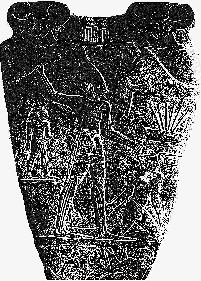
The Palette of Narmer, created in 3100 BC, is displayed in the Egyptian museum in Cairo. It is shown in a hauntingly spacious room, surrounded by monumental sculptures, in its own small glass case. It stands 25" tall and is wedge-shaped. Made of slate, its surface is smooth. The palette is carved in low-relief, and is divided into three horizontal bands that read from left to right. It depicts the values of the ancient Egyptian people and served a number of purposes.
The first value the palette shows is the prestige of Pharaoh Narmer. His image is the largest because he is the most important. This way of showing importance through size is called the Hierochic scale. One can also tell that this large, significant figure is a pharaoh because of his crown, It is the crown of Upper Egypt. The pharaoh is also seen in a formal rigid stance.
His power is also as evident. He carries a war club, and is depicted as having conquered his enemy single-handedly. There is no evidence of an army. Also, in the lower band, there are slain enemies. The pharaoh is strong enough to sin battles against these enemies, as shown on the palette.
Pharaoh means god-king. This is also demonstrated on the palette. The goddess Hathor is shown in the upper band as two human-headed cows. The god Horus is next to Narmer, controlling a human-headed hyroglyph with papyrus leaves. The pharaoh's divinity is displayed through Horus, because the pharaoh was believed to be the incarnation of Horus.
The importance, strength, and god-like status of the pharaoh Narmer is clearly evident in the carvings of the palette. The forcible unification of Upper and Lower Egypt is shown. This tells of its political purpose. It also served as a ritual item. It is buried with the pharaoh for him to use in the afterlife. The Palette of Narmer is truly a message, sotry and explanation from the far away Egyptian past.