ACKNOWLEDGEMENTS:
I did not think all of this up. I started my Panama home garden on May 2002 with a new vacation/retiree home that had no moist, dark dirt.
The house was surrounded with dry, hard, red clay and volcanic stones!
The construction bulldozers had removed all the dark topsoil before building the house.
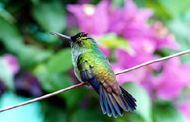
I knew I wanted my flowers to draw in the little green hummingbirds and the small singing finches.
I used Papa and Mama Lasso's (my wife's parents) advice on developing the home garden plan.
Lessons one and two (home garden and transplanting) were relearned by this Tuggle Road, Westport, Waunakee, Wisconsin farmboy the hard way. I killed alot of seed and plants before I got it right!
I even found dark clay dirt under the east side of the house! In that dark dirt a vegetable (guandu-cajanus cajan pigeon peas) grew bigger than a tree 20 feet high in just 5 months of rainy season!
It is called a pea tree by Craig Elevitch and Kim Wilkinson in "Nitrogen Fixing Trees - Overstory #4" at:
http://agroforestry.net/overstory/overstory4.html
Everybody in Panama grows the pea tree.
They call it guandu. It is canned and sold in the grocery stores. It is great with rice!
My home garden and farming guide in cold, temperate, Madison, Wisconsin has been:
http://www.organicgardening.com/
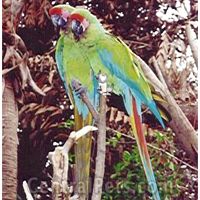
The finches love to eat the zinna and marigold flower seeds and the garden insects. Panama has all the birds of the Americas. I used the book: "A Guide to the Birds of Panama" by Roberts S. Ridgely and John A. Gwynne to sort them out.:
 :
:
more birds at: http://www.votawphotography.com/photo/Birds/birds.htm
I have given web links as credit to others.
The Spanish translation is by Oliver Mu�oz Esquivel from the Republic of Panama.
Oliver Mu�oz Esquivel
Bufete Esquivel & Asociados
Ave. Balboa,
Balboa Plaza Bldg.
Third Floor, Suite 312
Tel. (507) 269-7258
Fax. (507) 269-7259
Email: [email protected]
A great list of current authors is.
1. Danny Day's "Literature Cited"at:
www.eprida.com/hydro/2004doc.pdf
2. Amazonian Dark Earths: Explorations in Space and Time. Eds. Bruno Glaser and William I. Woods, Springer Verlag, Berlin Heidelberg New York.
ISBN 3540007547 July 2004 $139.
I agree with their ideas:
Draft 2004 Chapter 14 from Christoph Steiner
"Slash and Char: An Alternative to Slash and Burn Practiced in the Amazon Basin
Christoph Steiner1 1 Institute of Soil Science and Soil Geography, University of Bayreuth, 95440 Bayreuth, Germany ,2,
Wenceslau Geraldes Teixeira2 2 Embrapa Amaz�onia Ocidental, CP 319, 69011-970 Manaus, Brasil and
Wolfgang Zech1
SOM is defined as: Soil Organic Matter.
14.8 Conclusions
The observed effects of charcoal applications in slash and char agriculture seem to match the properties of the fertile anthropogenic terra preta soils in the Amazon Basin. Charcoal production is a lucrative activity and transfers SOM into stable pools when residues are used in agriculture. Where charcoal is produced the residues are used for soil amelioration. Farmers evolved various techniques to use charcoal residues. Due to the relatively low nutrient content, charcoal is mixed with chicken manure for planting holes or a nutrient-rich charcoal compost is produced for surface application. This compost could act as a slow-release fertilizer. In our experiments, soil charcoal amendments improved crop growth and yield significantly. We are conducting further experiments to determine the mechanisms of soil improvement through charcoal amendments and the efficiency of slash and char agriculture.
Should slash and char become common throughout the tropics it could serve as a significant carbon sink and could improve the sustainability of tropical agriculture.
Acknowledgements. The research was conducted within SHIFT ENV 45, a German�Brazilian cooperation, and financed by BMBF, Germany, and CNPq, Brazil. A financial contribution was given by the doctoral scholarship program of the Austrian Academy of Sciences. We are grateful for Johannes Lehmann�s (Cornell University) and Bruno Glaser�s (University of Bayreuth) valuable advice and for the fieldworkers� help particularly Luciana Ferreira da Silva and Franzisco Arag�ao Sim�ao and the laboratory technician, Marcia Pereira de Almeida. We thank Ilse Ackerman for her comments on a draft of this paper.
References
Artaxo P, Martins JV, Yamasoe MA, Proc�opio AS, Pauliquevis TM, Andreae MO, Guyon P, Gatti LV, Leal AMC (2002) Physical and chemical properties of aerosols in the wet and dry seasons in Rond�onia, Amazonia. J Geophys Res 107(Spec Issue 0):14
Bernoux M, Gra�ca PMA, Cerri CC, Fearnside PM, Feigl BJ, Piccolo MC (2001) Carbon storage in biomass and soils. In: Richey JE (ed) The biogeochemistry of the Amazon Basin. Oxford University Press, New York, pp 165�184
Coomes OT, Burt GJ (1999) Peasant charcoal production in the Peruvian Amazon: rainforest use and economic reliance. For Ecol Manage 140:39�50
Fancelli M (1999) Pragas. In: Alves �EJ (ed) A cultura da banana, aspectos t�ecnicos, socioecon�omicos e agroindustriais. Embrapa/SPI&Cruz das Almas. Embrapa-CNPMF, Brasilia, pp 409�431
Fearnside PM (1983) Land-use trends in the Brazilian region as factors in accelerating deforestation. Environ Cons 10:141�148 Fearnside PM (1997) Greenhouse gases from deforestation in Brazilian Amazonia: net committed emissions. Clim Change 35:321�360 Fearnside PM (2001) Effects of land use and forest management on the carbon cycle in the Brazilian Amazon. J Sustain For 12:79�97 Fearnside PM, Barbosa RI (1998) Soil carbon changes from conversion of forest to pasture in Brazilian Amazonia. For Ecol Manage 108:147�166 Fearnside PM, Guimar�aes WM (1996) Carbon uptake by secondary forest in Brazilian Amazonia. For Ecol Manage 80:35�45 Fearnside PM, Lima PM, Gra�ca A, Rodrigues FJA (2001) Burning of Amazonian rainforest: burning efficiency and charcoal formation in forest cleared for cattle pasture near Manaus, Brazil. For Ecol Manage 146:115�128
Gerais FCTDM (1985) Recuperac�ao de alcatr�ao vegetal. STI/CIT, Brasilia
Glaser B, Haumaier L, Guggenberger G, Zech W (1998) Black carbon in soils: the use of benzenecarboxylic acids as specific markers. Org Geochem 29:811�819 Glaser B, Balashov E, Haumaier L, Guggenberger G, Zech W (2000) Black carbon in density fractions of anthropogenic soils of the Brazilian Amazon region. Org Geochem 31:669�678 Glaser B, Haumaier L, Guggenberger G, Zech W(2001) The �terra preta� phenomenon: a model for sustainable agriculture in the humid tropics. Naturwissenschaften 88:37�41 Glaser B, Lehmann J, Zech W (2002) Ameliorating physical and chemical properties of highly weathered soils in the tropics with charcoal � a review. Biol Fertil Soils 35:219�230 Glass V (2001) Reportagens Tecnologia-Onde h�a fuma�ca h�a lucro. Globo Rural 188
Kuhlbusch TAJ, Crutzen PJ (1995) Toward a global estimate of black carbon in residues of vegetation fires representing a sink of atmospheric CO2 and a source of CO2. Global Biogeochem Cycles 9:491�501
Lehmann J, da Silva Jr JP, Steiner C, Nehls T, Glaser B, Zech W (2003) Nutrient availability and leaching in an archaeological Anthrosol and a Ferralsol of the central Amazon basin: fertilizer, manure and charcoal amendments. Plant Soil 249:343�357
Prado M (2000) The environmental and social impacts of wood charcoal in Brazil. Os Carvoeiros: the charcoal people of Brazil. Wild Images, Rio de Janeiro, 192 pp
Prance GT (1975) The history of the INPA capoeira based on ecological studies of Lecythidaceae. Acta Amazonica 5:261�263
Schmidt MWI, Noack AG (2000) Black carbon in soils and sediments: analysis, distribution, implications and current challenges. Global Biogeochem 14:777�793
Sombroek WG (1966) Amazon soils, a reconnaissance of the soils of the Brazilian Amazon region. Diss, Pudoc, Wageningen, The Netherlands Sombroek WG, Fearnside PM, Cravo M (2000) Geographic assessment of carbon stored in Amazonian terrestrial ecosystems and their soils in particular. In: Sewart BA (ed) Global climate change and tropical ecosystems. CRC Press, Boca Raton, 483 pp
Zech W, Haumaier L, Hempfling R (1990) Ecological aspects of soil organic matter in the tropical land use. Humic substances in soil and crop sciences; selected readings. American Society of Agronomy and Soil Science Society of America, Madison, pp 187�202 Zech W, Senesi N, Guggenberger G, Kaiser K, Lehmann J, Miano TM, Miltner A, Schroth G (1997) Factors controlling humification and mineralization of soil organic matter in the tropics."
3. A good tropical home garden book with lots of reading lists for advanced students:
"Home Gardens and Agrobiodiversity" edited by Pablo B. Eyzaguirre and Olga F. Linares (She was born in Panama.). Published 2004 by the Smithsonian Institution, Washington D.C.
I agree with Pablo and Olga when they say in the book's introduction:
"Many projects have been guided by western models of kitchen gardening. These horticultural models based on temperate vegetables are difficult to adapt to the social and environmental conditions of the tropics. Not enough scientific attention has been paid to traditional subsistence gardening systems within the tropics."(p.15)
I also agree with Pablo's and Olga's conclusion:
" With all the conservation values and economic benefits that home gardens may provide, is there any role for scientists concerned with biodiversity conservation and rural livelihoods?
Yes, there is a clear role to counteract and correct two main trends.
One is in the area of agricultural modernization and development that tends to undervalue the contribution of small, diverse, and messy patches such as home gardens. Often what is grown in home gardens is not sold or is consumed only occasionally; it may be medicinal or have spiritual value, but it is still ignored or looked down upon.
For these reasons the contribution and importance of the traditional home garden is overlooked. Development efforts are made to transform it into a vegetable patch or an orchard or to simply allow it to disappear as markets, health clinics, and higher yielding crop varieties take the place of the many products and services that the traditional home garden provides.
The other trend is to view home gardens from a single viewpoint or objective, be it income, nutrition, gardening, or species conservation. Only by considering the home garden holistically with all its cultural, ecological, spiritual, and economic services, can we provide the basis upon which this crucial system can continue to flourish.
In the final analysis, whether we conserve the biological and cultural resources of our world depends on how close to home the issues are felt. Those millions of households throughout the tropics that keep their biodiversity close at hand, that use it daily for multiple purposes, that imbue it with cultural and spiritual value are providing a lesson to all humanity about the importance and value of biodiversity.
If only for this reason, home gardens are to be celebrated, supported, and conserved." (p.286)
I am lucky that I can visit Tomas (Papa) Lasso and his tropical home garden near San Carlos, Panama. Papa Lasso has given me seeds and plants adapted to Panama!
Be warned many of the authors need to get a free current Yahoo.com email address. They must be losing ton$ of funding money $$$ by having listed bad email addresses!?
Thank you! Eugene Jerald Tuggle and mother Mildred for teaching me to cook, to home garden and to make and to enjoy wine.
Hello, my home gardening and biofuel (wine) web page www.geocities.com/rhtuggle13 is in memory of French chef Julia Child, and my french lover: Linda Moya of south France. love, rick in panama
Thank you, God!
and the fine people who send me
my monthly Leaflet Missal and Calender at:
Catholic Mass on Television
Diocese of Venice
Department of Communications
1000 Pinebrook Road
Venice, Florida 34285-6426
$$$$$$$$$$$$$$$$$$$$$$$$$$$$$$$$$$$$
This web site has K-12 teacher lessons plans in English, Spanish, Mandarin (Pinyin) Chinese, and other languages on "Tropical Urban Gardening with plant compost Charcoal and Biofuels."
$$$$$$$$$$$$$$$$$$$$$$$$$$
Help!
JOB Opening - Your Ad!
I need a Chinese/English or other language Translators!
I hope to give this web page to teachers that have Chinese or other language speaking students
$$$$$$$$$$$$$$$$$$$$$$$$$$$$$$$$$$$$$$$$$$$$$$$
domingo, 22 de agosto de 2004
Okay, thank you! for answering my job opening!
Many translators do not want pay $$$, But a free job ad: so look at Oliver's Job Ad!
If you have Microsoft XP home computer software , then I know you
can copy my web page to your system!,
Okay so, Permission granted to copy and to use!
Then you use "open the html code",
Add your Chinese or other language translation!
Great computer textbooks at: http://www.dummies.com/WileyCDA/
use html guidelines: http://werbach.com/barebones/
Remember to use
html tags, as you start new ideas!
Of course add your free job Advertisement like Oliver's Ad,
Then post this at all Chinese "or" other language speaking web site providers!
Then sit back and get millions $$$$$$$$$$ of dollars in new job offers!
Many GS9 (fat rich countries) or United States of America companies are hungry for you!!!!!!!!!!!!!!
$$$$$$$$$$$$$$$$$$$$$$$$$$$$$$$$$$$$$$$$$$$$$$$$$$$$$
draft Index
Introducci�n.................Introduction
1. Jard�n......................Garden
2. Tasplante.................Transplanting
3. Visi�n o Abono Confabulaci�n:Carbon
Vision or Manure Scheme: Carbon
4. Visi�n o Abono Confabulaci�n: Ecoss
Vision or Manure Scheme: Ecoss
5. Visi�n o Abono Confabulaci�n: Biocombustibles
Vision or Manure Scheme: Biofuels