
Refraction
Chapter 14
Optical Density
- Inverse measure of speed of light through transparent medium
- Light travels slower in more dense media
- Partial reflection occurs at boundary with more dense medium
- If incident angle not 90°, refraction occurs
Optical Refraction
- Bending of light rays as they pass obliquely
from one medium to another of different optical density
- Angle of refraction measured to normal from refracted ray
- Passing from lower to higher density, light refracted towards normal; high to low, away from normal
Index of Refraction
- Ratio of speed of light in a vacuum ( c) to its speed in a substance
- Snell's Law: index of refraction equals ratio of sine of incident angle divided by sine
of refracted angle - n = sin i/ sin r
- Measured by refractometer, used to test purity of substance
Atmospheric Refraction
- Causes gradual curve of light from stars and sun
- Makes sun visible 2-3 min. before sunrise and after sunset
Laws of Refraction
- Incident ray, refracted ray & normal line all lie in same plane
- Index of refraction for homogeneous medium is constant, independent of incident angle
- Oblique ray passing from low to high optical density is bent towards normal and vice versa
Total Reflection
- At media boundary, light from denser medium refracted back into it, rather than exiting into less dense medium
- Critical angle: incident angle that produces refracted angle of 90°
- At critical angle, refracted ray parallel to media boundary
- From Snell's law: n = sin 90°/sin ic so sin ic = 1/n
- Critical angle for water is 48.5°, for diamond it is 24°
- If incident angle > critical angle, total reflection occurs
- Causes diamond's sparkle, fiber optics
Lenses
- Transparent object with nonparallel surfaces, at least one of which is curved
- Usually glass or plastic but can be water, air, other transparent solid, liquid or gas
- Converging: thicker in middle, converges (focuses) rays
- Diverging: thinner in middle, diverges (spreads) rays
Lens Terms
- Each side of lens has center of curvature and focus
- Real focus (converging lens) where light rays pass through
- Real image forms on same side of lens as real focus, opposite side of object
- Virtual focus (diverging or converging) where light rays appear to have originated
- Virtual imageforms on same side of lens as virtual focus and object
- Focal length: distance from center of lens to focal point
- depends on curvature and index of refraction of lens
Mirrors & Lenses: Differences
- Secondary axes pass through center of lens
- Principal focus usually near C; use 2F instead of C in ray diagrams
- Real images on opposite side of lens as object, virtual images on same side
- Convex lenses are like concave mirrors, concave lenses like convex mirrors
Images of Converging Lenses
- Object at infinite distance forms point image at F on opposite side
- Object at finite distance > 2F forms real, reduced image between F and 2F on opposite side
- Object at 2F forms real, same size image at 2F on opposite side
- Object between F and 2F forms real, magnified image beyond 2F on opposite side
- Object at F forms no image, rays are parallel
- Object between F and lens forms enlarged, virtual image on same side (magnifying glass)
Images of Diverging Lenses
- Always virtual, erect, reduced size
- Often used to neutralize or minimize effect of converging lens (glasses)
Lens Equations
- 1/f = 1/do + 1/di
- hi / ho = di / do
- For simple magnifier, magnification M = hi / ho = di / do
- for normal vision, di = 25 cm, so M = 25 cm/f ( f =focal length)
f-numbers
- Ratio of focal length to aperture (effective diameter), used to rate camera lenses
- Determines light gathering power of lens
- "Fast" lenses have low f-numbers, gather more light, need shorter exposure times
- Since area of lens is prop. to square of
diameter, f-2 lens is 4 times faster than f-4, 16 times faster than f-8
The Microscope
- Objective lens forms enlarged, real image (case 4)
- Eyepiece magnifies image of objective (case 6)
- Objective power = tube length/focal length
- Total magnification M=25length/fe fo ( all in cm)
The Telescope
- Refracting telescopes have large objective lens for max. light
- Object at great distance means small, real image
- Eyepiece lens enlarges objective image
- Binoculars, terrestrial telescopes use extra lens or prism to invert image to upright
Dispersion
- Transparent media react differently to different wavelengths, slowing short waves more than long waves
- Different wavelengths are refracted to a different degree, violet more than red
- Causes spreading of the light according to wavelength (frequency) - rainbow
- Prisms, water drops readily disperse light due to non-parallel surfaces
- Rainbows created by refraction through many drops
- Each color produced by a set of drops at a certain angle from the eye
- Everybody sees their own rainbow
Color
- Determined by frequency of light
- Hot bodies produce different frequencies of light depending on temp. - red hot, white hot
- Color of object depends on light frequencies reflected (or not absorbed)
- Color of transparent object depends on light transmitted (or not absorbed)
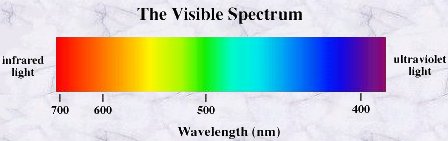
Approximate wavelength vs. color
| Color |
Wavelength (nm) |
| Red |
630-760 |
| Orange |
590-630 |
| Yellow |
560-590 |
| Green |
490-560 |
| Blue |
440-490 |
| Indigo |
420-440 |
| Violet |
380-420 |
| Purple |
not a spectral color |
Complimentary Colors
- Primary colors of light are red, blue, green
- When combined, produce white (polychromatic) light
- If one color is removed from white light, complimentary color results
- Mixing light is additive process - color TV, stage lighting
- Complimentary color pairs
- Red and cyan (blue-green)
- Blue and yellow
- Green and magenta (red-blue)
- Any color can be produced from a combination of red, blue, and green lights
Subtractive Mixing
- Mixing of pigments is subtractive process
- Pigment absorbs certain frequencies, reflecting color we see
- Primary pigments are cyan, magenta, yellow
- Used in paints, color printing, color photography
Lens Aberrations
- Spherical aberration: like mirrors, light passing through edges not focused at same
point as through center - correct with lens combination
- Chromatic aberration: different colors refracted differently, focus at different points -
correct with lens coatings, lenses of different materials