
The Nature of Light
- Advocated by Newton
- Said energy is carried by tiny particles
from source
- Could explain rectilinear propagation, reflection,
refraction; all observed in 17th century
- Predicted light would travel faster in water
than in air
Wave Theory
- Advocated by Christian Huygens, Dutch astronomer,
physicist
- Explained reflection
- Explained refraction if light traveled slower
in water than in air
- Had trouble explaining rectilinear propagation
- Huygen's principle: Each point on a wave
front may be regarded as a new source of
disturbance
- Interference of light not known until 19th
cent.
- Diffraction couldn't be explained without
it
- Discover of interference of light in 1801
and explanation of diffraction in 1816 proved
wave theory
- Foucault found speed of light slower in water
-- further proof of wave theory
- Since all known waves needed a medium, mysterious
substance called ether proposed that enabled
light to travel through space.
Electromagnetic Theory
- Light and heat radiate through space
- Faraday proposed lines of force to visualize
electric field
- Maxwell developed series of equations explaining
light & heat were electromagnetic waves
all moving at speed of light
- Each e-m wve has electrical and magnetic
components perpendicular to each other and
to direction of wave travel
- Hertz discovered radio waves also e-m, moving
at same speed with different frequency and
wavelength
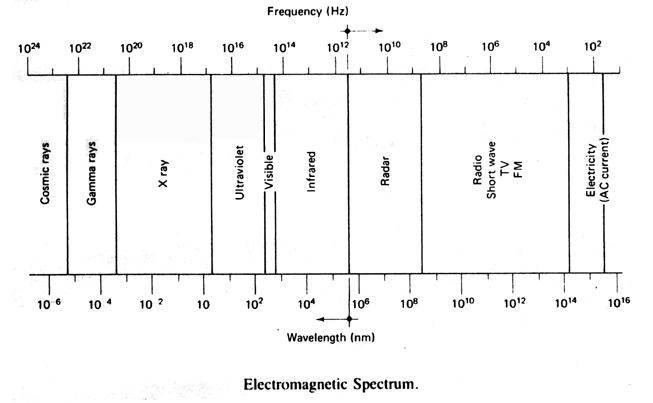
- Electromagnetic spectrum includes waves from
10 Hz to 1025 Hz
- All e-m waves travel at 3 x 10⁸ m/s ( c)
- Wavelengths range from 3 x 10⁷ m to less than 3 x 10-17 m
- Often expressed in nanometers or Angstroms (Å)
- Visible region is about 4000 - 7600 Å
or 400 - 760 nm
- Hertz observed spark discharges improved
with illumination (1898)
- Illumination of metal by electromagnetic
radiation causes emission of electrons
- Could not be explained by wave theory
- Frequency of e-m radiation determines if
emission occurs, not intensity
- Each metal has minimum energy that must be
supplied by light before emission occurs:
called the work function of the metal.
- Each metal found to have cutoff frequency
of incident light below which no emission
occurs , no matter how intense the light
- Only particle theory of light could explain
this
Quantum Theory
- Max Planck, examining heat radiation ( ir light) proposes energy is quantized, or occurring in discrete small packets
with a definite minimum value. (1901)
- All energy amounts were multiple of a certain
constant, called Planck's constant h with a value of 6.63 x 10⁻³⁴ Js
- Energy of radiation, E = hf
Einstein's Explanation
- Light consists of stream of massless particles
called photons having energy hf, moving along electromagnetic waves (1905)
- When photon strikes electron, it gives up
all its energy to the electron
- If hf > w (work function of metal), emission occurs
- Light intensity makes no difference if frequency
is too low.
- Max. electron kinetic energy = hf - w
- Einstein won Nobel Prize for explanation
Laws of Photoelectric Emission
- Rate of emission is directly proportional
to intensity of incident light
- Kinetic energy of photoelectrons is independent
of intensity of incident light.
- Maximum kinetic energy of photoelectrons
varies directly with difference between frequency
of incident light and cutoff frequency of
metal
- Rutherford's discovery of nucleus (1911)
led to "solar system" model of
atom
- Orbiting electrons contradicted e-m theory
- Niels Bohr (1913) proposed model of atom
with electron orbits based on quantized energy
states
- Difference between energy states always some
multiple of Planck's constant
Line Spectra
- Electrons absorb energy and "jump"
to higher energy level
- When electrons fall to lower level, they
emit photon whose energy equals difference
in electron energy at the two levels
- Since frequency depends on energy, different
energy changes cause different colors (frequencies)
of light emitted
- Unique structure of each element results
in unique pattern of emission for each element
allowing identification by spectroscopy
The Hydrogen Spectrum
- Hydrogen spectrum first to be analyzed
- Visible emission lines predicted and observed
by Balmer; called Balmer series.
- 6 uv emission lines (Lyman series) and 4 ir lines (Paschen series) discovered later.
Matter and Waves
- de Broglie proposed wave-particle duality
applied to matter particles, photons must
have momentum
- E = hf = mc2 ; so mc = h/λ , photon momentum
- λ = h/mv , wavelength of particle with mass m and velocity v
- Stands for light amplified by stimulated emission of radiation
- Emit coherent light: same direction, frequency, phase
- Ordinary light sources incoherent
Stimulated Emission
- Normal emission of light is spontaneous,
occurs almost instantly when electrons reach
higher energy levels
- Many materials can be brought to slightly
stable ( metastable) energized state
- Energy input causes population inversion where more atoms are in metastable state
than in ground state.
- Spontaneous emission of one photon causes
avalanche of identical photons through chain
reaction
- All photons have same energy and frequency
so light is monochromatic
Laser Construction
- Lasing cavity is shaped for resonance at
desired frequency; emissions at other frequencies
quickly die out
- Energy input by electricity or light flashes
excites lasing medium
- Mirrors at each end reflect laser light back
through medium amplifying beam
- Mirror at one end weakly silvered so beam
can escape when strong enough
- Some lasers pulse, some continuous
- Many lasing materials discovered, gases,
liquids, dyes, solids, semiconductors, crystals,
etc.
X-Ray Production
- Reverse of photoelectric effect
- High energy electron beam strike metal causing
emission of photons
- EK = hfmax - w Frequency of photon depends on speed of electron
- Most light comes from the sun
- Incandescent lights use hot filament
- Fluorescent bulbs contain ionized gas that gives off
ultraviolet ( uv) radiation absorbed by coating on inside
of tube; phosphorus coating then gives off
vis. light.
- Hot bodies emit infrared ( ir) radiation--thermal radiation
- Range of frequencies of thermal radiation
depends on temp
- "Red hot" is ir plus low frequency vis. (red to orange)
about 800° C;
- "White hot" includes higher visible
frequencies appearing white, about 3000° C
Terminology
- luminous
- giving off light because of energy of accelerated
particles (sun)
- illuminated
- seen because of light reflected and scattered
from it (moon)
- transparent
- transmits light readily--clear image can
be seen
- translucent
- light transmitted but scattered--no clear
image
- opaque
- no light transmitted
- ray
- single line of light
- beam
- several rays
- pencil
- narrow beam
- diverging
- spreading
- converging
- coming together
- focus
- converging to a point
- umbra
- dark central region of a shadow
- penumbra
- lighter region around the edges of a shadow
- Originally thought to be instantaneous
- Galileo first to realize it had a finite
speed
- Roemer first accurate measurement in 1675
by timing orbital period of Jupiter's moon
- Period varied with Jupiter's distance from
earth, must be due to time for light to travel
to earth
- First accurate measurement by Michelson using
2 observatories located some distance apart
- Used rotating octagonal mirror to time reflected
light and got 299729 km/s in air
- Later did experiments in vacuum, won Nobel
prize for this work
- Today c = 2.99792458 x 10⁸ m/s; we will use 3.00 x 10⁸ m/s in air or in vacuum.
- Light travels slower in other transparent
substances (water, plastic,etc.)
Light Measurements
- Photometry
- the quantitative study of light.
- Luminous Intensity (I)
- measured in candelas, a fundamental unit.
- Luminous flux (F)
- measured in lumens; energy per unit time delivered through
a unit area: a rate of flow.
- Illuminance (E)
- Density of flux on a surface, measured in lux. 1 lux = 1 lumen/m2 and E = F/A
- Since light travels in 3 dim. space, surface
for measuring light quantities is a sphere.
- Solid angles are measured in steradians: the ratio of intercepted surface area of
a sphere to square of radius
- Angle in steradians = A/r2; 4π steradians in a sphere of one meter
radius.
- So: F = 4πI X
- Since area of sphere also 4πr2, E = I /r2, an inverse square law. Illuminance varies
inversely with square of distance from source.
- Luminous Intensity measured with photometer, by comparing light sources in a darkened
room.
Photometer types
- Bunsen - grease spot on paper; set known
light source on one side, unknown on the
other; adjust position of photometer until
both sides look equally bright. Calculate
intensity with proportion.
- Joly - Like a sandwich of two translucent
plastic blocks with metal sheet in middle.
Viewed from edge, adjusted until each side
equally bright
- Photoelectric - measures current from photoelectric
cell. Compare known and unknown light sources.
- Spherical - large hollow sphere painted white
with calibrated photocell to measure intensity
directly.