Course Conduct and Syllabus 1999-2000
Text: Fundamentals of Physics, 4th Ed.: Halliday, Resnick, and Walker, 1993, Wiley, New York.
Course Description: AP Physics C is a two semester course with an emphasis on problem solving. It is approximately equivalent to the first two semesters of physics taken by college students in physics and engineering programs. The goal of the course is to prepare students for the AP Physics C exam, and all students are encouraged to take the exam, whether or not college credit is desired. During the first semester, we will cover topics from classical mechanics, chapters 2-15. These will be covered at the calculus based level, with use of calculus increasing as the course progresses. Approximately one week will be spent on each chapter. The second semester will be devoted to the study of electromagnetic theory. Calculus will be used freely in formulating principles and solving problems. This material will include chapters 23-37. The last two to three weeks prior to the AP exam is reserved for review. After the AP exam, other topics will be selected by students and presented to the class for the remainder of the term.
Course Evaluation: In accordance with district guidelines,
each six week grade will be determined as
follows:
50% daily work - homework, worksheets, labs
50% tests - announced in advance
The grade will be determined by dividing
the total number of points earned by the
total number of points possible. The semester
exam will count as 1/7th of the total semester
grade. The first semester test will cover
only mechanics; the second semester exam
will cover only electromagnetism.
Homework: There will be a written homework assignment for each chapter along with required reading assignments. Most homework assignments consist of about 10 problems per chapter from the text. Students may work together on solutions, but each must turn in complete work for credit, approximately once a week. Some class time will be available for homework, but this time is limited and will not be sufficient to complete entire assignments.
Late Work: There will be a penalty of 10 points for each day an assignment is late up to 3 days maximum. Work more than 3 days late will not be accepted unless prior arrangements have been made.
Absences: If you are absent, you will have the number of days you were absent plus one day to make up or turn in missed class work, including tests.
Tests: Unit tests will typically cover one to three chapters and be worth 100 points. These unit tests are cumulative and comprehensive, and any important material previously covered may be included. Tests will contain material taken from actual AP tests, both multiple choice and free response, along with selected homework problems. AP formula sheets and calculators may be used on unit tests.
Labs: laboratory exercises will be included where time and available equipment allow. Many will be exploratory in nature without formal procedure. Students will be required to devise their own procedure to reach desired results.
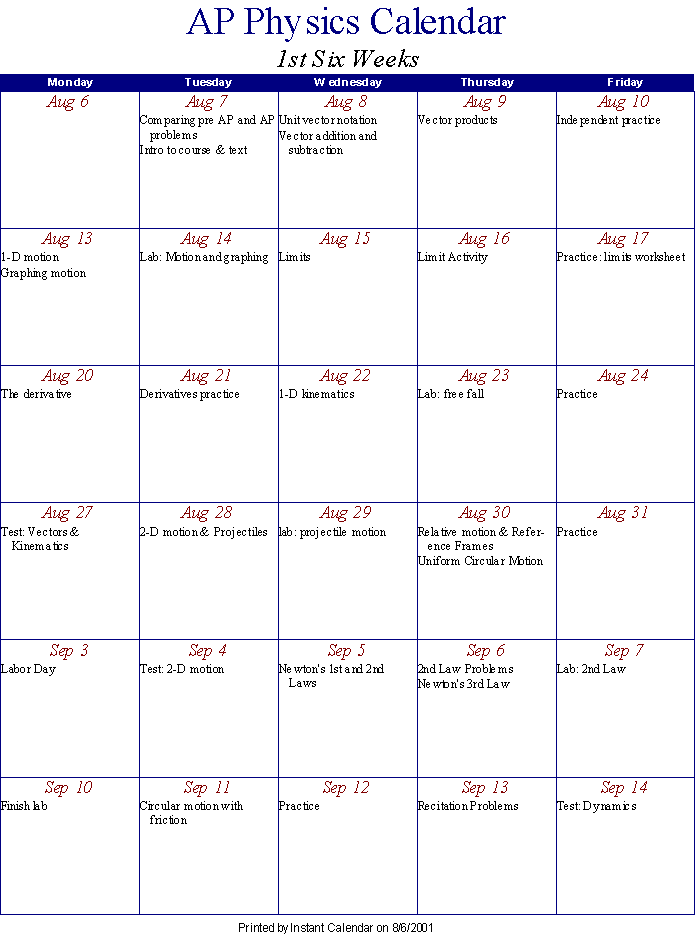
Study Guides: At the beginning of each unit, a study guide will be given, containing all reading and written assignments with due dates, test date, and approximate daily schedule for the unit. Also included will be a set of instructional objectives for the unit.
Recitations: Beginning at the end of September, students will be assigned a weekly recitation consisting of problems from previous years' AP tests. On a rotating basis, students will present their solutions to the class for analysis and discussion. Each recitation problem will be graded strictly by AP grading criteria.
Tutoring: Extra help is available. Tutorial days and times will be posted in the class room for individual or group tutoring. Students are also encouraged to help each other whenever possible.
| Week of | Chapter | Topics Covered |
| 8/11 | 3 | Vectors, Derivatives |
| 8/17 | 2 | Kinematics |
| 8/24 | 4 | Planar motion, Projectiles |
| 8/31 | 5 | Dynamics I |
| 9/7 | 6 | Dynamics II |
| 9/21 | 7 | Work, Energy, Integration |
| 10/5 | 8 | Conservation of Energy |
| 10/19 | 9 | Systems of Particles, Momentum |
| 10/26 | 10 | Collisions |
| 11/2 | 11 | Rotational Kinematics |
| 11/9 | 12 | Rotational Dynamics |
| 11/16 | 13 | Equilibrium |
| 11/30 | 14 | Oscillations |
| 12/7 | 15 | Gravitation |
2nd Semester Schedule
| Week of | Chapter | Topics Covered |
| 1/3 | 23 | Electric Charge, Coulomb's Law |
| 1/5 | 24 | Electric Fields |
| 1/10 | 25 | Gauss' Law |
| 1/20 | 26 | Electric Potential |
| 1/31 | 27 | Capacitance |
| 2/2 | 28 | Current and Resistance |
| 2/14 | 29 | DC circuits |
| 3/7 | 30 | Magnetic Fields |
| 3/10 | 31 | Ampere's Law |
| 3/21 | 32 | Induction, Faraday's Law |
| 3/24 | 33 | Inductance |
| 3/28 | 34 | Magnetism and Matter |
| 4/11 | 35 | Electromagnetic Oscillations |
| 4/14 | 36 | Alternating Currents |
| 4/22 | 37 | Maxwell's Equations |
| 4/25 | Review Mechanics |