
3. Assume q is very small compared to +Q and - Q so it has negligible effect on the field due to the larger charges.
4. Remember the shell theorem: both q1 and q2 look like point charges from outside the spheres, and the charge on any sphere affects only area outside its radius. (ans: diagram)
9. Use equation for point charge
18. Use symmetry to simplify, then use superposition principle.(ans: 0)
31. Direction can be found using symmetry arguments. To find magnitude, find E from one semicircle and double. The x components cancel so only y components contribute to E at center. Each bit of charge dq will produce dE = kdq/R2 whose y component depends on angle of R with x axis. Express dq as a function of charge density and a differential bit of length ( ds). You now have a function with 2 variables, s (length along ring), and theta, the angle between the x axis and the radius from the center to each ds. Eliminate s by expressing ds as a function of dtheta and integrate between theta = -pi/2 and theta = pi/2.
34. (a) from the definition of charge density
(ans: -q/L) (b) Write an expression for dE, the field from each differential bit of
charge dq. Express dq as a function of charge density and a bit
of length dx. Find an expression for r, the distance from point P to each dx, in terms of given quantities ( L, a) and the unknown distance ( x) from one end of the rod to each bit of
length ( dx). Now you have a function in terms of x and a bunch of constants. Integrate from
x = 0 to x = L You should have an integral that looks like:
 where n represents all the constants. To solve an
integral like this, look in a list of integrals
for a general type that fits, or can be made
to fit this form. This integral fits the
general type
where n represents all the constants. To solve an
integral like this, look in a list of integrals
for a general type that fits, or can be made
to fit this form. This integral fits the
general type 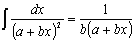 . In this case, a (in the general equation) = a + L; and b = -1. Substitute into the general solution,
evaluate between limits of integration. [ans.
kq/a( L+a)]
. In this case, a (in the general equation) = a + L; and b = -1. Substitute into the general solution,
evaluate between limits of integration. [ans.
kq/a( L+a)]
38. Use equation (24-27) for E above disk. At center of disk, z = 0. Set up ratio of two field functions which must equal ½. Solve for z. (ans: R/sq. root of 3)
49. At equilibrium, force of gravity and force from electric field are equal, therefore mg = qE. Density = m/V , assume drops are spherical. (ans: 5 e)
52. (a) Since field is uniform, force and acceleration will be constant. avg. v = d/t = ( vo + vf)/2. ans: ( 2.7 x 10⁶ m/s) (b) Use d = ½ at2, E = F/q, and F = ma. Combine and solve for E (ans: 1000 N/C)
57. (a) p = dq (b) find change in U = Uf - Ui
