Position Vectors
A moving object can be located at any time by a position vector that extends from a reference point (usually the origin of the coordinate system) to the object. We can write this vector in terms of its x, y, and z coordinates and the unit vectors: r = xi +yj + zk . As an object moves, its position vector changes so that it always goes from the origin to the object. The change in position or displacement during a time interval is the difference between the original and final displacement vectors: Dr = r2 – r1.
The average velocity for the time interval:  which is a vector
divided by a scalar. When written in unit-vector form, the three dimensions can
be separated with the x, y, and z
components each divided by the elapsed time.
which is a vector
divided by a scalar. When written in unit-vector form, the three dimensions can
be separated with the x, y, and z
components each divided by the elapsed time.
The instantaneous velocity is the value that the average
velocity approaches as the elapsed time
shrinks to 0, the derivative v = dr/dt. This likewise can be
separated into 3 dimensional components: 
Since the derivative gives the slope of a graph, the velocity vector is tangent to the path of the particle, which is, after all, the graph of the displacement.
A change in velocity, in magnitude or direction, over a time
period will give the average acceleration. 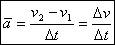 . If the time
interval shrinks to 0, then the average acceleration approaches the
instantaneous acceleration, and a = dv/dt . In three
dimensions,
. If the time
interval shrinks to 0, then the average acceleration approaches the
instantaneous acceleration, and a = dv/dt . In three
dimensions, 
Here, we have a particle that moves in two dimensions during
free fall with acceleration of g directed downward. We will neglect the
effect of air friction so there is no horizontal acceleration. The initial velocity at launch can be
written v0 = v0xi +v0yj.
The two velocity components can be found if the angle of launch, q0, is known. v0x
= v0 cos q0
and v0y = v0 sin q0. The velocity and position vector change constantly as the
projectile moves, but the problem can be simplified by separating the
horizontal and vertical motions from each other. They are each independent of
the other and share only the time dimension. In the horizontal, we have
constant velocity, and in the vertical, constant acceleration (free fall). The horizontal displacement from an initial
position can be easily found using d = vt or more correctly x – x0
= (v0 cos q0
) t . The vertical motion is analyzed using the constant
acceleration equations adapted for free fall, and using a =g and v0y
= v0 sin q0
. The equation for the y position becomes: y – y0 = (v0 sin q0 )t – ½ gt2
If we eliminate t by solving for t in the x equations and
substituting into the y equation we can get an equation for the
trajectory of the particle in terms of x
and y. 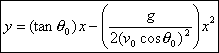 (assuming x0
= 0 and y0 = 0)
(assuming x0
= 0 and y0 = 0)
This equation is in the general form y = ax + bx2 , which is that of a parabola.
The range of the projectile is the horizontal distance
traveled when the projectile returns to its launch height so R = (v0
cos q0 ) t.
Using the same technique, we can use the horizontal equation to eliminate t
and get:  . Note that R will be a maximum when the launch angle
is 45o.
. Note that R will be a maximum when the launch angle
is 45o.
Uniform Circular Motion
When a particle travels in a circle or circular arc at a constant speed it is still accelerating because its direction is constantly changing. This is called a centripetal acceleration and can be found from the equation a = v2/r . The direction is always towards the center of the circle, while the velocity is always tangent to the circle.
Relative Motion in One Dimension
All measurements of motion are made with respect to a reference frame. Usually the reference frame is attached to the earth, but another system may be preferable, such as a moving vehicle. When two objects are moving with respect to one another they will measure things differently. The position of an object P measured from reference frame A will be different from the position measured from reference frame B if A and B are moving with respect to one another. The difference in measurements will be accounted for in the distance between the reference frames. In equation form: xPA = xPB + xBA Taking the derivative of the above equation will give the velocity measurements and a similar equation: vPA = vPB + vBA . These equations are valid as long as the reference frames are inertial, not accelerating with respect to one another. Taking the derivative of the velocity equation gives the acceleration equation aPA = aPB , since vBA is a constant. This tells us that observers in different inertial reference frames will always measure the same acceleration for a moving particle.
Relative Motion in Two Dimensions
In two dimensions we must use
position vectors to locate the origins of the reference frames A and B
and the particle P in question. Once again, assume the reference frames
are moving with respect to one another and observing a stationary point P.
We will need three position vectors, one from each origin to point P and
one between the two origins. Now we can write the vector equation for the
position of the particle: rPA = rPB + rBA.
Taking the derivative with respect to time, we get the vector velocity
equation, namely: vPA
= vPB + vBA. Taking the derivative again
gives the acceleration equation: aPA = aPB