When we say something is moving we mean its position is changing with respect to something else. All motion is relative. Nothing is actually stationary in the universe so motion must be related to a reference point or coordinate system that is considered stationary. Usually the earth and things attached to it are considered stationary unless we are concerned with the motion of the earth itself.
Displacement is a change in position. It is a vector and requires both a magnitude (with unit) and a direction. In straight-line motion, there are only two possible directions, so we use positive and negative signs to indicate direction. We can use a graphical representation with a linear coordinate system whose origin is at the center of a line, positive numbers to the right, and negative numbers to the left. Then the displacement (Dx) = x2 – x1, the initial position minus the final position.
Another way to plot displacement is to plot position as a function of time. If an object is stationary, the plot of x(t) will be a straight horizontal line but if it starts moving the plot will be a sloping line, straight or curved. The velocity of the object is the rate of change of position with respect to time. It is a vector quantity and must include direction (+ or – here) to be complete. The average velocity for any time interval is the displacement / elapsed time:
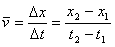
This also gives the slope of a straight line connecting the starting and ending points (x1,t1 and x2, t2). A positive or upward slope indicates movement in the positive direction (right or up) and a downward or negative slope means movement in the negative direction (left or down). Average speed is total distance / total time without regard to direction.
Often we need to know an object’s instantaneous velocity (usually just called the velocity.) To find this, we again use Dx/Dt but we need increasingly smaller values of Dt. As Dt approaches zero, Dx/Dt approaches v. This is called a derivative and is written as:
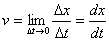
Physically, this will give the slope of a line tangent to the curve at the point in question.
Any change in velocity is acceleration whether the change is in magnitude or direction. For one-dimensional motion, this change will be in the magnitude or the speed. Acceleration is a vector quantity and requires a direction, in this case positive or negative. Deceleration is just a common term for a negative acceleration. Average acceleration is change in velocity divided by elapsed time for the change:
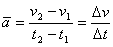
Instantaneous acceleration is the instantaneous rate of change of velocity and is found by taking the derivative of the velocity function v(t).

This will correspond to the slope of a line tangent to the graph of velocity vs. time at the point in question. (See graphs on p 21 of text)
A special case often used to simplify situations. If we let v1
= v0, the velocity at t = 0; v2
= v, the final velocity; the initial time, t1 = 0; and
the final time t2 = t we can rewrite the equations in
terms of final velocity or displacement. So now  or, solving for v:

Since the final position of an object is equal to its
initial position plus the average speed and the elapsed time of motion, we can
write  . And since
  we can combine with our velocity equation producing
  and combining terms:
  . When substituted into the final position equation above, we
derive the displacement equation in terms of initial velocity and acceleration:
. When substituted into the final position equation above, we
derive the displacement equation in terms of initial velocity and acceleration:
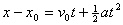
By rearranging and combing these two equations for velocity and displacement the other constant acceleration equations are easily found.


Free Fall
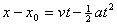
This is a common situation involving one-dimensional constant acceleration when air resistance is ignored. Here, the acceleration is that of gravity, 9.80 m/s2. Usually the downward direction is considered negative and the upward direction positive which makes a = -g = -9.80m/s2. The choice of signs is arbitrary but important when upward motion is included, and must be consistent throughout the problem. The equations for free fall are the same as those for all other constant acceleration situations.