In physics, relationships between quantities are expressed with functions using constants and variables.
Function: a relationship between variables, usually an equation or a graph. In an explicit function one variable is expressed in terms of the other. Example: y = x (tan 60o), often written as: f (x) = x(tan 60o) In an implicit function the variables are mixed together, unsolved. Example: y/x =tan 60o A function is continuous if the function is defined for all values of the independent variable.
Variable: a quantity that can change with the circumstances and may assume an indefinite number of values. Usually represented by letters s – z. The variable is continuous if it can assume all values between upper and lower boundaries.
Constant: a term that has a fixed value, either absolute (p, e, c) or arbitrary.
Independent variable: a quantity that is controlled by the experimenter in order to observe the change in a related variable.
Dependent variable: one whose value depends on the value of another variable. The dependent variable is a function of the independent variable.
Consider the following sequence of numbers: 1, 3/2, 5/3,
7/4, 9/5, …, 2 – 1/n, … As the sequence is continued to larger numbers
of n, the value of the sequence approaches 2 but never actually reaches
it. We say it approaches 2 as a limit and write it as  .
.
Consider the function f (x) = x2
. Now if  , as in the sequence above, the corresponding
values of f (x)
would be 1, 9/4, 25/9, 49/16, …, (2-1/n)2, … If the sequence
is continued, the value of f(x)
approaches 4 or
, as in the sequence above, the corresponding
values of f (x)
would be 1, 9/4, 25/9, 49/16, …, (2-1/n)2, … If the sequence
is continued, the value of f(x)
approaches 4 or  . But x could approach the value of 2 from above as
well as below. A quick examination of the sequence of x values 2.1,
2.01, 2.001, 2.001 … substituted into the function f (x) = x2
shows again that as
. But x could approach the value of 2 from above as
well as below. A quick examination of the sequence of x values 2.1,
2.01, 2.001, 2.001 … substituted into the function f (x) = x2
shows again that as  ,
,  .
We say “the limit, as x approaches 2, of x2
is 4” and write
.
We say “the limit, as x approaches 2, of x2
is 4” and write  .
.
In the above example we see that as x approaches 2
from the left (on a number scale) the function value approaches but is always
less than 4. As x approaches 2 from the right, the function value
approaches but is always greater than 4. The limits from the left and right
side are the same in this case and no distinction is necessary, but this is not
always the case. The existence of a right or left limit does not necessarily
imply the existence of the other limit. To indicate the left limit we write:  and for the right
limit:
and for the right
limit: 

If
 and
and  then:
then:
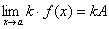 , k being any constant

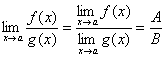 provided B
is not zero
provided B
is not zero provided the
result is a real number
provided the
result is a real numberInfinity
A variable or a function is said to become positively infinite if at some point in a sequence or limit it becomes and remains greater than any preassigned positive number, however large.
A variable or a function is said to become negatively infinite if at some point in a sequence or limit it becomes and remains less than any preassigned negative number, however small.
Often we are concerned only with the absolute value, in which case the function or variable is said to become infinite, without regard to sign.
Examples of infinite limits:


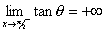
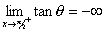
Do not use the theorems for multiplication and division above with functions having infinite limits, but only for functions whose limits exist.
A function f (x) is continuous at x = a if:
 exists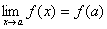
Examples:
(a.)  is discontinuous at x
= 2 since f (2) is not defined and the limit at x = 2 does not
exist (it is infinite). It is continuous everywhere except at x = 2
where it is said to have an infinite discontinuity.
is discontinuous at x
= 2 since f (2) is not defined and the limit at x = 2 does not
exist (it is infinite). It is continuous everywhere except at x = 2
where it is said to have an infinite discontinuity.
(b.)  is discontinuous at x
= 2 since f (2) is not defined (both numerator and denominator are
zero). The limit exists and is equal to
4, but is not equal to the value of f (2). This discontinuity is called
removable since it may be removed by redefining the function as
is discontinuous at x
= 2 since f (2) is not defined (both numerator and denominator are
zero). The limit exists and is equal to
4, but is not equal to the value of f (2). This discontinuity is called
removable since it may be removed by redefining the function as 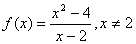 . Factoring and simplifying the function
gives the function g
(x) = x + 2 which has the same graph as f (x)
except for at x = 2 where the graph of f (x) has a hole.
. Factoring and simplifying the function
gives the function g
(x) = x + 2 which has the same graph as f (x)
except for at x = 2 where the graph of f (x) has a hole.
(c.) A function that changes over a range of values will exhibit jump discontinuities.
The following function: If 0 < x > 3, f (x) = 5; if x > 3, f (x) = 7 will have a jump discontinuity at x = 3. The left limit does not equal the right limit so the limit of the function at x = 3 does not exist.