
Increments: The increment of a variable x is the change
in x as it increases or decreases from one value x0 to
another x1 in its range. The change in value is represented
by Dx and
so: Dx = x1 – x0 or,
rearranging: x1 = x0
+ Dx
If x is given an
increment then a function y = f (x) will also be given an
increment, which we can write as Dy = f (x0 + Dx) – f
(x0). The ratio Dy/Dx =
(change in y)/(change in x) is the average rate of change of the
function in the interval between x0 and x0
+ Dx and is
equal to the slope of a line between the two points on a graph.
The Derivative: The derivative of a function y = f (x) with respect to x
is defined as  provided the limit
exists. This is the instantaneous rate of change of y with respect to x.
The derivative of y = f (x)
with respect to x may be indicated by any one of the following symbols:
provided the limit
exists. This is the instantaneous rate of change of y with respect to x.
The derivative of y = f (x)
with respect to x may be indicated by any one of the following symbols:  ,
,  ,
,  , y’,
f’(x), or
, y’,
f’(x), or 
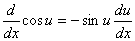
Differentiation: The process of differentiation is finding the
derivative of a function and possibly evaluating the function at a certain
value of x. Differentiation is done following a series of formulas
rather than the time-consuming limit process of the derivative definition.
These formulas are found in many textbooks and handbooks; the most commonly
used are printed below. In these formulas u, v, and w are
functions of x.
1.  , where c is any constant
2. 
3. 
4. 
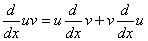
5. 
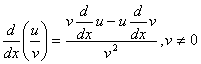
6. 
7. 
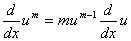
8. 
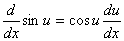
9. 
10. 
The Chain Rule: If u
is a function of x and y is a function of u, then y
is actually a function of x : y = f(u) , u = g(x)
, then y =f{g(x)}. To find the derivative dy/dx
you can substitute one function into the other and solve for y in terms
of x and find the derivative. Often it is easier to use the chain rule
which states:

Example: If y = u2
+ 3 and u = 2x + 1, then dy/du =2u, du/dx
= 2, and dy/dx = 4u = 8x + 4
Higher Derivatives:
Sometimes it is necessary to take a derivative of a derivative, which is called
the second derivative. It is designated by one of the symbols  , y’’, or f’’’(x). In turn, the derivative of the second
derivative is called the third derivative with analogous symbols.
, y’’, or f’’’(x). In turn, the derivative of the second
derivative is called the third derivative with analogous symbols.