 Shakespeare is a genius. His works are masterful. How he captures the essence of Elizabethan language
through plays and novels is magnificent. I cherish his plays, such as Romeo and Juliet, and how his plays
play a major role in our lives especially through teenagers in love. This web page is on the Globe Theatre.
The Globe Theatre is where all his plays were performed. I will like to one day watch a play in that arena.
Shakespeare is a genius. His works are masterful. How he captures the essence of Elizabethan language
through plays and novels is magnificent. I cherish his plays, such as Romeo and Juliet, and how his plays
play a major role in our lives especially through teenagers in love. This web page is on the Globe Theatre.
The Globe Theatre is where all his plays were performed. I will like to one day watch a play in that arena.
The Globe theatre, in Southwark district of London, was the venue or site of Shakespeare’s best know stage works, including his four tragedies, were first produced. The Globe was built during Shakespeare’s early era, in 1599, by Cuthbert Burbage, the brother of the most famous Shakespearean actor, Richard Burbage. Before building the Globe Theatre, Cuthbert Burbage, created and owned a London theatre, which he called simple, the Theatre. But the land, on which the Theatre was made on, was unable to be negotiated by his father and his eldest son for the renewal of the land lease. From this, the Theatre was tore down and the timbers and other elements for building were later used to construct the Globe Theatre. But after some initial success in the early years of 1590s with the three parts of Henry VI, The Comedy of Errors, and Richard III, during the seasons of 1592 and 1593 the theatres were not as successful, causing Shakespeare to turn to composing poetry.
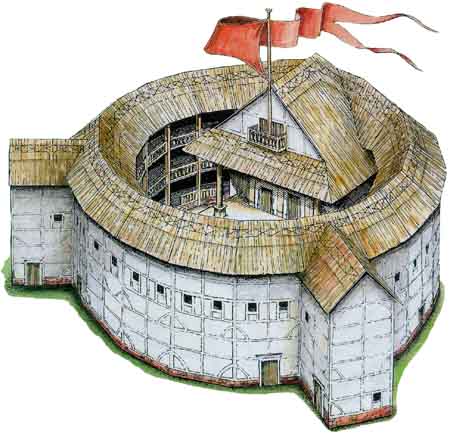
The Globe theatre, which was built for Chamberlain’s men, had a capacity of 2,000 and 3,000 spectators and audience. Because of the lack of lighting, all the plays were during the day (probably during 2 P.M. and 5 P.M.) Because most of the Globe and its stages were open air, acoustics and instrumental were poor and the actors had to scream their lines, stress enunciation, and engage in exaggerated gestures. Although changes in scene were not conducted by stagehands during curtain closings, Shakespeare wrote in the text of the plays explicitly or implicitly in the speeches and narrative situations. The stage of the Globe was a level platform about 43 feet in width some 27 or 28 feet deep that was raised about five feet off the ground. The stage had a number of mechanisms, including trap doors and distinct section, which were creatively utilized by Shakespeare by stage directions. On a side of the stage was an adjacent "tiring" house, where costumes changes were made. It was capped by a small tower structure, from which a flag and a trumpeter would announce the day’s performances.
On June 26, 1613, the king’s men were performing one of Shakespeare’s newest plays, King Henry VIII. In doing so, a cannon was shot to waken the people of the presence of Burbage, who played King Henry VIII. A spark from the explosion of the cannon set fire the roof. No one had smelled nothing and those who did ignored the problem until it was too late. In less than an hour, Shakespeare’s theatre was no more. But the king’s men planned to rebuild the theatre on its old foundations. By the following summer, the new globe was reopened to the public. It was the same as the old one, if not better in all aspects. Shakespeare had joint ownership but during this time, he had already retired and went to Stratford. The theatre was never his own in quite the sense that it once had been. Shakespeare wrote his plays for audiences with a broad social background. To the Globe Theatre, came across a wide diversity of people for different economic status. But most of the Globe’s audience was of middle-class citizens, such as merchants and craftsmen and their wives. They went to the theatre for relaxation and to escape a while from their cares and worries.
Shakespeare was the most popular playwright of London. He created vivid and strong characters, in which people can relate too, on the Elizabethan stage. His use of language shows his wit and ability to think and pleasing the audience. And most importantly his themes are universal, allowing people too be educated as well as being entertained, stirring the imaginations of audiences.