|
Overview of the Combat Service Support
Control System (CSSCS)
CPT Anthony R. Ely
The Combat Service Support Control System (CSSCS) is a key logistics management tool for commanders and staff in combat, combat support and especially in combat service support (CSS) units. Connected to all major Standard Army Management Information Systems (STAMIS) and four other Battlefield Functional Area Control Systems (BFACS), the CSSCS can capture and display logistical and tactical data. This captured data, combined with the unit task organization (UTO), enables the CSSCS to track selected command assets as low as company level, produce logistics reports and compute course-of-action effects on overall status. These capabilities, among others, are the reason why the CSSCS is not only a vital logistics decision-making tool for commanders and staff, but also an integral component of the modern battlefield.
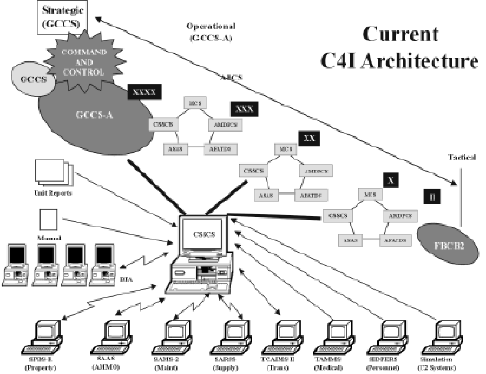
The CSSCS is the CSS component of the BFACS. The BFACS has a total of five interconnected components. The other four components are the Maneuver Control System (MCS), the All Source Analysis System (ASAS) for intelligence on the enemy, the Advanced Field Artillery Target Data System (AFATDS) and the Air and Missile Defense Planning Control System (AMDPCS). (See Figure 1.) Each of these components is a command and control (C²) tool for the commander and staff in each particular battlefield functional area (BFA) and make up the Army Battle Command System (ABCS).
|
The BFACS, which comprise the tactical and operational C² systems, is linked to strategic-level C² systems through the ABCS. All these systems form the Command, Control, Communications, Computers and Intelligence (C4I) Architecture. (See Figure 2.) This is a complex network, but it is all based on one principle: a common picture of the battlefield through shared information. For example, commanders and staff from battalion to theater level can view detailed CSS status information displayed on the CSSCS. The CSSCS provides CSS, medical and personnel information to this battlefield picture. To accomplish this, every CSS battalion; all combat, combat support and CSS brigade-sized units; and each division, corps and theater will have CSSCS. Eventually, every battalion will be fielded CSSCS.
The CSSCS can track a customized list of supplies, based on what a specific commander considers important to monitor and report. This list is called the Commander’s Tracked Item List (CTIL). The CTIL is extracted from the Baseline Resource Item List (BRIL). The BRIL is a list containing more than 3,000 items. These include personnel and supply items, listed by military occupational specialty (MOS), National Stock Number (NSN), Line Item Number (LIN), or nomenclature. The commander creates his CTIL by selecting from the BRIL items he considers mission essential.
|
Consistent Reports
The CTIL is established
in the CSSCS by the highest command in a particular area of operations. All
subordinate CSSCS nodes use the CTIL established by the highest command. For
example, a theater commander’s CTIL is also used at corps, division, brigade
and battalion levels. This ensures that all commanders are tracking the same
items through their CSSCS nodes. Also, all reports are consistent because they
have the same items. Subordinate commanders may add their own items for their
own use.
The CTIL is part of the CSSCS database equation. Another part is the Unit Task Organization (UTO). The UTO is loaded at battalion level or higher. The UTO consists of all subordinate units, down to companies. Combining the UTO and the CTIL (with updated/accurate logistics data), the CSSCS can display the status of any CTIL item for any company in that UTO.
The CSSCS displays supply status through a wide range of reports. These include CSS status reports (graphic displays of status by class of supply and personnel), force echelon reports (consolidated CTIL item status for units and supply points within an echelon), CSS capability reports (based on a five-day supply use projection), battle loss reports (CTIL item losses for a specific unit), unit reports (CTIL item status for items in a unit), supply point reports (asset status within a supply activity), class of supply reports (Classes I (rations), II (general supplies), bulk III (petroleum, oils and lubricants), V (ammunition), VII (major end items), and maintenance VII, medical module reports (medical unit status), personnel reports (by unit and MOS), and transportation reports (graphic display of assets moving CTIL items).
‘Gumballs’ Show Supply Status
All
these reports require data entries. This data comes from STAMIS, manual input
and the Force XXI Battle Command Brigade and Below (FBCB2) system. The FBCB2 is
a new ABCS node capable of sending small unit (company and below) information
directly to the CSSCS. Eventually, nearly every vehicle is scheduled to have a
FBCB2. The CSSCS sorts these data entries by CTIL and UTO and assigns a supply
status using a black, red, amber, or green circle of color or
"gumball."
These "gumball" colors are based on predetermined percentages. For example, a unit has a green "gumball" in Class III (bulk) when it has 80 to 100 percent of its basic load on hand. Also, the CSSCS can show why a unit’s "gumball" is a certain color through the "peel back" feature. This feature is recalled by simply double-clicking on the "gumball" and viewing the exact supply quantities a unit has on hand, compared to the basic load. The date and time of the last data update is also displayed.
The "peel back" feature is also convenient, for instance, when analyzing why a battalion has a red "gumball" for any class of supply. By double-clicking on the battalion line, the subordinate companies are displayed, showing a "gumball" status for each company. These gumballs will reflect the supply status of each company and reveal the reason why the battalion "gumball" was red.
Using data such as the stockage objective, days of supply, consumption rates and units involved, the CSSCS can analyze up to three courses of action. The CSSCS can make CSS capability projections for each course of action for up to five days in the future. The "peel back" function is also available to view supporting unit information for each course-of-action analysis.
Because the CSSCS is connected to the other BFACS (Figure 1), the CSSCS can access information in the other battlefield functional areas. Specifically, the MCS provides maneuver operation orders (OPORDs) and fragmentary orders (FRAGOs). The ASAS has common intelligence information. The AFATDS provides fire support information. Finally, the AMDPCS shows the air defense picture.
BFACS Significant to Logistics Planning
The information found
in the other BFACS will have a significant impact on logistics mission planning
and execution. For example, when considering resupply routes, the forward
support battalion (FSB) support operations officer can view the ASAS
intelligence on the enemy, using the CSSCS, and determine the safer resupply
routes. Also, other BFACS can view the logistics information on the CSSCS and
make decisions about unit supply capabilities and employment in future missions.
One of the most important benefits of this interconnectivity between BFACS is the time saved obtaining information among different battlefield functional areas. This link also exists between CSSCS nodes at all levels. Information is passed from battalion to theater through a rapid, seamless process. This is because of a common database: types of reports, formats and the CTIL are the same at every level. Using the CSSCS results significantly reduces the amount of manpower and time at the computer compared to analog or manual reporting. Time saved in receiving, processing and sending reports is time gained to make sound decisions and executable plans.
As with all computers, CSSCS is only as effective as the quality of the data put into the system. Much of the information that makes up the system database must be manually input, such as UTO, CTIL, stockage objective, and days of supply. This creates the potential for errors in data that can translate into flawed reports and supply statuses sent to the highest levels. Currently, the CSSCS lacks a "common sense check" system that can identify irregularities or exceptions. For example, a green unit with 0 percent of Class III(bulk) on hand may have a green "gumball" for Class III(bulk) because the basic load was not entered. This is one of several cases in which the system may use flawed data without identifying the information as such.
Lack of Information Degrades
CSSCS at Battalion Level
Also,
the CSSCS relies heavily on units equipped with FBCB2 to regularly send accurate
information. However, based on the last Army Warfighter Experiment (AWE),
reports were seldom sent from the FBCB2 to the CSSCS. The lack of information
received from the FBCB2 seriously degraded the CSSCS capabilities at battalion
level. The CSSCS operators were using E-mail, telephone and manual reporting
procedures to compensate. These reporting procedures were time-consuming and, in
many cases, the information was old or incorrect. These errors were sent up to
division and corps levels. The FBCB2 operators indicated that it was very
difficult for them to send messages when they were always on the move or
reacting to enemy actions.
The CSSCS is a new system. As such, the CSSCS is under constant revision. The feedback from past AWEs has not gone unheard. Near term, and future, improvements will resolve most issues with this system. The CSSCS is a significant improvement from traditional, manual CSS data organizing and reporting. It is capable of crossing into other functional areas to obtain information that can impact logistics support operations. This ensures that the FSB commander has the same information as the brigade commander. Consequently, the FSB support plan will be properly synchronized with the maneuver plan. In addition, higher echelons will be informed of all CSSCS transactions through the ABCS network.
Where fielded, the CSSCS has become the key logistics management and decision-making tool for commanders in all battlefield functional areas. The CSSCS is already an integral part of the modern battlefield. The value of the CSSCS, for logisticians and the Army, will continue to grow as capabilities and acceptance increase.