
Shape Recognition
Hypothesis
I think that the rat will go to the shape with the food on it, become familiar with that shape, and when shown that shape (the circle) and the other shape (the square), the rat will go to the circle shape, because that is where the food was.
Materials
circular shape
rectangular shape
rat
cage
reward, such as water or food
chart to record data onto
Procedure
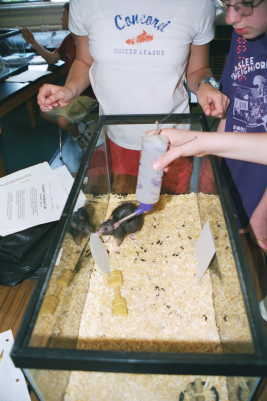
First, put the circular shape in the cage and put food onto it. The rat should go to the food and learn that the circular shape is the one that earns the food, or the reward. Next, after the rat has had time to adjust to the circle, and it�s rewards, put in a different circle, and a rectangle. The different circle is to make sure that the rat isn�t just smelling the food. If the rat goes to the circle, reward the rat with water and mark it on the chart. If the rat doesn�t go to the circle, do not give a reward.
Results
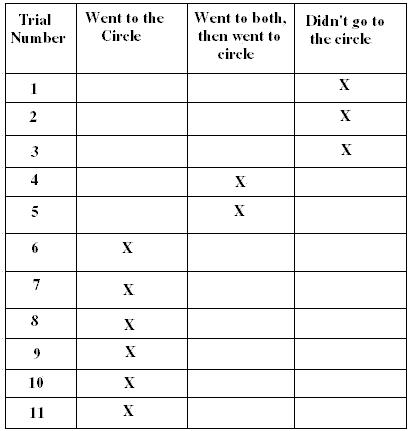
One out of the eleven times Midnight didn�t go to the circle. Most of that time he went immediately, or right away. We waited about five minutes before we tried it again, and when we put the shapes in, Midnight still went to the circle.
Conclusion
Our hypothesis, that rats can learn the difference between shapes, was correct, because Midnight learned to tell the difference between the shapes. Even when we switched the shapes places, Midnight still went to the circle, and the one time he didn�t go to the circle, he took awhile to decide which shape he was going to.
Hypothesis
Midnight (the rat) will learn to tell the difference between the circle and square, and will learn to go to the circle for food.
Materials
A cardboard (cut out) circle
A cardboard square (the same color as the circle)
Food
Water
A rat
Procedure
1. Put rat in a cage by his/herself.
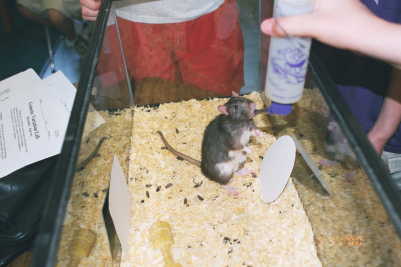
2. Prop up circle and square against the wll of the cage about 2 inches apart.
3. Let the rat sniff at the shapes. Everytime the rat goes to the circle, give him food (or water if the rat is thirsty).
4. After a while, move the position of the circle and square (switch sides, move to opposite ends of the cage...).
Results
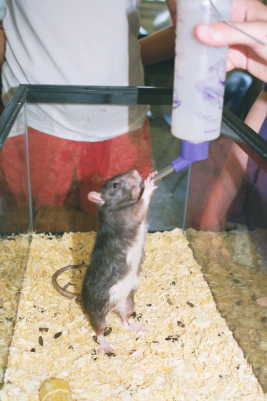
See the chart above!!! We did this with water because the rat had run out and hadn't taken a drink in a while. So, the rat was very thirsty and kept wanting more and more water. Sometimes, he wouldn't even let go of the bottle, so I think he caught on faster than if he didn't need anything. I think it made him try harder.
Conclusion
My hypothesis was (amazingly) correct. I thought the would be able to tell the difference, but I didn't expect Midnight to learn so fast. I guess that shows that rats are smarter than people think they are.
Sources of Error
You have to remember that this research is just one rat! So, this may not represent all rats. If we had time, I would've done a female and a young rat, but I didn't. Therefore, some error could be that Midnight could just be super-intelligent!!!
Mr. Purnell's Home Page
