Hypothesis
My hypothesis is that the older mice would find the food faster than the older mice due to knowledge, experience, and scavenging skills.
Materials
cardboard to build a maze
a timer
Frick
Bo
Morgan
Speckles
food for small rodents
Procedure
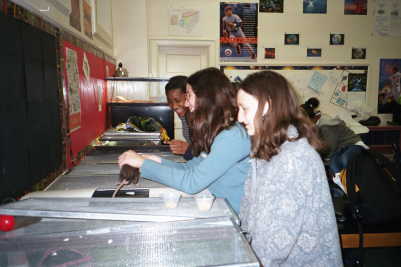
First I cut and taped cardboard to form a maze with passage ways, obstacles, and walls that were high enough so that the mice could not crawl over. The next step in my experiment was to pick out the younger and older mice that I wanted to use in the experiment. This was a rather hard step because the mice had built tunnels in their cage and hid when I tried to pick them up. Once I picked out mice and got them out of the cage we put them in a box while we put food for mice at the end of our maze. First I tested Bo, then Speckles, then Morgan, and last Frick I timed the results of how long it took them to go through the maze with the timer I got from Mr. Purnell. After each run I recorded my results, to make sure my results were accurate I timed Bo, an older mouse, twice and Speckles one of the younger mice twice.
Results
Bo (older) 1.08 s, .33 s
Frick (older) 2.38 s
Speckles (younger) .59 s, .32 s
Morgan (younger) 2.24 s
The mean of the time it took for an older mouse to find the food at the end of the maze was 1.26 minutes. The mean of the time it took the younger mice to find the food was 1.05 minutes. The results was it took older mice about 21 seconds longer than it took the younger mice to find the food.