Senses, Feelings, and Mind of a Hamster


Sam's Formal Lab Report

Hypothesis 1

We predict that Elmo (our oldest hamster) would immediately go to his family's scent, rather than to the grain (food), thinking that our younger female hamster (who was the granddaughter of Elmo) was in some sort of danger, in attempt to rescue her.

Hypothesis 2

We tested the one male baby hamster and the one female baby hamster together in our maze thinking that the male would also make an attempt to rescue the female by recognizing the female's scent as its own, rather than going to the grain (food).

Hypothesis 3

We tested the female by herself thinking that she would explore for a little while then settle down with some grain (food) for she had been starved for one week like the others. We wanted to see how the female would react on her own, with no male present.

Materials

  • cardboard
  • bedding
  • Elmo
  • Male baby hamster
  • Female baby hamster
  • Tape
  • Scissors

    Procedure

    1. We set a hypothesis which was just to put Elmo and either baby hamster together.
    2. We both got extremely excited about what was happening, so we set more ideas out to make our project longer.
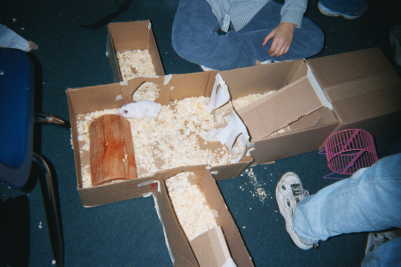
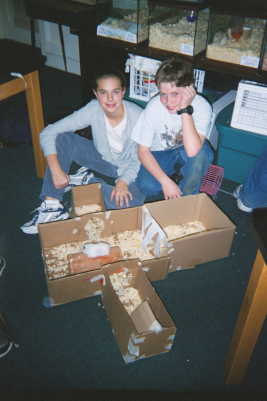
    3. We planned out our maze. We then made it and put some hamster bedding in our maze. We kept adding to our maze to make it more of a struggle for Elmo to get to the babies.
    4. One week later, after starving the babies and Elmo, we put our project into action. We first put a huge pile of grain in an open area and a moderate size under the shaded area which we had built into the maze. This was to test if the hamster cared more about its babies, it's own safety or its food more.
    5. We set Elmo in the maze along with the female baby hamster with Elmo at one end and the baby up a ramp that we had constructed. After we gathered the results, we ran the second part of the experiment, testing the second hypothesis. We put the male baby hamster with the female hamster and then we took notes on the interaction. I told my partner, Reeve, what was going on while she recorded the time at which it happened and what happened.
    6. When we finished that part of the lab we were both extremely excited and positive about the lab. We decided to conclude with one final experiment, testing hypothesis 3. We wanted to see how the female would react without either male. So we did and we recorded her actions.

    Results - Hypothesis 1

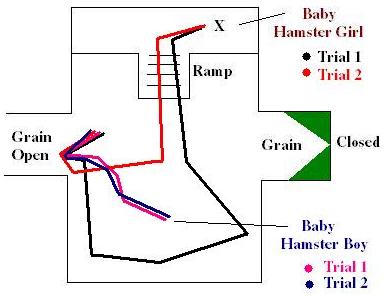
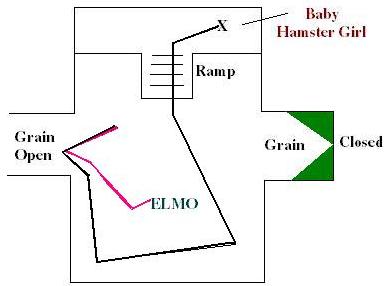
    During phase one of our experiment (with the baby girl and Elmo), the female hamster started to glide down the stairs while Elmo (who had been starved for one week) goes to the left wing where the food is, in an open area. The baby followed Elmo's family scent and when they met in the left wing they curled up in a ball and started to mate. We pulled them apart because we didn't want baby hamsters (hehe). Hypothesis 1 was incorrect. Indeed, instead of Elmo following the baby female hamster's scent, he went to the food while she followed his scent.


    Hypothesis two was to see how the male baby and the female baby would react together. They reacted exactly the same as Elmo and the baby did. She came down the ramp and followed still Elmo's scent, not the male baby hamster's scent. The male follows Elmo's scent as well. After they started mating we put the female back at her starting point. She did the same thing again except this time a little faster.
    Hypothesis 2 was incorrect and resulted in the same way as Hypothesis 1, except this time the female hamster has memorized the trail of Elmo's scent and realizes that a male will always be there to be followed.


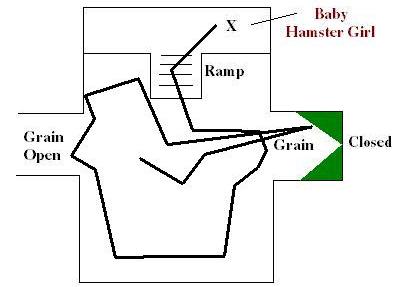
    Hypothesis 3 for us was the most exciting. We put the female hamster in the cage all by herself. She started looking frantically for a male. She followed Elmo's scent, but when he wasn't there she got scared. She started moving quickly. She tried to climb out of the cage quite a few times. It was like she was in need of a male.


    Conclusion


    These experiments suggest three conclusions. First, obviously, the hamsters have some memory as demonstrated in Hypothesis 2, when the female hamster followed Elmo's scent much more quickly than the past two times. Second, hamsters do not have soulmates. They are willing to mate with any partner available. Third, and most interesting, while the males preferred the food (grain) over the female, the female seemed to be in some sort of heat. While she did not have grain in her own part of the maze, immediately after, even with some grain left, she went after the males.
    I feel that it was very suprising to me that the females cared more about mating than the males. If we were to put two females in the same maze, with a male would it be the same results as if we put two males in with a female? If we conducted this experiment, we could clearly see if the males or the females are the more dominant species in hamsters, determined by which sex would fight over the third party.
    I hope you use the information today to conduct your own experiments and further research on the topics that my partner, Reeve and I have begun.


    Reeve's Formal Lab Report

    Hypothesis

    My hypothesis for the first two experiments is that the hamster that is put in the main area will go to the other hamster scent which will be on the second floor. I believe this because I think that the animals care about others that are in their family, which is what we are dealing with. For the experiment with one hamster alone, I think they will try and find another hamster for company, becuase they will be used to being in the environment with another hamster.

    Materials

  • Cardboard
  • Tape
  • Scissors
  • Hamster bedding
  • Hamster food - grain
  • Male & Female grandchildren of Elmo (the hamster)
  • Elmo


    Procedure

    When my partner and I decided to start, we agreed to experiment with Elmo and the femlae grandchild. We put the female on the 2nd floor of the environment we built. After this experiment took place, it was my opinion that the grain (food) scent was stronger than the female scent. Therefore, Elmo wen to the grain. For the female, she could see Elmo the whole time and was trying to get off the 2nd floor, wanting to meet Elmo.
    Next, the second experiment was with the female and the male grandchild. This was a very short experiment because we let the female down the stairs very quickly so we recieved data on the female's actiosn more than the male.
    The last experiment was with the female alone in the environment, we did this trial, because she was getting a lot of action, so we wanted to see what she would do by herself.
    As you have read, our experiments were very simple. Most of our time was spent on making the environment. The architectural design was developed by both my partner and myself. My partner, Sam, thought of the two wings and the main area. I thought of the 2nd floor and the hut to go on the right wing to give some privacy and to have an enclosed area for the hamster's comfort. After developing these design plans, we built the environment. We let Elmo get used to the environment as we built it because we were not studying reactions to the environment but rather to the smells in it.

    Results

    The first experiment with Elmo and the female grandchild was very suprising. We collected the following data:

    Elmo is put into the main area. Elmo smells grain and enters left wing. Elmo is eating grain. At 42 seconds, female grandchild is let downstairs. Female hamster follows Elmo's scent and avoids food, even though starved. Female sees Elmo in left wing and walks up to Elmo and then leaves wing. Elmo leaves wing following female's scent. At one minute and 42 seconds, Elmo and grandchild try to mate in main area.

    The next trial with female and male grandchildren was similar to the prior trial. The data for the second trial is below:

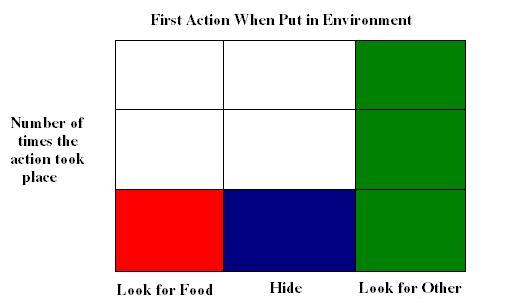
    Female was looking for grain while male was hiding. Female was put upstairs. Female recognized area and went down to main area where the grandchildren met each other and tried to mate.

    For the third trial, we tried a totally different approach. We trialed the female grandchild by herself in the environment my partner and I built. The data for the third trial is below:

    Female hamster was looking for Elmo, tracking his old scent, roaming around looking for Elmo. She was nervous and trying to find Elmo. She was nervous and trying to escape. She was put upstairs and stops at right wing facing the wall. Hamster enters right wing hideout and ignores food even though starved.
    Conclusion


    When my partner and I thought of this experiment, we hypotheized that the two hamsters would go to each other by scent. After this experiment was over, we realized that the hamster went to something familiar. For example, Elmo knew the smell of grain because that was what he ate for his whole life. The female could see Elmo from the second floor and probably knew Elmo was related to her. Therefore, I conclude that hamsters are nervous animals that need to be comfortable and familiar with something. If they are not familiar with anything they will be nervous.


    Sources of Error


    As you have read, our data was based on the actions of the hamsters and our interpretation of those actions. Therefore, someone may argue that our opinion is subjective and may differ from others observing the same actions. I hope you will still understand that these are solely the opinion of Reeve Ridgeway and Sam Finesurrey.
    .


    Mr. Purnell's Home Page

    1
    Hosted by www.Geocities.ws