Hypothesis
The male furry mouse will enter and explore the tunnels of the "habitat" before the female furry mouse will (male furry mice are more inquisitive than female furry mice).
Materials
Procedure
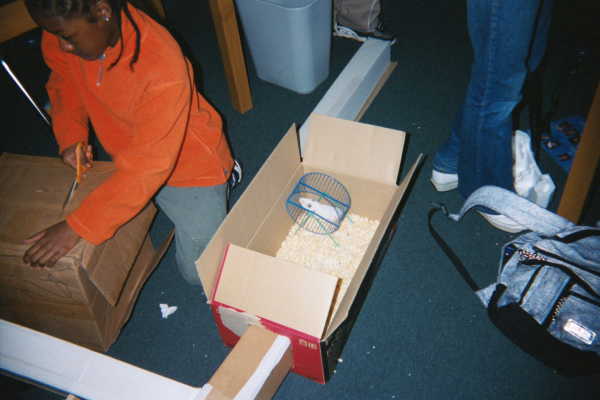
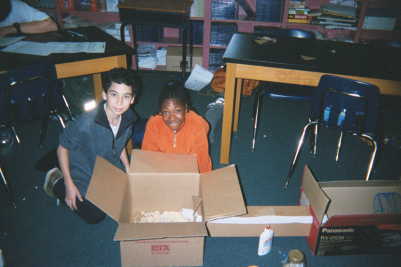
First, we cut holes in all three boxes so the tubes could fit through. Then we taped one of the tubes to two of the boxes (with gauze tape), and taped a ramp to the tube (so the mice could get up it). Next, we cut a hole in the center of the tube, and taped another tube into it, which led to a third cardboard box (at a steep upward angle). We then placed a toy (wooden car) and exercise wheel in the first chamber (to give the mouse an option: use the wheel or toy, or explore). Then, after the habitat was completed, we put a male furry mouse, "Pennsacola" into the first chamber with a female furry mouse, "Bo". We noted the results, and then we did it again, with male furry mouse "Malomar", and female furry mouse, "Butterworth". Bo and Butterworth were both pregnant (we knew this beforehand), so not one of the mice tried to mate, as this would ruin the experiment.
Results
Our hypothesis was correct. When Pennsacola and Bo were tested, Bo did not enter the tube until 6 minutes and three seconds (she was running the wheel), and Pennsacola entered at 3 minutes and 35 seconds, and had explored the entire habitat by 4 minutes and 50 seconds. When we inserted Malomar and Butterworth, we had similar results, though Malomar had gone in at 1 minute and 33 seconds, and explored by 2 minutes and 26 seconds, while Butterworth had entered at 4 minutes and 13 seconds, proving that our hypothesis was correct.
Conclusion
The purpose of this experiment was to find out about animal behaviors, something that had to do with genetics, that we did not know already. Also, the experiment gave us an opportunity to work with the animals, so we could be more experienced with them for science experiments, or any other time in life that would call for the use of animals (I plan on becoming a scientist).Sources of Error
There were several errors in this experiment. First of all, the entire hypothesis had to be changed. We were trying to see if training a hamster to run through tunnels would improve its ability. The hamster's sibling was used in another experiment with its grandfather, Elmo. We did not know that the hamster's sibling was female. Elmo tried to mate with it, and (in a way) "taught" it how to mate. So when I used both hamsters in my experiment (we didn't know the first hamster was male), the female tried to mate with its brother, so it ruined the experiment. On the other hand, the real experiment worked without a problem.